How to Find Percentage Easy Methods, Formulas and Examples
Finding a percentage is one of the most common math skills used in everyday life. Whether you are calculating a discount while shopping, checking a pay increase, comparing two numbers, or working out how much something has changed, understanding percentages can save time and help you make better decisions.
If you have ever wondered how to find percentage from a number, this guide explains the process with simple formulas and practical examples. You will also learn how a percent off calculator, pay increase calculator, and other percentage calculators can make these calculations faster.
If you are wondering how to find percentage without complicated math, the basic process is actually quite simple. Once you understand the relationship between the part and the whole, you can solve most percentage problems quickly.
What Is a Percentage?
A percentage is a number expressed as a part of 100. The word “percent” literally means “per hundred.”
For example:
- 10% means 10 out of 100
- 25% means 25 out of 100
- 50% means 50 out of 100
- 75% means 75 out of 100
Percentages are useful because they make it easier to compare parts of different quantities using the same scale.
For example, if 20 students out of 50 passed an exam, you can express the result as a percentage rather than simply saying 20 students passed.
Before learning how to find percentage, it helps to understand that every percentage represents a portion of 100.
How to Find Percentage
This is the most common type: “What is 20% of 150?”
Formula: Percentage × Number = Result (as a decimal, so 20% becomes 0.20)
Step by step:
- Convert the percentage to a decimal — divide by 100 (20% → 0.20)
- Multiply the decimal by the number (0.20 × 150)
- Result: 30
So 20% of 150 is 30.
Another example: What is 35% of 80?
0.35 × 80 = 28
35 ÷ 100 = 0.35
How to Calculate Percentage of a Number
This is when you know two numbers and want to know the percentage relationship — “45 out of 60 is what percent?”
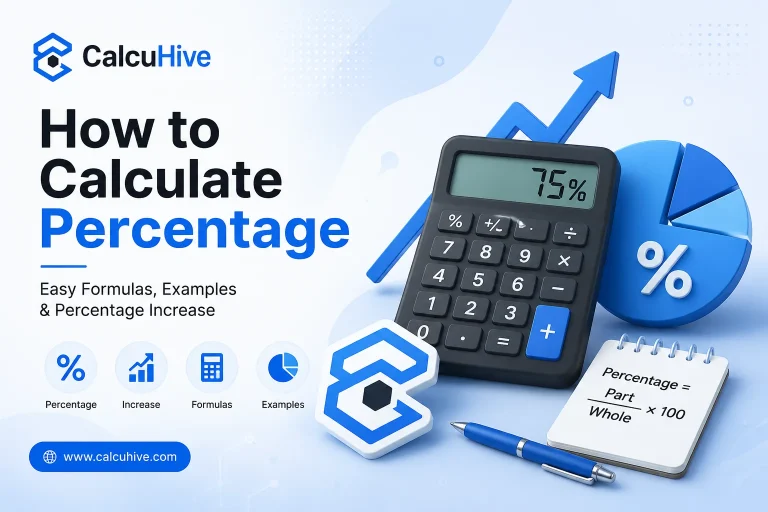
Formula: (Part ÷ Whole) × 100
Step by step:
- Divide the part by the whole (45 ÷ 60 = 0.75)
- Multiply by 100 (0.75 × 100)
- Result: 75%
So 45 out of 60 is 75%.
How to Find Percentage Change
Another common calculation is determining how much a value has increased or decreased.
The percentage change formula is:
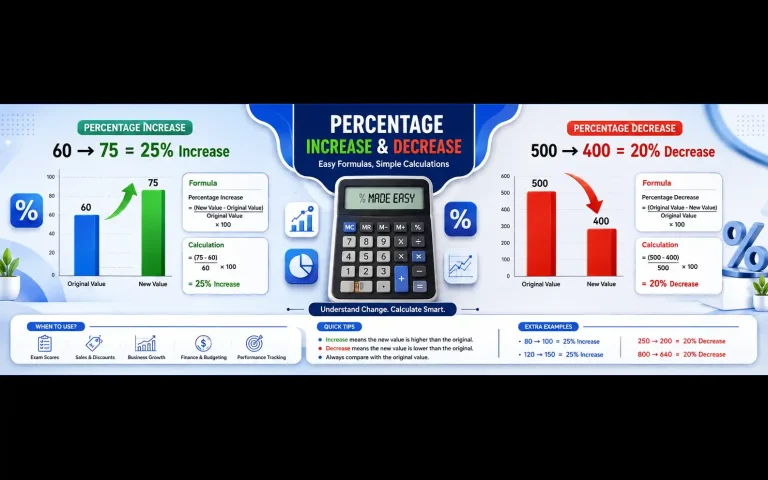
Percentage Change = ((New Value − Original Value) ÷ Original Value) × 100
For example, suppose a product originally costs $100 and its price increases to $120.
First find the difference:
$120 − $100 = $20
Then divide the difference by the original price:
$20 ÷ $100 = 0.20
Finally, multiply by 100:
0.20 × 100 = 20%
The price increased by 20%.
This process is often called calculating percentage of increase.
Calculating Percentage of Increase & Decrease
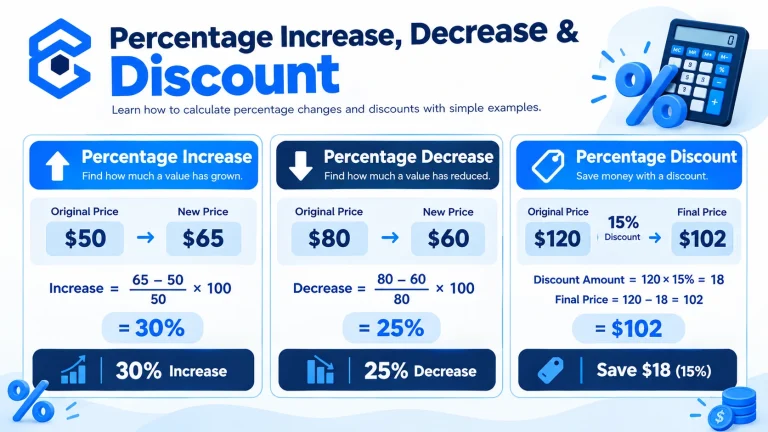
This is used for price changes, growth rates, and comparisons — “A price went from $50 to $65. What’s the percentage increase?”
Formula: ((New Value − Old Value) ÷ Old Value) × 100
Step by step:
- Subtract old from new (65 − 50 = 15)
- Divide by the old value (15 ÷ 50 = 0.30)
- Multiply by 100 (0.30 × 100)
- Result: 30% increase
If the new value is smaller than the old one, the same formula gives you a negative number — that’s your percentage decrease. For example, going from $50 to $40:
- (40 − 50) ÷ 50 = −0.20
- ×100 = −20%, i.e. a 20% decrease
Quick Reference Table
| You know | You want | Formula |
| A number and a percentage | The result | Number × (Percentage ÷ 100) |
| Two numbers | The percentage one is of the other | (Part ÷ Whole) × 100 |
| An old and new value | Percentage change | ((New − Old) ÷ Old) × 100 |
How Does a Percent Off Calculator Work?
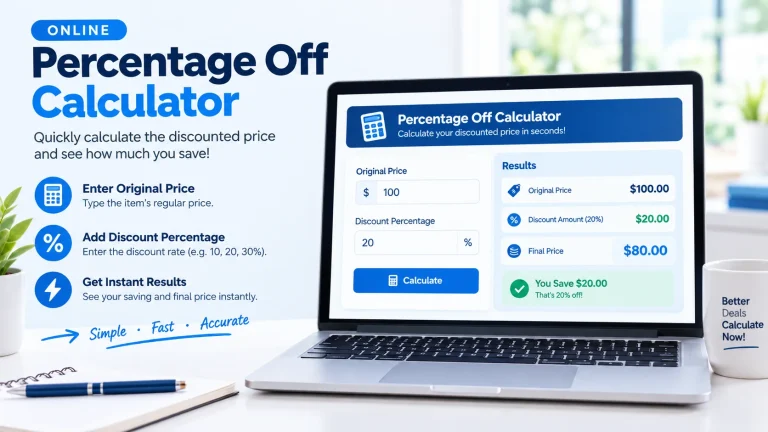
A percent off calculator is useful when you want to determine the final price of an item after a discount.
The basic discount formula is:
Discount Amount = Original Price × (Discount Percentage ÷ 100)
Then:
Final Price = Original Price − Discount Amount
For example, suppose a jacket costs $100 and is 20% off.
Discount:
$100 × 20% = $20
Final price:
$100 − $20 = $80
So the customer pays $80.
A price with percent off calculator performs these calculations automatically, which is particularly convenient when comparing several sale prices.
30 Percent Off 50 Dollars Calculator Example
Let’s use a practical example.
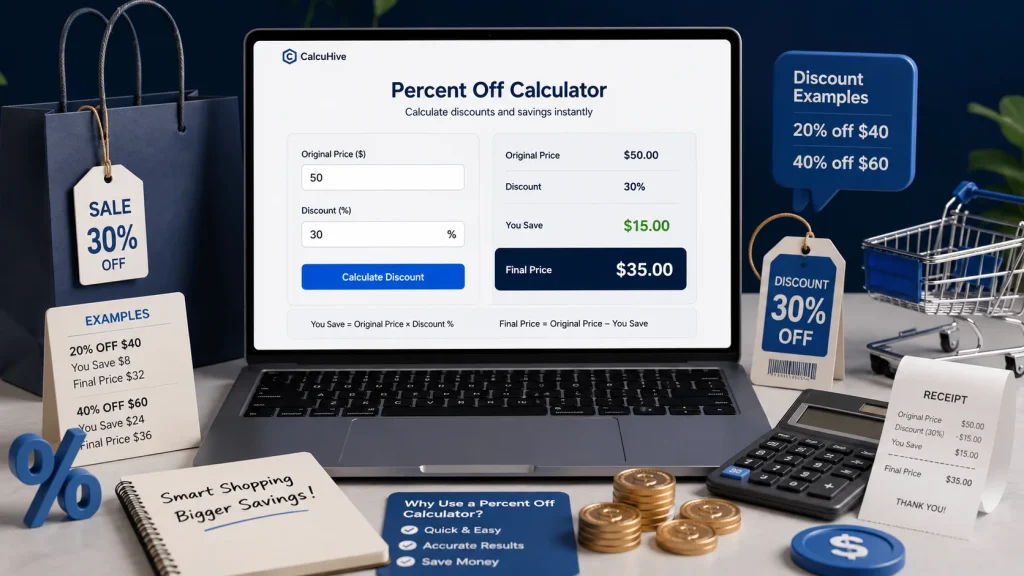
Suppose an item costs $50 and has a 30% discount.
First calculate the discount:
$50 × 30% = $15
Then subtract the discount:
$50 − $15 = $35
The final price is $35.
So, using a 30 percent off 50 dollars calculator, you would get:
Original Price: $50
Discount: 30%
Savings: $15
Final Price: $35
20 Percent Off 40 Dollars Calculator Example
Now suppose an item costs $40 and is discounted by 20%.
Discount:
$40 × 20% = $8
Final price:
$40 − $8 = $32
Therefore:
Original Price: $40
Discount: 20%
Savings: $8
Final Price: $32
A 20 percent off 40 dollars calculator gives you the same result instantly.
40 Percent Off 60 Dollars Calculator Example
What if a $60 product is 40% off?
Calculate the discount:
$60 × 40% = $24
Then subtract it from the original price:
$60 − $24 = $36
The final price is $36, meaning you save $24.
A 40 percent off 60 dollars calculator is helpful when you want to quickly check sale prices without doing the calculation manually.
How to Use a 10 Percent Off Calculator
A 10% discount is particularly easy to calculate because 10% is one-tenth of the original amount.
For example, if a product costs $250:
10% of $250 = $25
Therefore:
$250 − $25 = $225
The final price is $225.
A 10 percent off calculator can be useful when checking discounts on products, services, subscriptions, or other purchases.
How to Use a 40 Percent Off Calculator
A 40% discount means you pay 60% of the original price.
For example, if something costs $150:
40% of $150 = $60
Then:
$150 − $60 = $90
The final price is $90.
Using a 40 percent off calculator can make this process easier when you are comparing multiple products or sale offers.
Percentage Calculators Hub
Percentage calculations can involve more than just finding a percentage or discount. Different situations require different formulas.
A percentage calculators hub can bring several useful tools together in one place, allowing users to solve different percentage problems without repeatedly calculating them by hand.
Useful percentage calculators may include:
- Basic percentage calculator
- Percent off calculator
- Percentage increase calculator
- Percentage decrease calculator
- Pay increase calculator
- Discount calculator
- Price with percent off calculator
- Percentage difference calculator
- How to Find Percentage
Having these tools available in one place can make everyday calculations much quicker.
When Are Percentage Calculations Useful?
Percentages are used in many areas of everyday life.
Shopping
Retailers frequently use percentages for discounts and promotions. A percent off calculation helps you determine how much you will actually pay.
Salary and Pay
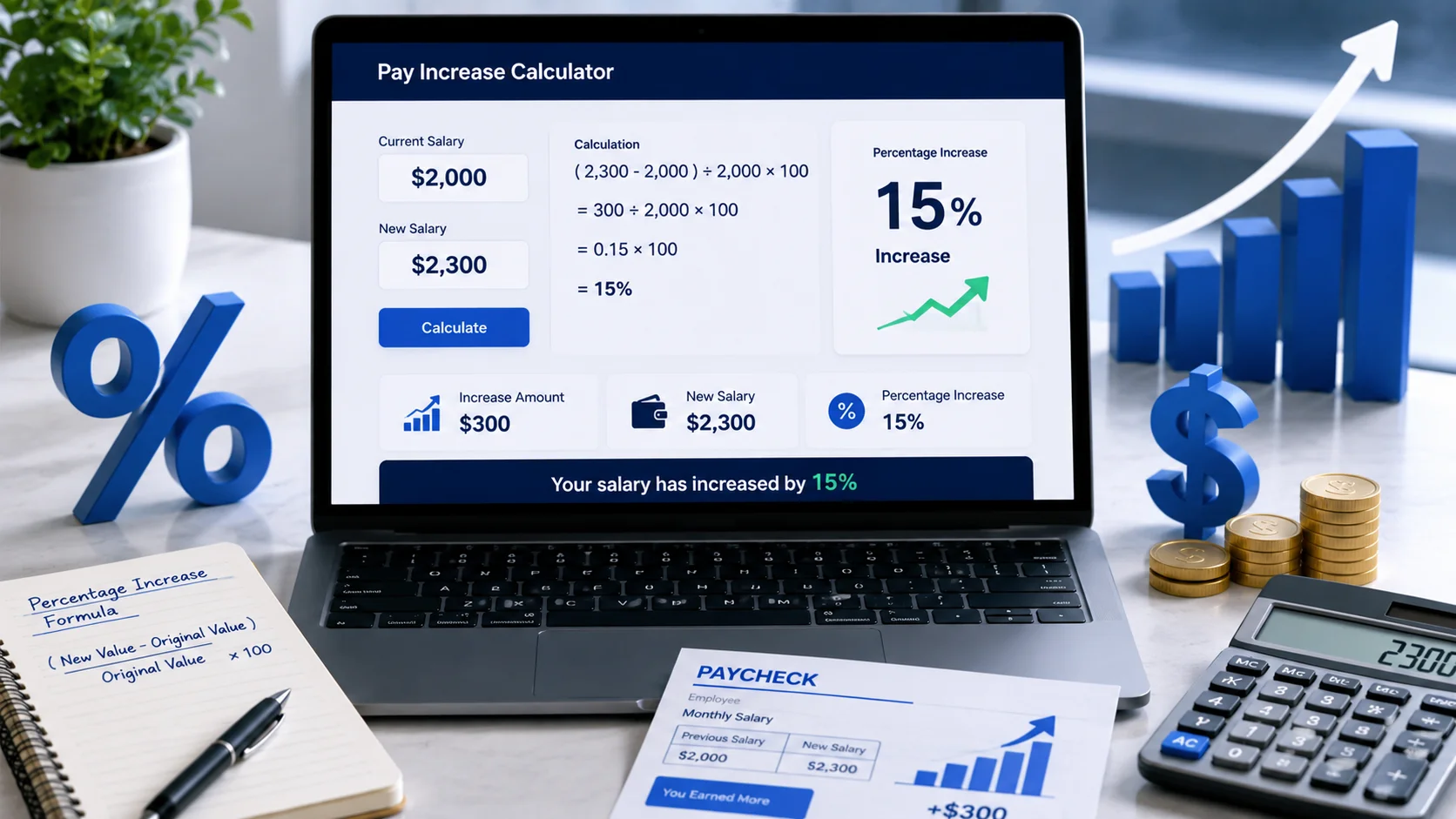
Employers may give employees annual raises based on a percentage. A pay increase calculator can show both the dollar increase and the new salary.
Education
Teachers and students use percentages to calculate test scores, grades, attendance, and performance.
Business
Businesses use percentage calculations to analyze sales growth, profit margins, expenses, conversion rates, and other important metrics.
Personal Finance
Percentages are also used for taxes, savings, interest rates, investment returns, and budgeting.
Common Mistakes When Finding Percentages
Although percentage calculations are straightforward, several mistakes are common.
One mistake is using the wrong original value when calculating percentage change. The original value should normally be the number used as the baseline.
Another common mistake is forgetting to multiply a decimal by 100 when converting it into a percentage.
For example:
0.25 = 25%
not 0.25%.
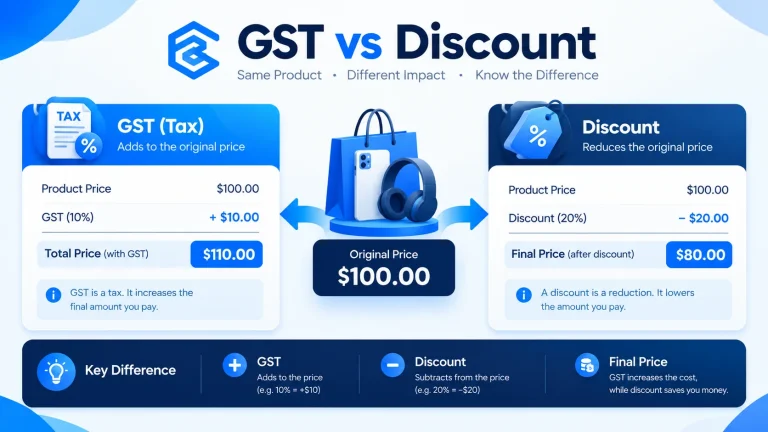
When calculating discounts, remember that the discount amount is not the same as the final price. If an item is $100 and 20% off, the discount is $20, while the final price is $80.
Whether you are checking a discount, comparing prices, calculating a salary increase, or reviewing a test score, knowing how to find percentage makes these everyday calculations much easier.
Final Thoughts
Learning how to find percentage is a valuable skill that can help with shopping, personal finance, education, salaries, business, and everyday decision-making. Once you understand the basic formulas, most percentage problems become much easier.
For simple calculations, you can use the formulas explained above. For faster results, online tools such as a percent off calculator, pay increase calculator, and other tools in a percentage calculators hub can handle the calculations for you.
Whether you need to calculate a discount, find a percentage increase, or determine the final price of a sale item, understanding the calculation helps you verify the result and make smarter decisions.
Frequently Asked Questions
How do I find a percentage of a number?
Use the formula:
(Percentage ÷ 100) × Number
For example, 25% of 200 is:
(25 ÷ 100) × 200 = 50
So, 25% of 200 is 50.
How do I calculate percentage increase?
Subtract the original value from the new value, divide the difference by the original value, and multiply by 100.
((New Value − Original Value) ÷ Original Value) × 100
This tells you the percentage increase.
What is the easiest way to calculate a discount?
Multiply the original price by the discount percentage divided by 100. Then subtract the discount amount from the original price. A percent off calculator can perform both steps automatically.
What is 30% off $50?
30% of $50 is $15. After subtracting the discount, the final price is $35.
What is 20% off $40?
20% of $40 is $8. The final price is $32.
What is 40% off $60?
40% of $60 is $24. The final price is $36.
What is a price with percent off calculator?
A price with percent off calculator determines the discount amount and final price after applying a percentage discount to an original price.
Can a percentage calculator calculate salary increases?
Yes. A pay increase calculator can help determine the difference between an old and new salary and calculate the percentage increase.
How do I calculate a percentage without a calculator?
Convert the percentage to a decimal (divide by 100), then multiply it by the number. For 15% of 200: 0.15 × 200 = 30.
What’s the difference between percentage and percentage points?
Percentage is a relative measure (a 10% increase on 50 is 5). Percentage points measure the raw difference between two percentages (going from 20% to 30% is a 10 percentage point increase, but a 50% relative increase).
How do I calculate a percentage of a percentage?
Multiply the two decimals together. 50% of 20% = 0.50 × 0.20 = 0.10, or 10%.
Can percentages be more than 100%?
Yes — this happens whenever the “part” is larger than the “whole,” such as measuring growth (a value that doubled increased by 100%, one that tripled increased by 200%).