How to Take Percentage Off: A Simple Step-by-Step Guide
Have you ever found a shirt marked at $80 with a 25% discount and wondered what you would actually pay? You are not alone. Percent discounts look simple, but the math can feel confusing when you are standing at the checkout.
Learning how to take percentage off helps you calculate sale prices, compare offers, and avoid misleading discounts. You do not need advanced math or a calculator app full of complicated buttons. You only need the original price, the discount rate, and one simple formula.
This guide explains the process with practical examples in US dollars, Canadian dollars, and Australian dollars. You will learn how to calculate common discounts, check special price combinations, understand percentage differences, and use an online percentage calculator to get answers faster.
By the end, you will be able to work out a discount in seconds, whether you are shopping online, comparing store offers, or checking a price before buying.
Quick Answer
To take a percentage off a price, multiply the original price by the discount percentage divided by 100. Subtract the result from the original price to find the final cost. For example, 30% off $100 saves $30, leaving you with a final price of $70.
Table of Contents
What Does It Mean to Take a Percentage Off?
Taking a percentage off means reducing an original price by a certain proportion. The percentage tells you how much of the original price you save. A 10% discount removes one-tenth of the price, while a 50% discount cuts the price in half.
Direct Answer: Taking a percentage off means calculating a portion of the original price and subtracting that amount to find the discounted price.
For example, imagine a jacket costs $120 and the store offers 25% off. The discount equals $30, so you pay $90 before any applicable taxes or additional charges.
Here is the important part: the discount percentage applies to the original price unless the offer states otherwise. A 20% discount does not automatically mean $20 off. It means 20% of the price, which could be $10, $40, or $200.
The difference between discount amount and final price
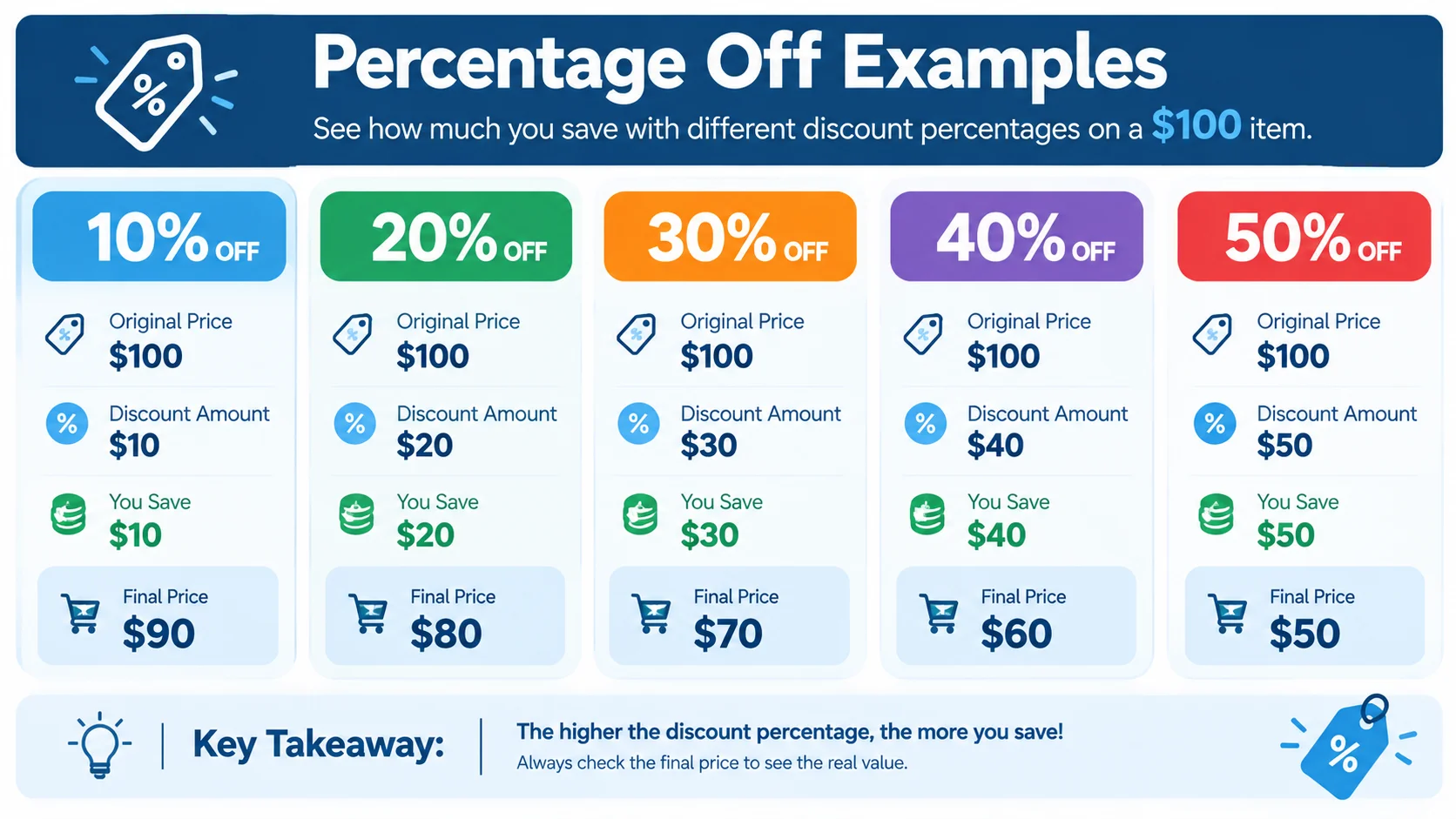
These two figures are related, but they mean different things.
- Original price: The price before the discount.
- Discount amount: The money removed from the original price.
- Final price: The amount left after subtracting the discount.
Suppose a pair of shoes costs $150 and has a 20% discount. You save $30 and pay $120. The discount amount is $30, while the final price is $120.
Why percentage discounts matter
Understanding discounts helps you compare products with different prices. A 40% discount on a $50 item saves $20, while a 20% discount on a $200 item saves $40.
The larger percentage does not always produce the larger cash saving. Always check both the discount amount and the final price before deciding which offer is better.
Key Takeaway
- A percentage represents a portion of the original price.
- The discount amount is not the same as the final price.
- Compare actual savings, not just the advertised percentage.
How to Take Percentage Off Using a Simple Formula
The easiest way to calculate a discount is to use a basic percentage formula. It works for clothing, electronics, groceries, furniture, and almost any product with a percentage-based price reduction.
Direct Answer: Multiply the original price by the discount percentage divided by 100, then subtract the discount amount from the original price.
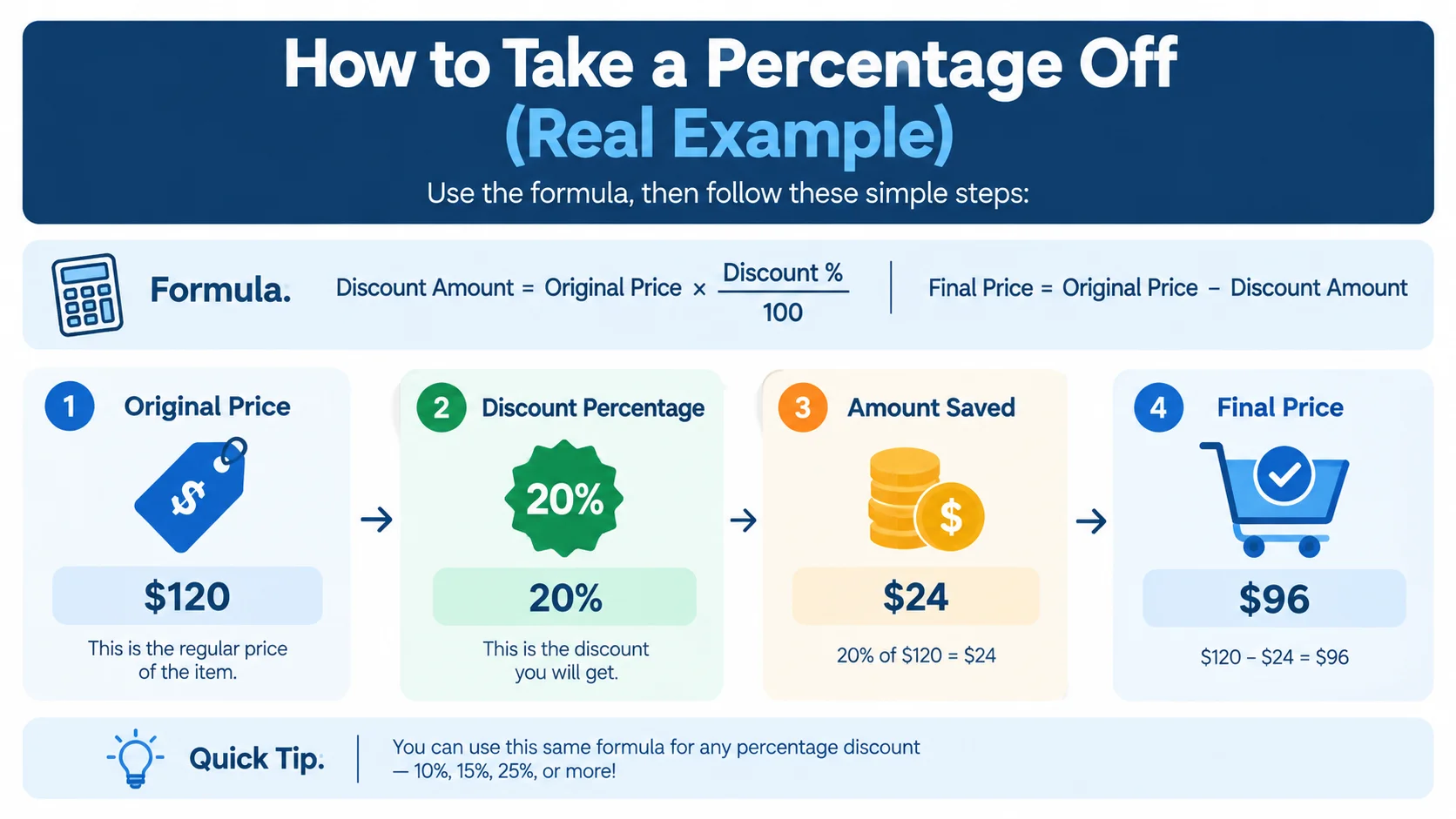
Use these two formulas:
Discount amount = Original price × (Discount percentage ÷ 100)
Final price = Original price − Discount amount
For example, suppose a laptop costs $800 and the retailer offers 15% off.
- Divide 15 by 100 to get 0.15.
- Multiply $800 by 0.15 to get $120.
- Subtract $120 from $800.
- Your discounted price is $680.
You can also calculate the final price in one step:
Final price = Original price × (1 − Discount percentage ÷ 100)
For the laptop, the calculation becomes $800 × 0.85 = $680.
A shortcut for mental math
Some discounts are easy to calculate without a calculator.
- 10% off: Move the decimal point one place left to find the saving.
- 20% off: Find 10%, then double it.
- 25% off: Divide the original price by four to find the saving.
- 50% off: Divide the original price by two.
- 75% off: Calculate 25% of the price and subtract it, leaving 25% to pay.
For instance, 10% of $90 is $9. Therefore, 20% of $90 is $18, leaving a final price of $72.
These shortcuts are handy in shops across the United States, Canada, and Australia. Remember that sales tax, GST, shipping, and other fees may affect your final checkout total.
Key Takeaway
- Calculate the discount amount before subtracting it.
- Use the one-step formula when you want the final price quickly.
- Mental math works especially well for 10%, 20%, 25%, and 50% discounts.
What Is 10%, 20%, 30%, 40%, or 50% Off a Price?
The amount you save depends on two things: the original price and the discount percentage. A 30% discount on a $100 item saves $30, but the same discount on a $250 item saves $75.
Direct Answer: To find any percentage off, multiply the original price by the discount rate and subtract the result from the original price.
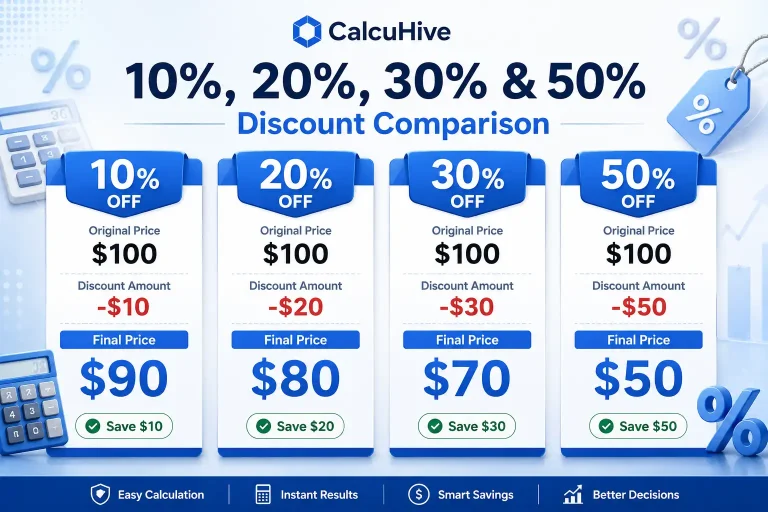
The following table shows common discounts on a $100 item.
| Discount | Amount saved | Final price |
|---|---|---|
| 10% off | $10 | $90 |
| 15% off | $15 | $85 |
| 20% off | $20 | $80 |
| 25% off | $25 | $75 |
| 30% off | $30 | $70 |
| 40% off | $40 | $60 |
| 50% off | $50 | $50 |
| 60% off | $60 | $40 |
| 75% off | $75 | $25 |
How much is $20 with $10 off?
If an item costs $20 and the store takes $10 off, the final price is $10. The discount percentage is 50%, because $10 represents half of the original $20 price.
Notice the wording here. “$10 off $20” means a fixed $10 reduction, not a 10% discount. That distinction matters when you compare promotions.
How much is $45 with 40% off?
Calculate 40% of $45:
$45 × 0.40 = $18
Now subtract the discount:
$45 − $18 = $27
You save $18 and pay $27 before taxes or other charges.
What is 30% off $100?
Thirty percent of $100 is $30. Subtract that amount, and the final price becomes $70.
The same method works for larger purchases. If a $250 item has 30% off, you save $75 and pay $175.
Key Takeaway
- The discount percentage applies to the original price.
- A fixed-dollar reduction and a percentage discount are different offers.
- Always calculate the amount saved and the price remaining.
How Do You Calculate Common Discount Examples?
You can use the same formula for almost every price reduction. The only things that change are the original price and the discount rate. Let’s work through several searches people commonly make when checking sale prices.
Direct Answer: Multiply each original price by its discount rate, then subtract the saving to get the final price.
What is 20% off $40?
First, calculate the discount:
$40 × 0.20 = $8
Then subtract it:
$40 − $8 = $32
You save $8 and pay $32.
What is 15% off $30?
Calculate 15% of $30:
$30 × 0.15 = $4.50
Subtract the saving:
$30 − $4.50 = $25.50
This example also shows why calculating the discount is useful. The saving includes cents, even when the original price is a whole number.
What is 25% off $120?
Divide $120 by four to calculate 25%:
$120 ÷ 4 = $30
Subtract the discount:
$120 − $30 = $90
What is 30% off $200?
Calculate the saving:
$200 × 0.30 = $60
Find the final price:
$200 − $60 = $140
What is 20% off $250?
The discount amount is:
$250 × 0.20 = $50
The final price is:
$250 − $50 = $200
What is 40% off $34?
Calculate 40% of $34:
$34 × 0.40 = $13.60
Subtract the discount:
$34 − $13.60 = $20.40
Here is a quick reference for these examples.
| Original price | Discount | Money saved | Final price |
|---|---|---|---|
| $20 | $10 fixed | $10 | $10 |
| $45 | 40% | $18 | $27 |
| $100 | 30% | $30 | $70 |
| $120 | 25% | $30 | $90 |
| $200 | 30% | $60 | $140 |
| $200 | 15% | $30 | $170 |
| $250 | 30% | $75 | $175 |
| $250 | 20% | $50 | $200 |
| $34 | 40% | $13.60 | $20.40 |
Key Takeaway
- Use the same formula for small and large purchases.
- Watch for fixed-dollar discounts that look similar to percentage offers.
- Round money to the nearest cent when appropriate.
How Do You Calculate Two Discounts on the Same Item?
Two discounts can make a deal look more attractive than it really is. Some retailers offer an additional percentage off an already reduced price. The key is understanding that the second discount usually applies to the new price, not the original price.
Direct Answer: Apply the first discount, calculate the reduced price, and then apply the second discount to that new price.
How do stacked discounts work?
Suppose a $100 jacket has a 20% discount, followed by another 15% off the reduced price.
First discount:
$100 × 0.20 = $20
New price:
$100 − $20 = $80
Second discount:
$80 × 0.15 = $12
Final price:
$80 − $12 = $68
The total saving is $32, which equals 32% of the original price. It is not 35%.
Why? The second discount applies to $80 rather than $100.
What happens with 40% off followed by 20% off?
Imagine a $200 product with 40% off, followed by another 20% discount.
- First saving: $200 × 0.40 = $80.
- Reduced price: $200 − $80 = $120.
- Second saving: $120 × 0.20 = $24.
- Final price: $120 − $24 = $96.
Your total saving is $104, or 52% of the original price.
This method works whether you shop online or visit a physical store. Always read the promotion terms because some offers cannot be combined, and certain discounts may exclude specific products.
Key Takeaway
- Apply each discount to the price remaining after the previous discount.
- Two successive discounts of 20% and 15% equal a combined 32% reduction.
- Check the retailer’s terms before assuming discounts can be stacked.
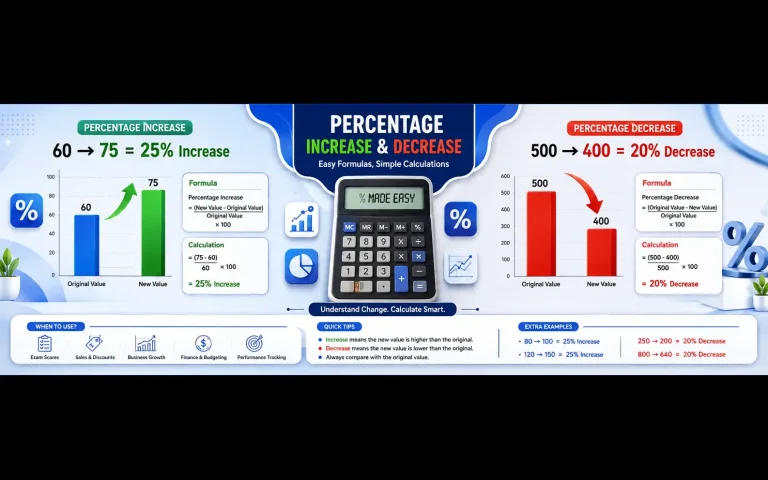
How Do You Find the Percentage Difference Between Two Numbers?
Percentage difference and percentage change are related, but they answer different questions. This distinction matters when you compare prices, sales results, measurements, or figures from different dates.
Direct Answer: Percentage difference compares two values using their average, while percentage change measures how much a value changed relative to its starting value.
What is the formula for percentage difference?
When comparing two positive numbers, use this formula:
Percentage difference = (Absolute difference ÷ Average of the two numbers) × 100
For example, compare $80 and $100.
- Find the difference: $100 − $80 = $20.
- Find the average: ($100 + $80) ÷ 2 = $90.
- Divide the difference by the average: $20 ÷ $90 = 0.2222.
- Multiply by 100 to get 22.22%.
The percentage difference is approximately 22.22%.
How do you calculate percentage change?
Percentage change uses the original value as its reference point.
Percentage change = ((New value − Original value) ÷ Original value) × 100
Suppose a product rises from $80 to $100.
[
\frac{100-80}{80}\times100=25%
]
The price increased by 25%.
If the price falls from $100 to $80, the percentage change is:
[
\frac{80-100}{100}\times100=-20%
]
That means the price decreased by 20%.
Notice that the percentage change differs depending on the starting value. This is why you should choose the correct formula for the question you are answering.
When should you use each formula?
- Use percentage difference when comparing two values without treating either as the starting point.
- Use percentage change when measuring an increase or decrease from an original value.
- Use percentage discount when calculating a reduction from a listed price.
For a deeper explanation, see the official educational resources linked in the references at the end of this article.
Key Takeaway
- Percentage difference uses the average of two values.
- Percentage change uses the original value.
- A discount is a specific type of percentage decrease.
How Can an Online Percentage Calculator Help You?
An online percentage calculator saves time when you need quick, accurate results. It is particularly useful for unusual prices, decimal discounts, or repeated calculations. You can still learn the formula and use the calculator to check your work.
Direct Answer: Enter the original price and discount percentage into a percentage-off calculator to find the saving and final price without doing the arithmetic manually.
How to use a percentage-off calculator
Follow these steps:
- Open the CalcuHive Percentage Calculator.
- Choose the calculation that matches your task.
- Enter the original price.
- Enter the discount percentage.
- Review the discount amount and final price.
- Check whether taxes, shipping, or extra fees apply separately.
For example, if a television costs $749 and has a 17% discount, the saving is $127.33. The discounted price is $621.67 before applicable taxes and additional charges.
A calculator can also help you compare offers quickly. You can calculate several prices without repeating the same arithmetic by hand.
Which CalcuHive tools should you use?
<text>Choose a tool based on the calculation you need:</text>
- Percentage Calculator — calculate percentages and solve common percentage problems.
- Percent Off Calculator — work out sale discounts and final prices.
- Calculate for the Percentage — explore percentage calculations using different values.
These tools address different percentage questions. Select the one that matches your calculation rather than forcing every problem into the same format.
A percentage calculator also helps you check mental math. If your result differs from the calculator, review the decimal conversion and subtraction steps before making a purchase.
Key Takeaway
- An online calculator reduces repetitive arithmetic.
- Check that you entered the original price rather than an already discounted price.
- Confirm whether the displayed result includes taxes and other fees.
What Common Percentage-Off Mistakes Should You Avoid?
Most discount mistakes happen because people confuse the discount rate, the amount saved, and the final price. A quick check can prevent you from paying more than expected or misunderstanding a promotional offer.
Direct Answer: To avoid discount errors, use the original price as your starting point, apply each discount correctly, and verify the final amount.
Myth-busting: Is 50% off always the best deal?
No. A larger discount percentage does not always mean a lower final price.
Imagine two stores selling similar headphones:
| Store | Original price | Discount | Final price |
|---|---|---|---|
| Store A | $100 | 30% | $70 |
| Store B | $85 | 20% | $68 |
Store B offers the lower final price, even though its advertised discount is smaller.
The original price matters just as much as the percentage. Compare the final prices of similar products before deciding which deal offers better value.
Five mistakes to watch for
- Confusing dollars with percentages: $10 off is not always the same as 10% off.
- Adding stacked discounts: Two discounts of 20% and 15% do not automatically equal 35% off.
- Using the wrong starting price: Calculate each successive discount using the price remaining after the previous reduction.
- Ignoring extra costs: Sales tax, shipping, and service fees can increase the checkout total.
- Trusting an advertised discount without comparing prices: A reduced price is only a good deal if the product offers suitable value.
Beginner versus expert approach
A beginner might look at a 40% discount and assume it is automatically the best offer. An experienced shopper checks the original price, calculates the final cost, and compares alternatives.
That extra minute can make a real difference, especially on expensive purchases.
Key Takeaway
- Check the arithmetic before accepting a discount claim.
- Compare final prices rather than discount percentages alone.
- Treat taxes, shipping, and other charges as separate costs unless included in the quoted price.
Conclusion: Calculate Discounts With Confidence
Learning how to take percentage off makes everyday shopping easier. You can calculate sale prices, compare competing offers, and understand exactly how much money a promotion saves. The process is simple: multiply the original price by the discount rate, then subtract the saving from the original amount.
For quick mental calculations, start with familiar discounts such as 10%, 20%, 25%, and 50%. For unusual percentages or larger purchases, use an online calculator to check your results. Remember to distinguish percentage discounts from fixed-dollar reductions and apply successive discounts to the correct price.
Try the CalcuHive Percent Off Calculator to work out your next discount. Have a useful shortcut or a tricky discount example? Share it with other readers so they can benefit, too.
Bottom Line
Taking a percentage off means finding the discount amount and subtracting it from the original price. For example, 30% off $100 saves $30, leaving $70. Use the original price as your starting point, calculate successive discounts one at a time, and compare final prices before buying. An online percentage calculator can help you verify the math quickly. Always check taxes, shipping, and other charges because the final checkout total may differ from the advertised sale price.
Frequently Asked Questions
1. How do you figure out percentage off a price?
Answer: Divide the discount percentage by 100, multiply the result by the original price, and subtract the discount amount. For example, 20% off $50 saves $10, leaving a final price of $40.
2. What is 30% off $100?
Answer: Thirty percent of $100 is $30. Subtract $30 from the original price, and the final price is $70 before any applicable taxes or additional charges.
3. How much is $250 with 20% off?
Answer: Twenty percent of $250 is $50. Subtract $50 from $250 to get a discounted price of $200.
4. How do you calculate 40% off $45?
Answer: Multiply $45 by 0.40 to get a discount of $18. Subtract $18 from $45, leaving a final price of $27.
5. What is the difference between percentage difference and percentage change?
Answer: Percentage difference compares two values using their average as the reference point. Percentage change measures an increase or decrease relative to the original value. Use the formula that matches the question you need to answer.
6. Can you calculate percentage off without a calculator?
Answer: Yes. For 10% off, move the decimal point one place left to find the saving. Double that amount for 20% off, divide the original price by four for 25% off, or divide it by two for 50% off.
7. Do percentage discounts include sales tax?
Answer: Not necessarily. Retailers may display discounts before taxes, and tax rules vary by location. In the United States and Canada, sales tax treatment depends on the applicable jurisdiction and transaction. In Australia, GST may be included in displayed consumer prices. Check the final checkout total for the actual amount payable.