How to Calculate Percentage for Discount
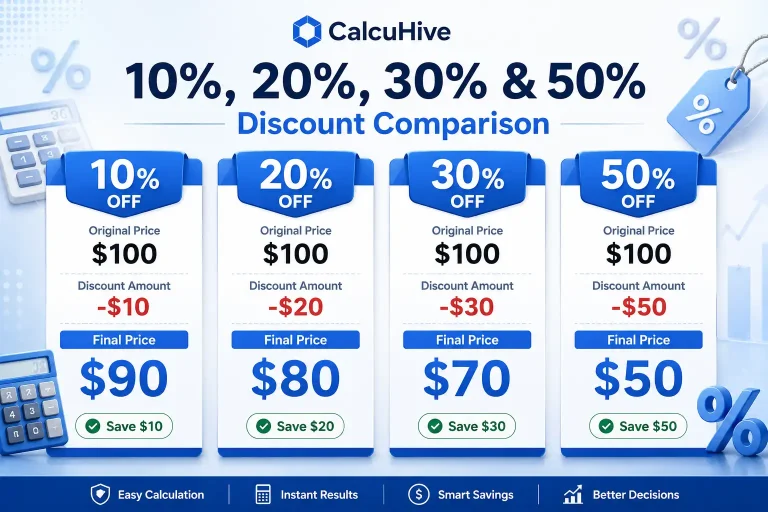
To calculate a percentage discount, multiply the original price by the discount percentage, then subtract the discount amount from the original price. For example, a $100 item with a 20% discount has a $20 discount, so the final price is $80.
Whether you’re checking a sale price in the USA, Canada, or Australia, the same basic percentage formula works. The only thing that changes is the currency.
Table of Contents
How to Calculate Percentage for Discount
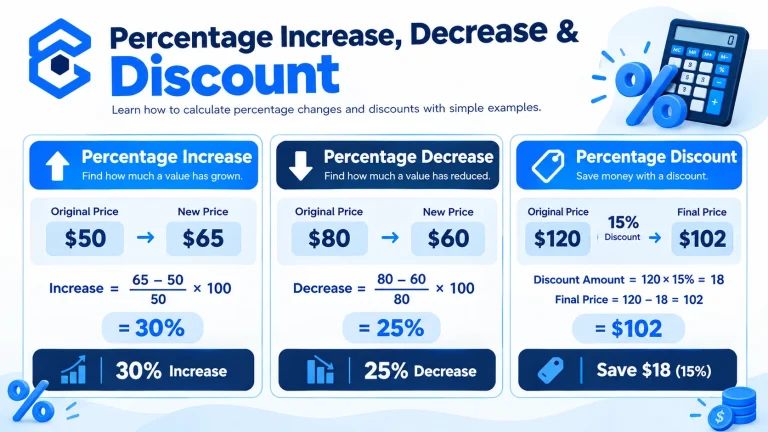
The basic discount formula is
Discount Amount = Original Price × Discount Percentage ÷ 100
Then calculate the sale price:
Final Price = Original Price − Discount Amount
Example: 20% off $80
Suppose a jacket originally costs $80 and is advertised at 20% off.
First, calculate the discount:
$80 × 20 ÷ 100 = $16
Then subtract the discount:
$80 − $16 = $64
So:
- Original price: $80
- Discount: 20%
- Money saved: $16
- Final price: $64
You can also calculate the final price directly:
$80 × (1 − 20 ÷ 100) = $64
This shortcut is particularly useful when you’re comparing several sale items.

Discount Percentage Formula
When you want to calculate a discount from a percentage, use this simple formula:
Discount = Original Price × (Discount Percentage ÷ 100)
For the final price:
Sale Price = Original Price × (1 − Discount Percentage ÷ 100)
Here’s a quick reference table:
| Original Price | Discount | Amount Saved | Final Price |
|---|---|---|---|
| $50 | 10% | $5 | $45 |
| $75 | 20% | $15 | $60 |
| $100 | 25% | $25 | $75 |
| $120 | 30% | $36 | $84 |
| $200 | 40% | $80 | $120 |
| $500 | 50% | $250 | $250 |
The formula works the same way for dollars, Canadian dollars, or Australian dollars.
How to Calculate a Discount Step by Step
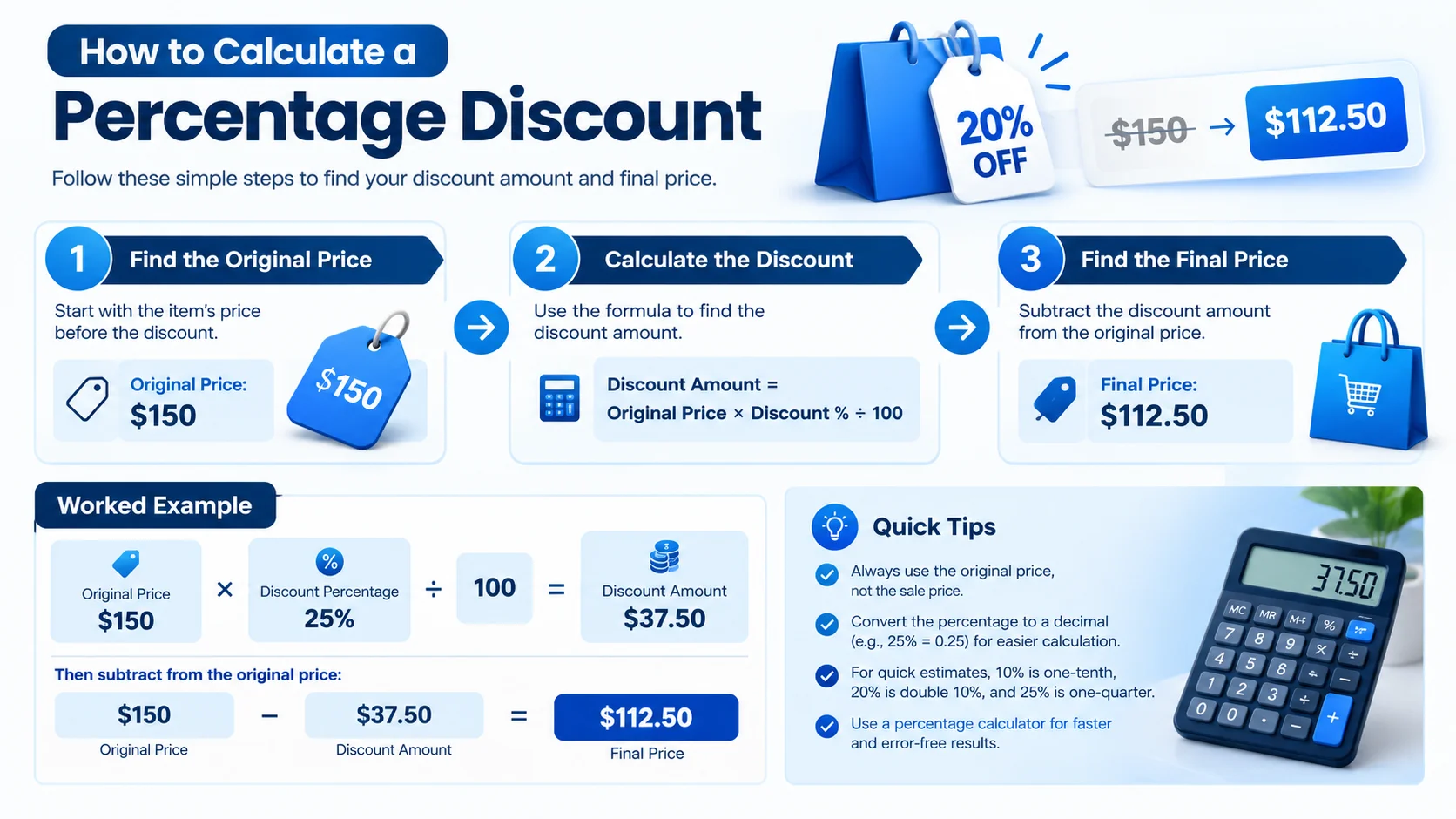
If you’re doing the calculation manually, follow these three steps.
Step 1: Identify the original price.
Start with the item’s price before the discount.
For example:
Original price = $150
Do not use the sale price as the starting number. The advertised discount percentage is normally based on the original price.
Step 2: Convert the percentage into a decimal.
Divide the percentage by 100.
For a 25% discount:
25 ÷ 100 = 0.25
For a 15% discount:
15 ÷ 100 = 0.15
For a 30% discount:
30 ÷ 100 = 0.30
Step 3: Multiply and subtract.
For a $150 item at 25% off:
$150 × 0.25 = $37.50
The discount is $37.50.
Now subtract it:
$150 − $37.50 = $112.50
The final price is therefore $112.50.
How to Calculate Percentage for Discount on a Sale Price
Sometimes a store displays an original price and a discounted price but doesn’t tell you the percentage discount.
In that situation, you can work backward.
Use:
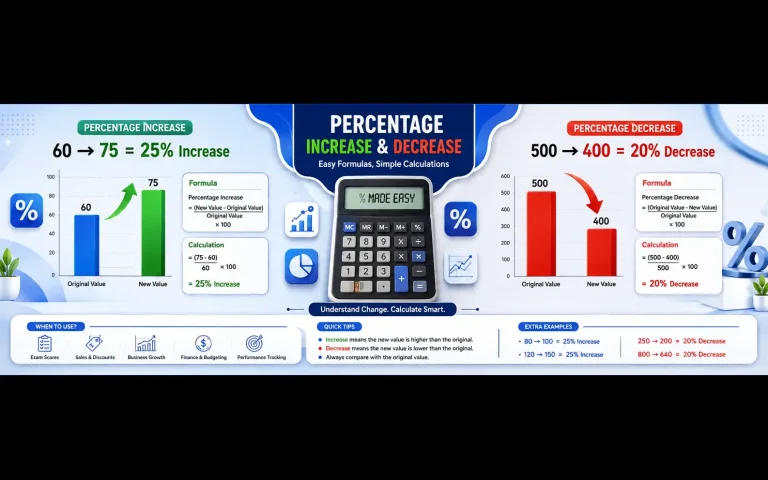
Discount Percentage = (Original Price − Sale Price) ÷ Original Price × 100
Example: From $120 to $90
Suppose an item was originally $120 and now costs $90.
First find the amount saved:
$120 − $90 = $30
Then divide the savings by the original price:
$30 ÷ $120 = 0.25
Convert it to a percentage:
0.25 × 100 = 25%
So the item was discounted by 25%.
This reverse calculation is useful when comparing store promotions that show prices but don’t clearly display the discount percentage.
How to Calculate 10%, 20%, 25%, and 50% Discounts Quickly
You don’t always need a calculator for common discount percentages.
10% discount
Move the decimal point one place to the left.
For $90:
10% = $9
Final price:
$90 − $9 = $81
20% discount
Calculate 10%, then double it.
For $90:
10% = $9
20% = $18
Final price:
$90 − $18 = $72
25% discount
A 25% discount is one-quarter of the original price.
For $80:
$80 ÷ 4 = $20
Final price:
$80 − $20 = $60
50% discount
A 50% discount means half the original price is removed.
For $140:
$140 ÷ 2 = $70
Final price:
$70
These shortcuts are handy when you’re shopping and want to estimate a sale price without opening a calculator.
How to Calculate Percentage for Discount on Multiple Items
Discount calculations become slightly more useful when you’re buying several items.
Suppose you purchase:
- Shoes: $100
- Shirt: $60
- Bag: $40
Your total before the discount is
$100 + $60 + $40 = $200
If the store offers 20% off your entire purchase:
$200 × 20% = $40
Your final total is
$200 − $40 = $160
A useful shopping check
If every item receives exactly the same percentage discount, you can calculate the discount either:
- Item by item and add the results, or
- Add the prices first and calculate the percentage once.
The result should be the same, apart from possible rounding differences.
This gives you a simple way to check whether a checkout total looks correct.
A Common Discount Mistake: Two Discounts Are Not Always Added
Stores sometimes advertise two consecutive discounts, such as 20% off plus another 10% off.
It may sound like a 30% discount, but that isn’t necessarily how the calculation works.
Suppose an item costs $100.
First discount:
$100 × 20% = $20
Price after the first discount:
$100 − $20 = $80
Now apply the second 10% discount to $80, not the original $100:
$80 × 10% = $8
Final price:
$80 − $8 = $72
The total saving is
$100 − $72 = $28
So the effective discount is 28%, not 30%.
This is one of the easiest ways to overestimate your savings when comparing promotions.
How to Check Whether a Discount Calculation Is Correct
After calculating a sale price, you can perform a quick reverse check.
Suppose:
- Original price = $250
- Discount = 30%
- Final price = $175
Calculate the savings:
$250 − $175 = $75
Then check:
$75 ÷ $250 × 100 = 30%
Because the result is 30%, the calculation checks out.
This reverse-check method is a useful habit because it catches mistakes where the discount percentage was accidentally applied to the wrong price.
Discount vs Final Price: What Are You Actually Calculating?
There are two different questions people often mean when they ask about a percentage discount.
How much money will I save?
Use:
Original Price × Discount Percentage ÷ 100
Example:
$300 × 15% = $45
You save $45.
How much will I pay?
Subtract the discount from the original price:
$300 − $45 = $255
Or use the shortcut:
$300 × 0.85 = $255
So:
- Savings: $45
- Final price: $255
Knowing which result you need makes discount calculations much easier.
Use a Percentage Calculator for Faster Results
Manual calculations are useful for understanding the formula, but a calculator can save time when you’re comparing several prices or percentages.
With a percentage calculator, you can quickly work out the percentage of a price, the amount saved, and the resulting price.
Discount Examples for Everyday Shopping
Here are a few realistic examples.
Example 1: 15% off $95
Calculate the discount:
$95 × 15 ÷ 100 = $14.25
Final price:
$95 − $14.25 = $80.75
You save $14.25 and pay $80.75.
Example 2: 30% off $250
$250 × 30 ÷ 100 = $75
Final price:
$250 − $75 = $175
You save $75.
Example 3: 40% off $68
$68 × 40 ÷ 100 = $27.20
Final price:
$68 − $27.20 = $40.80
You save $27.20 and pay $40.80.
Example 4: 10% off $450
$450 × 10 ÷ 100 = $45
Final price:
$450 − $45 = $405
You save $45.
Does Sales Tax or GST Change the Discount Calculation?
The price to which the promotion applies is used for the discount calculation. Taxes or GST may be collected separately based on the retailer, location, and the way the advertised price is displayed.
For instance, if a store gives a 20% discount before tax, work out the discount first, and then calculate the tax on this discount amount.
The discount amount will need to be calculated differently if a store’s terms are that the discount will be applied after the tax.
When shopping in the USA, Canada, and Australia, they always question whether the advertised price contains the sales tax or GST and if the promotion terms specify the time of discount.
(FAQs) Frequently Asked Questions
How do I calculate a percentage discount?
Multiply the original price by the discount percentage divided by 100. Subtract the resulting discount amount from the original price to find the final price.
What is the formula for calculating a discount?
The formula is Discount Amount = Original Price × Discount Percentage ÷ 100. The final price is the original price minus the discount amount.
How do I calculate 20% off a price?
Multiply the original price by 0.20 to find the savings, then subtract that amount from the original price. For example, 20% off $100 is $20, making the final price $80.
How do I find the discount percentage between two prices?
Subtract the sale price from the original price, divide the difference by the original price, and multiply by 100. The formula is (Original Price − Sale Price) ÷ Original Price × 100.
Is 20% off plus 10% off equal to 30% off?
Not usually. If the second discount is applied after the first discount, the second percentage is calculated from the already-reduced price. For example, 20% followed by 10% produces an effective discount of 28%.
How can I calculate discounts quickly while shopping?
For common percentages, use shortcuts such as dividing the price by 10 for 10% or dividing it by 4 for 25%. For unusual percentages or multiple discounts, use a percentage or discount calculator to reduce calculation errors.
Key Takeaway
Calculating a percentage discount only requires two basic steps: find the discount amount and subtract it from the original price.
The core formulas are
Discount Amount = Original Price × Discount % ÷ 100
Final Price = Original Price − Discount Amount
Once you understand these formulas, you can quickly check sale prices, compare promotions, calculate your savings, and verify whether a retailer’s advertised discount is correct.