Percentage Difference Calculator How Calculate Percentage Difference
Comparing two numbers is common in everyday life. You may want to compare prices, test results, measurements, sales figures, wages, percentages, or other values. A percentage difference calculator makes these comparisons easier by showing the relative difference between two numbers.
Percentage difference is especially useful when you are comparing two values without treating either one as the original or “correct” value. This is different from percentage increase or percentage decrease, where you normally have a starting value and a new value.
In this guide, you will learn how percentage difference works, how to calculate it manually, and how it differs from percentage change. We will also cover how to calculate percentage of a number, how to calculate percentage increase, percentage of marks, and several everyday examples useful for people in Australia, the USA, UK, Canada, and elsewhere.
What Is Percentage Difference?
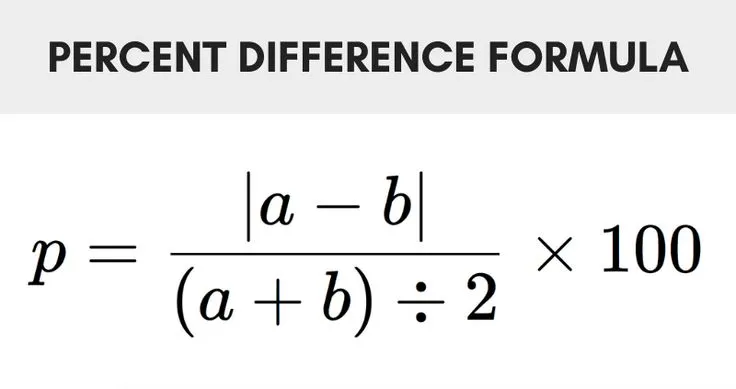
Percentage difference measures how far apart two numbers are relative to the average of those two numbers.
The formula is:
Percentage Difference = |A − B| ÷ [(A + B) ÷ 2] × 100
Here:
- A = first value
- B = second value
- |A − B| = absolute difference between the two values
- (A + B) ÷ 2 = average of the two values
For example, suppose one measurement is 80 and another is 100.
First find the difference:
100 − 80 = 20
Then find the average:
(80 + 100) ÷ 2 = 90
Now calculate:
20 ÷ 90 × 100 = 22.22%
So the percentage difference between 80 and 100 is approximately 22.22%.
For quick calculations, you can enter the two values into a percentage difference calculator instead of calculating the formula manually.
Percentage Difference vs Percentage Increase
These two calculations are often confused, but they answer different questions.
Percentage difference
Use percentage difference when you are comparing two values and neither value is necessarily the starting point.
For example:
- Measurement A = 80
- Measurement B = 100
Percentage difference = 22.22%
Percentage increase
Use percentage increase when you have an original value and a new, higher value.
For example:
- Original value = 80
- New value = 100
The increase is:
100 − 80 = 20
Then:
20 ÷ 80 × 100 = 25%
So the percentage increase from 80 to 100 is 25%.
Notice that percentage difference and percentage increase produce different results because they use different reference points.
How to Calculate Percentage Difference
You can calculate percentage difference in three simple steps.
Step 1: Find the absolute difference
Subtract the smaller value from the larger value.
Difference = |A − B|
Step 2: Find the average
Add both values and divide by two.
Average = (A + B) ÷ 2
Step 3: Divide and multiply by 100
Percentage Difference = Difference ÷ Average × 100
For example, compare 120 and 150.
Difference:
150 − 120 = 30
Average:
(120 + 150) ÷ 2 = 135
Percentage difference:
30 ÷ 135 × 100 = 22.22%
Therefore, the percentage difference is approximately 22.22%.

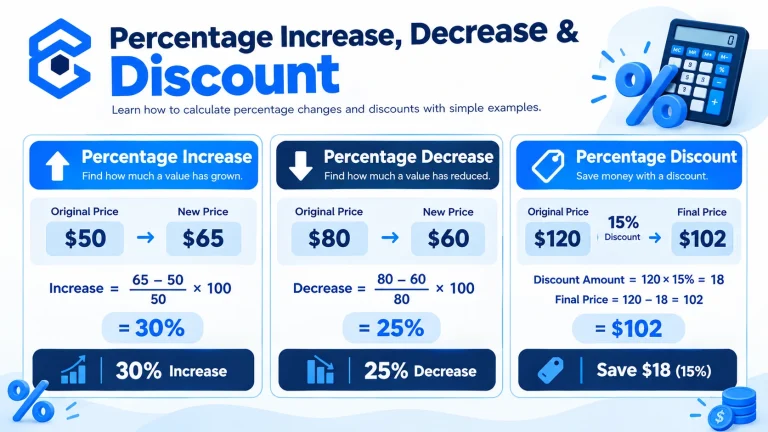
How to Calculate Percentage Increase
If you want to know how much a value has increased, use the original value as the reference.
The formula is:
Percentage Increase = (New Value − Original Value) ÷ Original Value × 100
For example, a product price increases from $50 to $65.
Increase:
$65 − $50 = $15
Percentage increase:
$15 ÷ $50 × 100 = 30%
So the price increased by 30%.
This formula works with dollars, pounds, Canadian dollars, Australian dollars, marks, measurements, sales figures, and many other types of values.
How to Calculate Percentage of a Number
Another common question is how to calculate percentage of a number.
The basic formula is:
Percentage of a Number = Number × Percentage ÷ 100
For example, to find 20% of 150:
150 × 20 ÷ 100 = 30
Therefore:
20% of 150 = 30
Another example:
15% of 200 = 200 × 15 ÷ 100 = 30
So 15% of 200 is 30.
This calculation is also useful when working with discounts, tips, commissions, taxes, marks, and financial figures.
How to Calculate Percentage
A percentage represents a part of a whole expressed out of 100.
To calculate what percentage one number is of another, use:
Percentage = Part ÷ Whole × 100
For example, if you scored 42 marks out of 50:
42 ÷ 50 × 100 = 84%
Your score is therefore 84%.
This basic formula can be used for school results, business statistics, survey results, sales performance, and many other situations.
How to Calculate Percentage of Marks
Students often need to calculate their percentage from marks.
Use:
Percentage = Marks Obtained ÷ Total Marks × 100
For example, suppose you scored 450 marks out of 500.
450 ÷ 500 × 100 = 90%
Your percentage is 90%.
If you have several subjects, first add your marks and then divide by the total possible marks.
For example:
- Marks obtained = 425
- Total marks = 500
425 ÷ 500 × 100 = 85%
So your percentage is 85%.
This method can be useful for students in Australia, the UK, Canada, the USA, and other education systems, although grading systems and qualification structures can vary between institutions.
How to Calculate Love Percentage on Paper
There are some wishing to know how to find a love percentage on paper as a love compatibility exercise.
There isn’t any scientifically supported mathematical formula that can measure romance compatibility as a real percentage. If you’re playing a standard compatibility or name game for fun, though, you can play the game according to its specific rules.
These results are more of a fun game than a scientific measure.
Use standard mathematical formulas for real percentage calculations (e.g. mark, price, statistics, measurement).
Percentage Difference Examples
Here are several examples to make the concept easier to understand.
Difference between 50 and 60
Difference:
60 − 50 = 10
Average:
(50 + 60) ÷ 2 = 55
Percentage difference:
10 ÷ 55 × 100 = 18.18%
Difference between 100 and 120
Difference:
20
Average:
110
Percentage difference:
20 ÷ 110 × 100 = 18.18%
Difference between 200 and 250
Difference:
50
Average:
225
Percentage difference:
50 ÷ 225 × 100 = 22.22%
These examples demonstrate why percentage difference is not simply the numerical difference divided by one of the values.

Percentage Difference for Prices
Percentage calculations are useful when comparing prices in online stores.
For example, suppose one retailer lists a product for $80 and another lists it for $100.
The difference is:
$100 − $80 = $20
Average:
($80 + $100) ÷ 2 = $90
Percentage difference:
$20 ÷ $90 × 100 = 22.22%
So the two prices differ by approximately 22.22%.
The same calculation can be applied to prices shown in:
- AUD in Australia
- USD in the United States
- GBP in the United Kingdom
- CAD in Canada
The currency does not change the percentage formula.
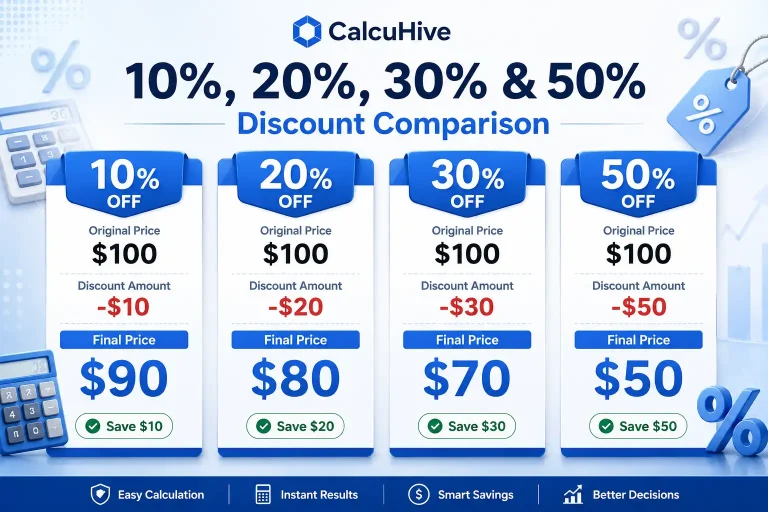
Percentage Difference and Discounts
Percentage calculations are also closely connected to discounts.
For example, if a product originally costs $100 and is reduced to $75, the reduction is:
$100 − $75 = $25
As a percentage of the original price:
$25 ÷ $100 × 100 = 25%
Therefore, the price has been reduced by 25%.
For detailed discount calculations, use the relevant discount calculator or your Percent Off Calculator to find savings and final prices.
When Should You Use Percentage Difference?
Percentage diWhen comparing two values without taking one as a standard, then difference is useful.
- Common examples include:
- Comparing two measurements
- Comparing prices
- Comparing test results
- Comparing experimental values
- Comparing sales figures
- Comparing product specifications
- Comparing statistics
- Comparing two estimates
Use percentage increase or percentage decrease if you are measuring the increase or decrease from some original value.
Use a Percentage Difference Calculator
Percentage calculations can be simple when the numbers are easy, but manually calculating differences, increases, and percentages can become time-consuming when you are comparing multiple values.
A percentage difference calculator makes the process faster. Enter the two values, and you can determine their relative percentage difference without working through every step manually.
For other percentage problems, you can also use a percentage calculator to find a percentage of a number, calculate percentage increases or decreases, or solve everyday percentage questions.
Whether you are comparing prices in Australia, checking figures in the USA, comparing measurements in the UK, or working with Canadian prices, the underlying percentage formulas remain the same.
Understanding the difference between percentage difference, percentage increase, percentage decrease, and percentage of a number helps you choose the correct calculation for the situation and avoid common mathematical mistakes.
Frequently Asked Questions
What is the percentage difference formula?
The formula is:
|A − B| ÷ [(A + B) ÷ 2] × 100
It compares the absolute difference between two values with their average.
What is the difference between percentage difference and percentage change?
Percentage difference uses the average of two values as the reference. Percentage change uses the original value as the reference.
How do I calculate percentage increase?
Subtract the original value from the new value, divide by the original value, and multiply by 100.
Percentage Increase = (New − Original) ÷ Original × 100
How do I calculate percentage of a number?
Multiply the number by the percentage and divide by 100.
For example:
20% of 150 = 150 × 20 ÷ 100 = 30
How do I calculate percentage of marks?
Divide the marks obtained by the total possible marks and multiply by 100.
Percentage = Marks Obtained ÷ Total Marks × 100
Can I calculate percentages in AUD, USD, GBP and CAD?
Yes. The mathematical formula remains the same regardless of whether the value is expressed in Australian dollars, US dollars, British pounds, or Canadian dollars.