How to Calculate Percentage: Formulas, Examples & Common Mistakes
Percentages are, around us. We use them when looking at prices figuring out discounts checking test results understanding how businesses grow calculating taxes and seeing how things change in life.
Even though percentages are common understanding how to calculate them correctly can sometimes be tricky. The good news is that most percentage questions can be solved using a few formulas.
In this guide we will explain how to calculate percentage step by step show you how to calculate a percentage increase explain what percent change means and cover examples from real life. If you want a way you can also use a percentage calculator to get your answer right away.
What Is a Percentage?
A percentage is a number that shows a part of one hundred. The word percent actually means for every hundred.
For example:
- 25 percent means 25 out of one hundred.
- 50 percent means 50 out of one hundred.
- 75 percent means 75, out of one hundred.
- 100 percent means the amount of something.
You can change a percentage into a decimal by dividing the percentage by one hundred.by 100.
For example:
- 10% = 0.10
- 25% = 0.25
- 50% = 0.50
- 80% = 0.80
Understanding this basic relationship makes it much easier to learn how to calculate percentage.
How to Calculate Percentage
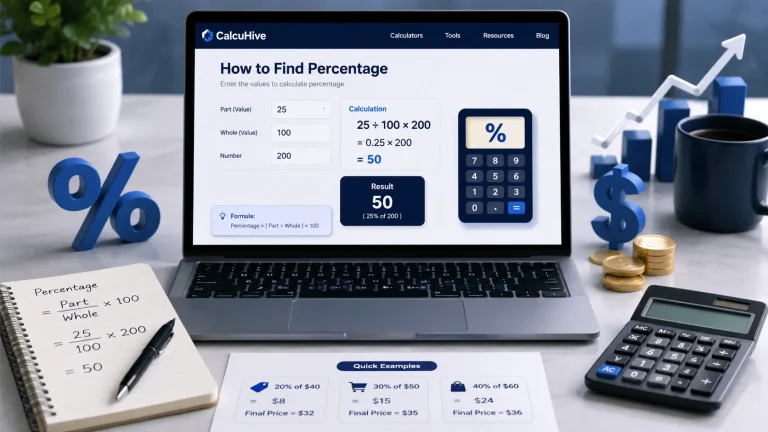
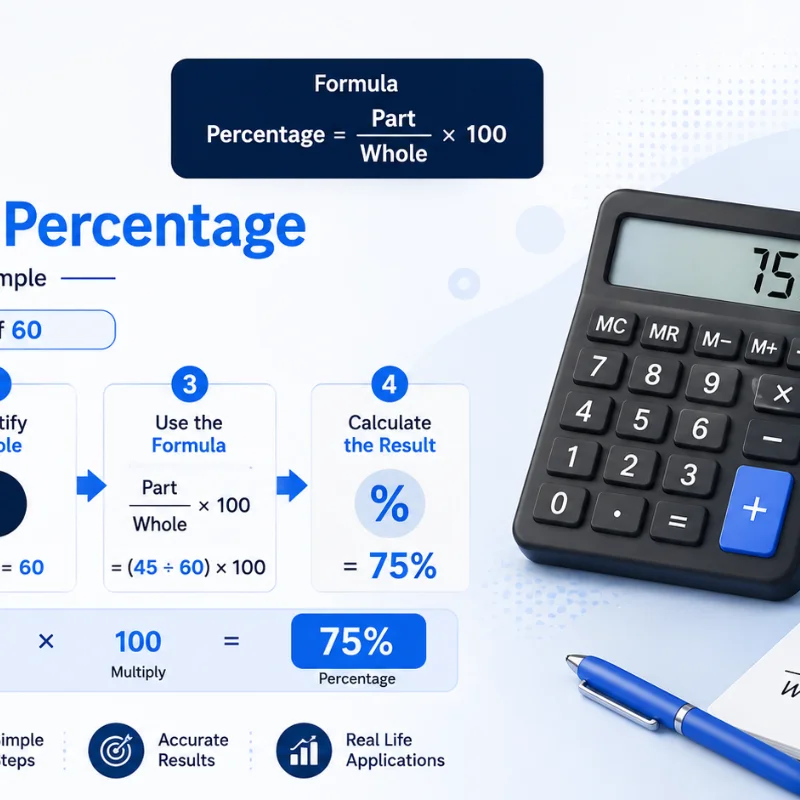
The basic percentage formula is:
Percentage = (Part ÷ Whole) × 100
For example, suppose you scored 45 marks out of 60 on a test. To calculate your percentage:
Percentage = (45 ÷ 60) × 100
Percentage = 75%
So, your score is 75%.
This is the simplest method for calculating what percentage one number represents of another.
Another Simple Example Of How to Calculate Percentage
Suppose a shop has 200 products and 50 of them are on sale. What percentage of the products are on sale?
Use the formula:
(50 ÷ 200) × 100 = 25%
Therefore, 25% of the products are on sale.
How to Calculate a Percentage of an Amount
Sometimes, you already know the percentage and want to find the actual amount.
For example, you want to calculate 20% of $500.
First, convert 20% to a decimal:
20 ÷ 100 = 0.20
Then multiply it by the amount:
0.20 × $500 = $100
Therefore, 20% of $500 is $100.
The formula is:
Percentage Amount = (Percentage ÷ 100) × Original Amount
Example: Calculate 15% of 800
(15 ÷ 100) × 800 = 120
So, 15% of 800 is 120.
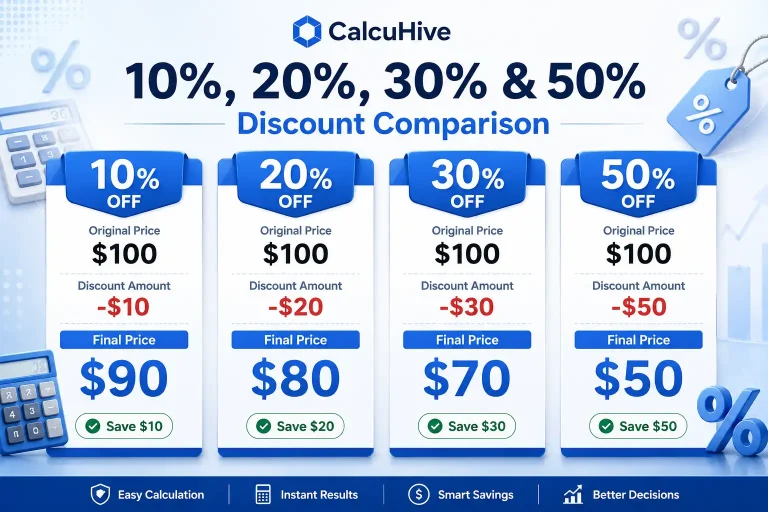
This type of calculation is useful for discounts, tips, commissions, taxes, interest, and many other everyday situations.
How to Calculate What Percent One Number Is of Another
Another common question is: “What percent is one number of another?”
For example, 30 is what percent of 120?
Use:
(30 ÷ 120) × 100 = 25%
Therefore, 30 is 25% of 120.
The key is to identify the two numbers correctly:
- The number you’re comparing is the part.
- The number you’re comparing it against is the whole.
Then divide the part by the whole and multiply by 100.
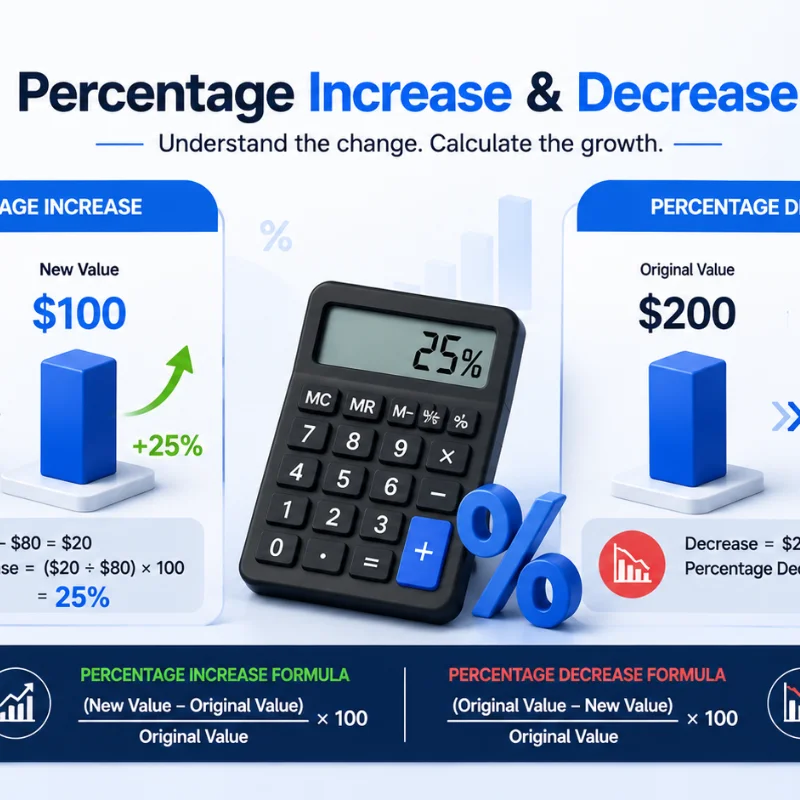
How to Calculate Percentage Increase
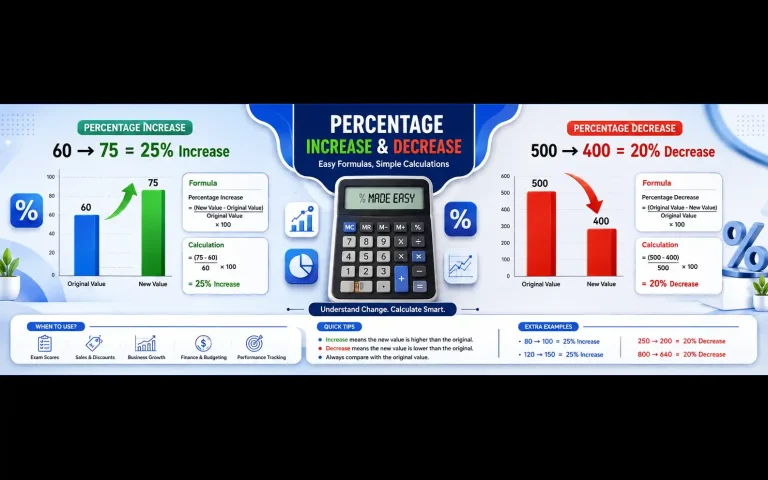
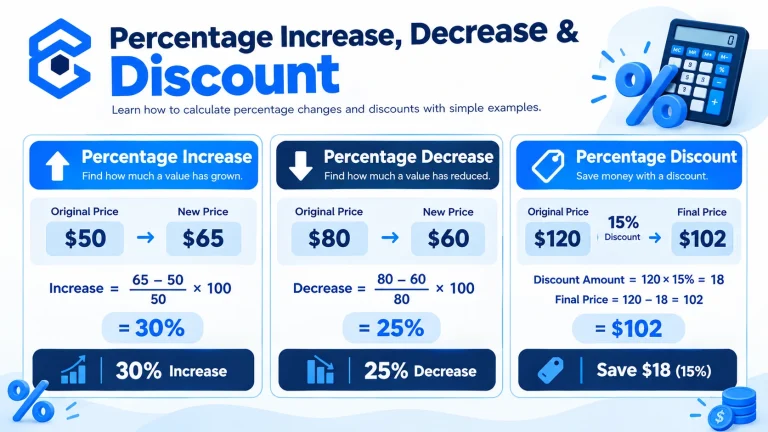
A percentage increase tells you how much a value has increased compared with its original value.
The percentage increase formula is:
Percentage Increase = ((New Value − Original Value) ÷ Original Value) × 100
For example, suppose the price of a product increases from $80 to $100.
First, find the increase:
$100 − $80 = $20
Then divide the increase by the original price:
$20 ÷ $80 = 0.25
Finally, multiply by 100:
0.25 × 100 = 25%
So, the price increased by 25%.
Another How to Calculate Percentage Increase Example
Imagine your website received 2,000 visitors last month and 2,500 visitors this month.
The increase is:
2,500 − 2,000 = 500
Now calculate the percentage increase:
(500 ÷ 2,000) × 100 = 25%
Your website traffic increased by 25%.
This formula is particularly useful for tracking sales, revenue, website traffic, investments, salaries, prices, and business performance.
How to Calculate Percentage Decrease
Percentage decrease works in a similar way, but instead of measuring growth, you’re measuring how much a value has fallen.
The formula is:
Percentage Decrease = ((Original Value − New Value) ÷ Original Value) × 100
For example, suppose a product originally cost $200 but is now $150.
The decrease is:
$200 − $150 = $50
Now calculate:
($50 ÷ $200) × 100 = 25%
Therefore, the price decreased by 25%.
This calculation is especially useful for discounts, price reductions, sales, and changes in expenses.
How to Calculate Percent Change
The term percent change is often used when comparing an old value with a new value.
The basic formula is:
Percent Change = ((New Value − Original Value) ÷ Original Value) × 100
For example, if a company’s monthly revenue changes from $10,000 to $12,000:
($12,000 − $10,000) ÷ $10,000 × 100
= $2,000 ÷ $10,000 × 100
= 20%
The result is a 20% increase.
If the new value were lower than the original value, the result would be negative, indicating a decrease.
How to Calculate a Percentage Increase of a Percentage
This calculation can be confusing because you’re increasing a percentage by another percentage.
Suppose a conversion rate is currently 20%, and you want to increase it by 10%.
First, calculate 10% of 20%:
20% × 0.10 = 2 percentage points
Then add the increase:
20% + 2% = 22%
So, a 10% increase of 20% results in 22%, not 30%.
It’s important to distinguish between a 10% increase and an increase of 10 percentage points.
For example:
- Increasing 20% by 10% gives 22%.
- Increasing 20% by 10 percentage points gives 30%.
This distinction is particularly important in statistics, business reports, advertising, finance, and performance analysis.
Quick Percentage Examples
Here are some common examples to make percentage calculations easier to understand.
Example 1: Finding a Percentage
You answered 36 questions correctly out of 40.
(36 ÷ 40) × 100 = 90%
Your score is 90%.
Example 2: Finding a Percentage of an Amount
You want to find 15% of $600.
0.15 × $600 = $90
So, 15% of $600 is $90.
Example 3: Percentage Increase
A product’s price rises from $50 to $65.
Increase:
$65 − $50 = $15
Percentage increase:
($15 ÷ $50) × 100 = 30%
The price increased by 30%.
Example 4: Percentage Decrease
A price falls from $500 to $400.
Decrease:
$500 − $400 = $100
Percentage decrease:
($100 ÷ $500) × 100 = 20%
The price decreased by 20%.
Common Percentage Mistakes
Percentage calculations are simple once you know which formula to use, but a few mistakes are very common.
1. Using the Wrong Starting Value
When calculating percentage increase or decrease, you normally divide by the original value, not the new value.
For example, if a price changes from $100 to $120:
Correct: $20 ÷ $100 × 100 = 20%
2. Forgetting to Multiply by 100
If you calculate:
25 ÷ 100 = 0.25
That’s a decimal, not yet a percentage.
To convert it to a percentage:
0.25 × 100 = 25%
3. Confusing Percent With Percentage Points
A change from 20% to 25% is an increase of 5 percentage points.
But the relative percentage increase is:
(25 − 20) ÷ 20 × 100 = 25%
So the percentage increased by 25%, while the percentage-point difference is 5 points.
4. Rounding Too Early
If your calculation produces several decimal places, avoid rounding intermediate results too soon. Keep the full number until the final step, then round your answer if necessary.
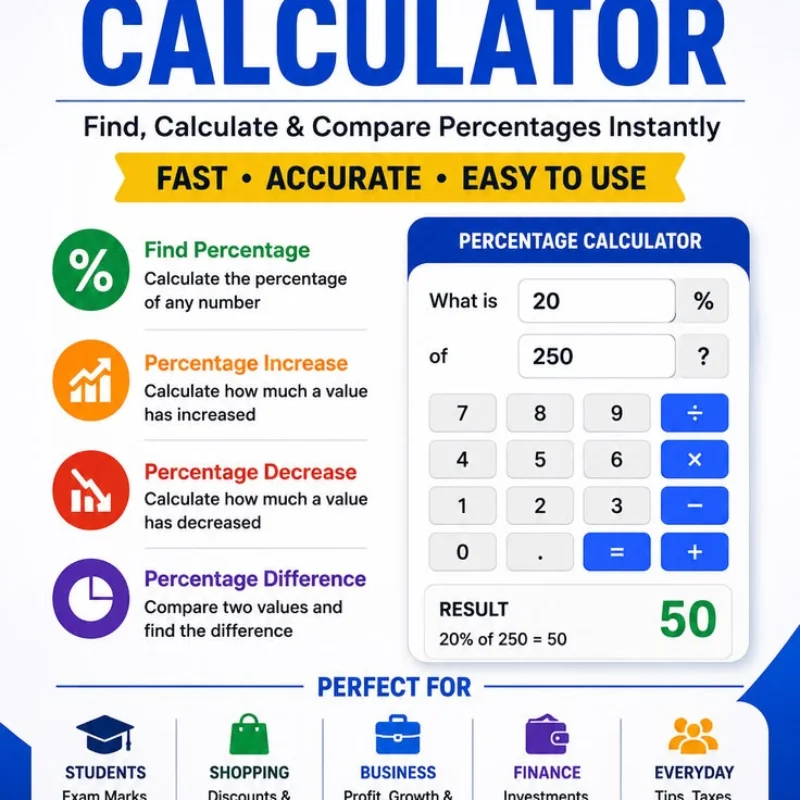
Use a Percentage Calculator
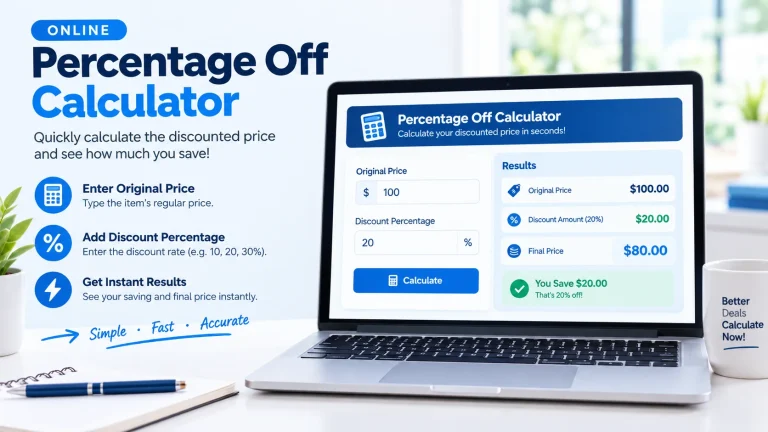
If you do not want to do all the math by hand a percentage calculator can help you finish the work quicker.
A calculator is really helpful when you are dealing with numbers looking at several numbers at the same time figuring out percentage changes or making sure your manual math is correct.
With CalcuHives calculators you can do regular percentage tasks fast, without needing to remember all the formulas.
For math though learning the basic formulas is still important because it lets you see how the answer is reached.
Final Thoughts
Learning how to calculate percentage is a useful skill for school, work, business, shopping, budgeting, and everyday decisions. Once you understand the basic formula, you can solve many different types of percentage problems.
Remember these key formulas:
Percentage = (Part ÷ Whole) × 100
Percentage of an Amount = (Percentage ÷ 100) × Amount
Percentage Increase = ((New − Original) ÷ Original) × 100
Percentage Decrease = ((Original − New) ÷ Original) × 100
Whether you’re checking a discount, measuring business growth, calculating a test score, or comparing two numbers, these formulas can help you find the answer quickly and accurately.
And when you need a faster way to calculate percent, use an online percentage calculator to check your result.
Frequently Asked Questions About Percentages
How do you calculate percentage?
To calculate a percentage, divide the part by the whole and multiply the result by 100.
Percentage = (Part ÷ Whole) × 100
How do you calculate a percentage of an amount?
Convert the percentage to a decimal and multiply it by the amount.
For example:
20% of 500 = 0.20 × 500 = 100
How do you calculate percentage increase?
Subtract the original value from the new value, divide the difference by the original value, and multiply by 100.
Percentage Increase = ((New − Original) ÷ Original) × 100
How do you calculate percent change?
Subtract the original value from the new value, divide by the original value, and multiply by 100.
Percent Change = ((New − Original) ÷ Original) × 100
What is 20% of 100?
20% of 100 is 20.
What is the easiest way to calculate a percentage?
For quick calculations, use the appropriate percentage formula or an online percentage calculator. For example, to find what percentage 25 is of 100:
(25 ÷ 100) × 100 = 25%
How to calculate 20% of 500?
To calculate 20% of 500, use the formula: (Part ÷ Whole) × 100But here we need to find the part, so we reverse it:
Value = (Percentage ÷ 100) × Total NumberSo, (20 ÷ 100) × 500 = 0.2 × 500 = 100