How to Calculate for the Percentage: An Easy Guide
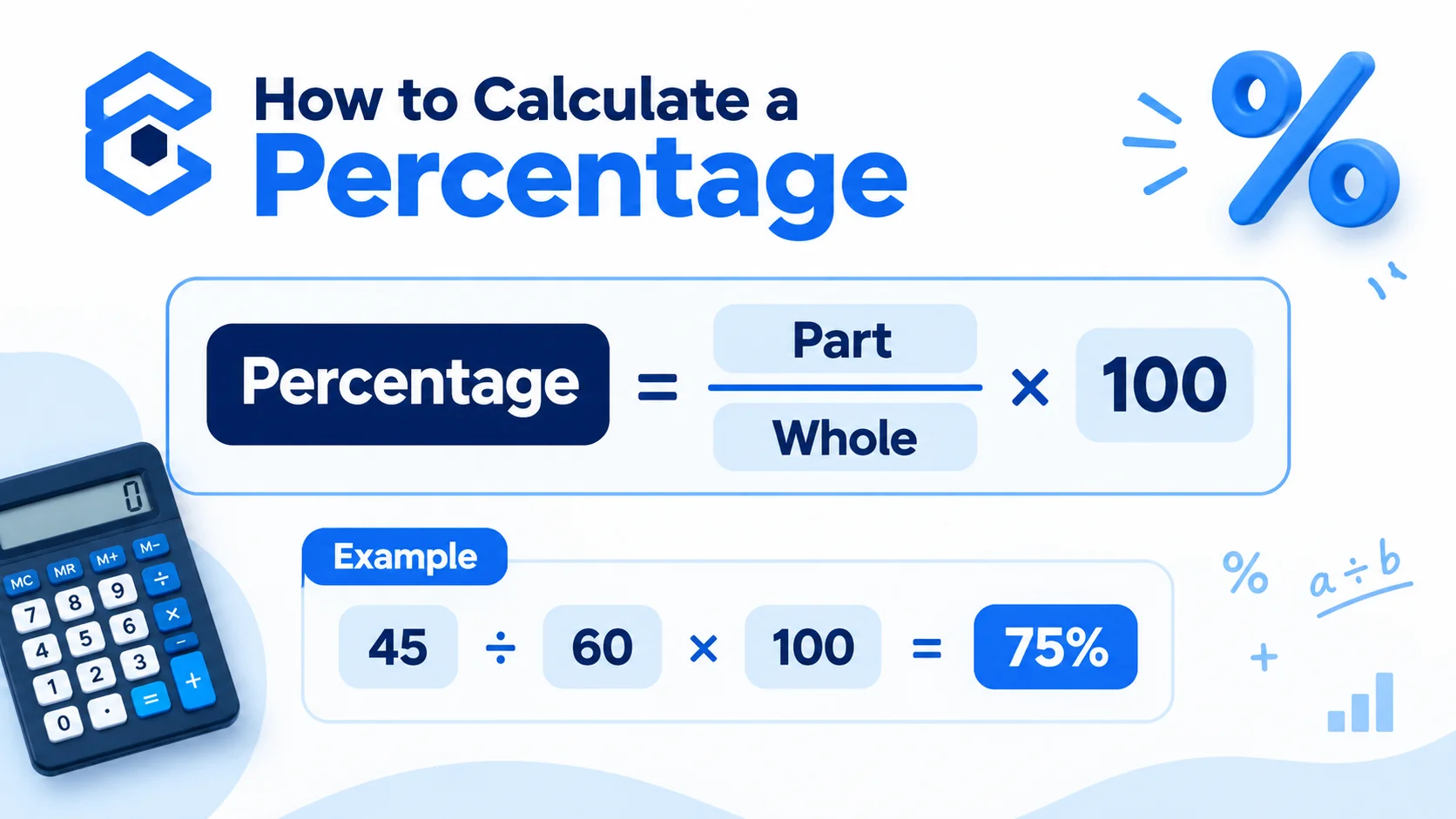
Learning to calculate for the percentage is simple once you know the basic formula. To calculate a percentage, divide the part by the whole and multiply the result by 100. For example, if you scored 45 out of 60, calculate 45 ÷ 60 × 100 = 75%.
This basic method helps you calculate percentages for prices, discounts, test scores, salaries, business figures, and many everyday situations. Whether you need to find a percentage of a number, compare two values, or calculate a percentage increase or decrease, the same core principles can help you get the answer.
Table of Contents
What Is a Percentage?
A percentage is a way of expressing a number as a fraction of 100. The word percent literally means “per hundred.”
For example:
- 10% means 10 out of 100
- 25% means 25 out of 100
- 50% means 50 out of 100
- 75% means 75 out of 100
- 100% means the entire amount
Percentages make it easier to compare values that may have different totals.
For instance, saying you answered 18 questions correctly out of 20 tells you the raw result. Converting it to 90% makes the result easier to understand and compare.
How to Calculate the Percentage
The basic percentage formula is:
Percentage = (Part ÷ Whole) × 100
Here is the process:
- Identify the part.
- Identify the whole.
- Divide the part by the whole.
- Multiply the result by 100.
- Add the percentage sign.
Example: 30 out of 50
Suppose you completed 30 tasks out of 50.
Percentage = (30 ÷ 50) × 100
Percentage = 0.6 × 100
Percentage = 60%
So, 30 is 60% of 50.
You can use the same formula for test scores, completion rates, survey results, sales figures, and many other situations.
How to Find a Percentage of a Number
Sometimes you already know the percentage but need to find the corresponding amount.
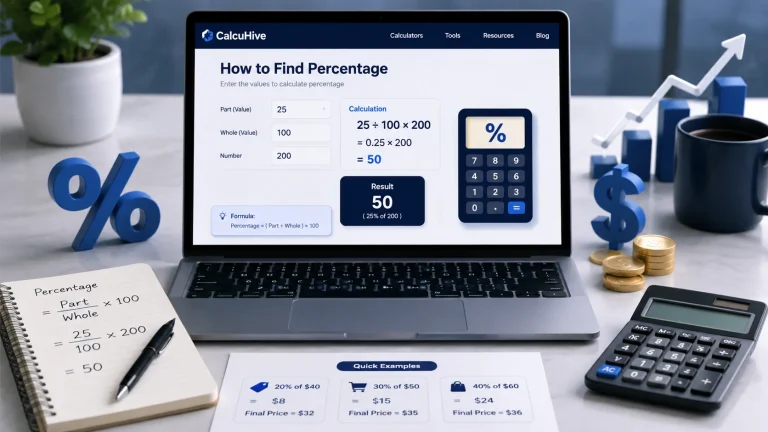
For this calculation, use:
Percentage of a number = (Percentage ÷ 100) × Number
Example: What is 20% of 250?
First, convert 20% into a decimal:
20 ÷ 100 = 0.20
Then multiply:
0.20 × 250 = 50
Therefore, 20% of 250 is 50.
You can also calculate this directly:
20% × 250 = 50
A quick mental shortcut
Some percentages are easy to calculate without a calculator.
For example:
- 10% of 300 = 30
- 5% of 300 = 15
- 20% of 300 = 60
- 25% of 300 = 75
- 50% of 300 = 150
A useful trick is to find 10% first. From there, you can build other percentages.
For example, to find 30% of $80:
10% = $8
Therefore:
30% = $8 × 3 = $24
This approach can be faster than entering every calculation into a calculator.
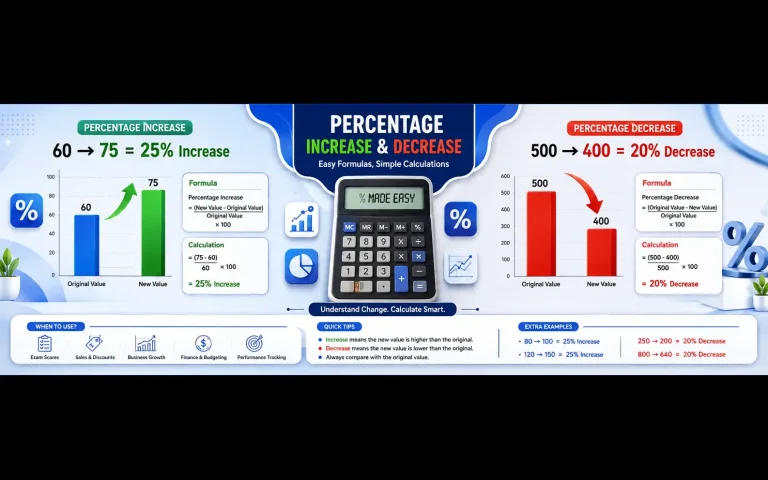
How to Calculate Percentage Increase
A percentage increase tells you how much a value has grown relative to its original value.
Use this formula:
Percentage Increase = ((New Value − Original Value) ÷ Original Value) × 100
Example: A price increases from $50 to $65.
First find the difference:
$65 − $50 = $15
Then divide by the original price:
$15 ÷ $50 = 0.30
Multiply by 100:
0.30 × 100 = 30%
The price increased by 30%.
The key detail here is that you divide by the original value, not the new value.
That small distinction causes many percentage errors.
How to Calculate Percentage Decrease
The percentage decrease formula works similarly:
Percentage Decrease = ((Original Value − New Value) ÷ Original Value) × 100
Example: A price falls from $80 to $60.
Find the difference:
$80 − $60 = $20
Divide by the original value:
$20 ÷ $80 = 0.25
Multiply by 100:
0.25 × 100 = 25%
Therefore, the price decreased by 25%.
This calculation is particularly useful when comparing prices, expenses, sales, population figures, or other measurements over time.
How to Find What Percentage One Number Is of Another
If you want to know what percentage one number represents of another, use:
Percentage = (First Number ÷ Second Number) × 100
Example: 40 is what percentage of 160?
40 ÷ 160 = 0.25
Then:
0.25 × 100 = 25%
Therefore, 40 is 25% of 160.
This is one of the most common percentage calculations because it works for grades, budgets, business metrics, and everyday comparisons.
For a faster calculation, you can also use the percentage calculator to check your result.
How to Calculate Percentage Difference
Percentage difference is slightly different from percentage increase or decrease.
It is generally used when comparing two values without treating either value as the starting point.
The formula is:
Percentage Difference = |Value 1 − Value 2| ÷ ((Value 1 + Value 2) ÷ 2) × 100
Example: Compare 40 and 50.
First find the absolute difference:
|40 − 50| = 10
Then calculate their average:
(40 + 50) ÷ 2 = 45
Now divide:
10 ÷ 45 × 100 ≈ 22.22%
So, the percentage difference is approximately 22.22%.
This differs from percentage increase because percentage difference uses the average of the two values as its reference.
Internal link suggestion: Use the anchor text “percentage calculator” to link to your /percentage-calculator/ page here.
Real-Life Percentage Examples
Percentages appear in more situations than most people realize.
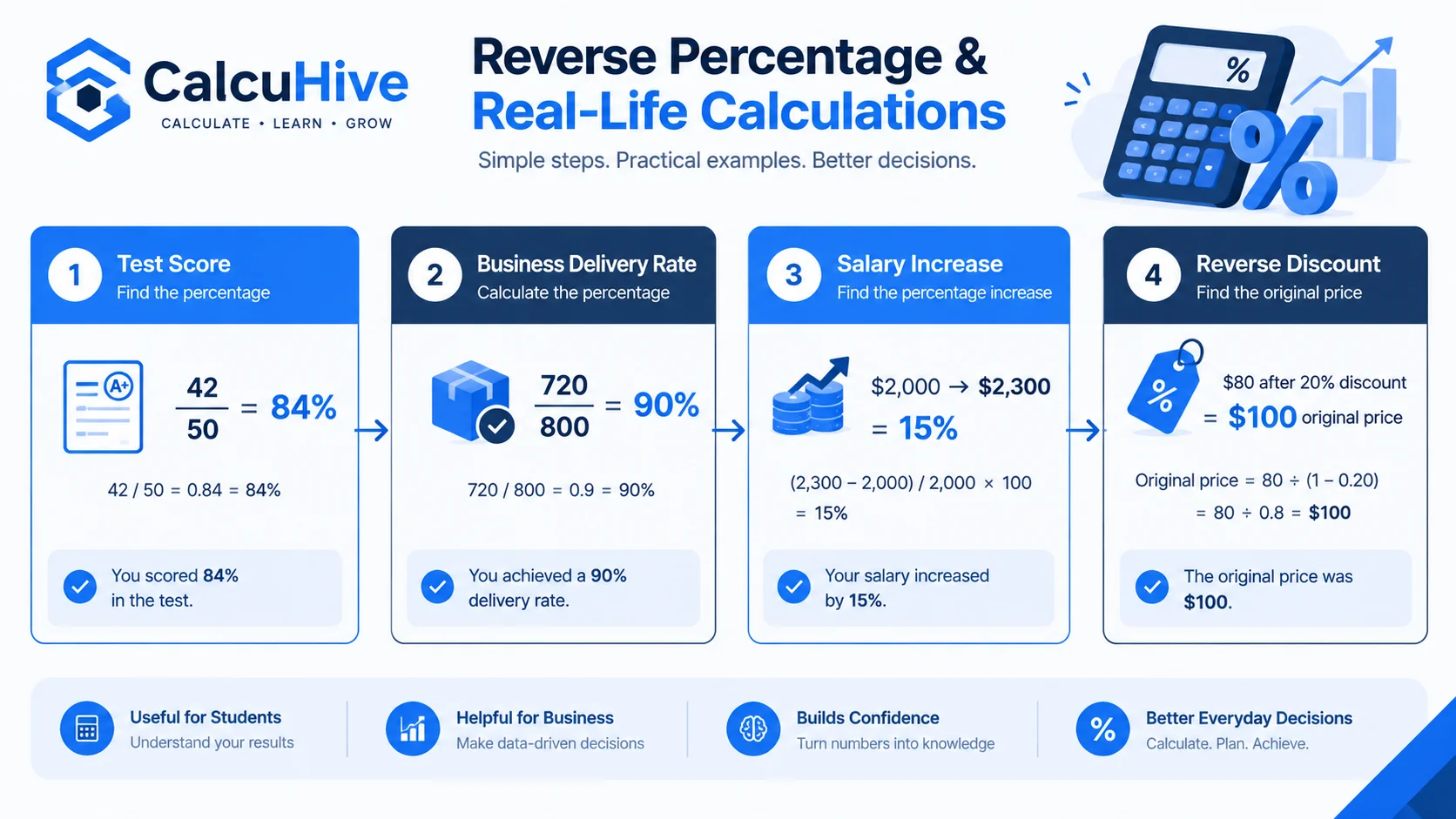
Example 1: Test score
You answered 42 questions correctly out of 50.
42 ÷ 50 × 100 = 84%
Your score is 84%.
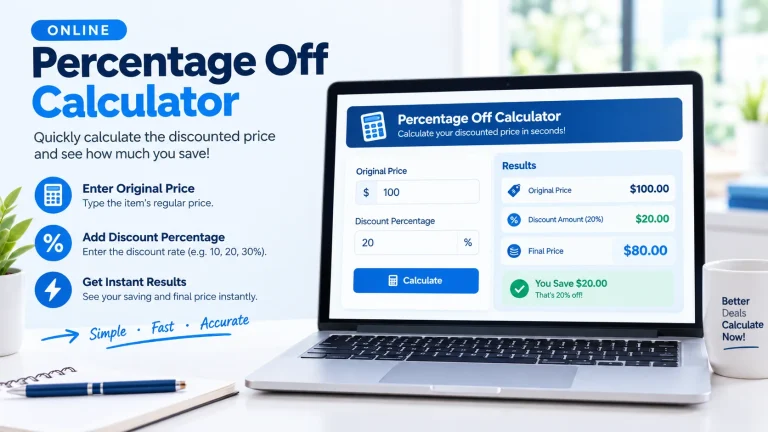
Example 2: Discount
A $120 product has a 15% discount.
First calculate the discount:
15 ÷ 100 × $120 = $18
Then subtract the discount:
$120 − $18 = $102
The discounted price is $102.
Internal link suggestion: If you have a discount-related article, use anchor text such as “how percentage discounts work” and link to your relevant discount guide.
Example 3: Salary increase
Suppose a salary rises from $2,000 to $2,300.
The increase is
$2,300 − $2,000 = $300
Then:
$300 ÷ $2,000 × 100 = 15%
The salary increased by 15%.
Example 4: Business completion rate
A business receives 800 orders and successfully delivers 720.
720 ÷ 800 × 100 = 90%
The delivery rate is 90%.
This same formula can be used for completion rates, attendance, conversion rates, and survey responses.
A Useful Trick for Reverse Percentage Calculations
Percentage calculations become slightly more interesting when you know the final number but need to discover the original value.
Suppose a jacket costs $80 after a 20% discount. What was its original price?
A 20% discount means you paid 80% of the original price.
So:
Original Price = $80 ÷ 0.80
Original Price = $100
The original price was $100.
Notice that you should not simply add 20% to $80. The discounted price represents 80% of the original, so you need to divide by 0.80.
This reverse-calculation method is useful for discounts, tax-inclusive prices, commissions, and other situations where you know the final amount.
Common Percentage Mistakes
Percentage problems often look simple, but a few small mistakes can produce very different answers.
Using the wrong reference number
For percentage increase and decrease, use the original value as the denominator.
For example, if something rises from 50 to 60:
10 ÷ 50 × 100 = 20%
Using 60 instead would produce a different result.
Forgetting to multiply by 100
If you calculate:
30 ÷ 50 = 0.6
That is the decimal form.
To convert it into a percentage:
0.6 × 100 = 60%
Confusing percentage points with percentage change
Suppose a rate rises from 20% to 30%.
The change is 10 percentage points.
But the relative increase is:
(30 − 20) ÷ 20 × 100 = 50%
So a 10-percentage-point increase can represent a 50% relative increase.
This distinction matters when comparing statistics, rates, and business metrics.
Treating stacked discounts as simple addition
A 20% discount followed by another 10% discount does not create a 30% discount.
For a $100 item:
First discount:
$100 × 0.80 = $80
Second discount:
$80 × 0.90 = $72
You pay $72, meaning the combined reduction is 28%, not 30%.
Internal link suggestion: Use anchor text “how stacked discounts work” and link to your article on stacked discounts.
When to Use a Percentage Calculator
A calculator is useful when the numbers are large, contain decimals, or require several steps.
You may want to use one when calculating:
- Discounts and sale prices
- Percentage increases
- Percentage decreases
- Test scores
- Business growth
- Tax amounts
- Profit margins
- Completion rates
- Percentage differences
- Reverse percentage problems
For simple numbers, mental math can be quicker. For more complicated calculations, a calculator reduces the chance of entering the wrong formula.
You can use the CalcuHive Percentage Calculator when you want to calculate a percentage without working through the formula manually.
Frequently Asked Questions
How do I calculate a percentage of a number?
Multiply the number by the percentage expressed as a decimal. For example, 25% of 200 is 0.25 × 200 = 50.
What is the easiest percentage formula?
The basic formula is (Part ÷ Whole) × 100. It tells you what percentage the part represents of the whole.
How do I calculate percentage increase?
Subtract the original value from the new value, divide the difference by the original value, and multiply by 100.
How do I calculate percentage decrease?
Subtract the new value from the original value, divide the difference by the original value, and multiply by 100.
How do I calculate what percentage one number is of another?
Divide the first number by the second number and multiply by 100. For example, 30 ÷ 120 × 100 = 25%.
What is the difference between percentage difference and percentage change?
Percentage change normally uses the original value as its reference. Percentage difference uses the average of the two values, making it useful when neither value is treated as the starting point.