Calculation of Pregnancy: How to Calculate Your Due Date
The calculation of pregnancy helps you estimate how far along you are and when your baby may be due. The most common starting point is the first day of your last menstrual period (LMP). From there, pregnancy dating is usually counted in weeks, with an estimated due date around 40 weeks from the beginning of the last period.
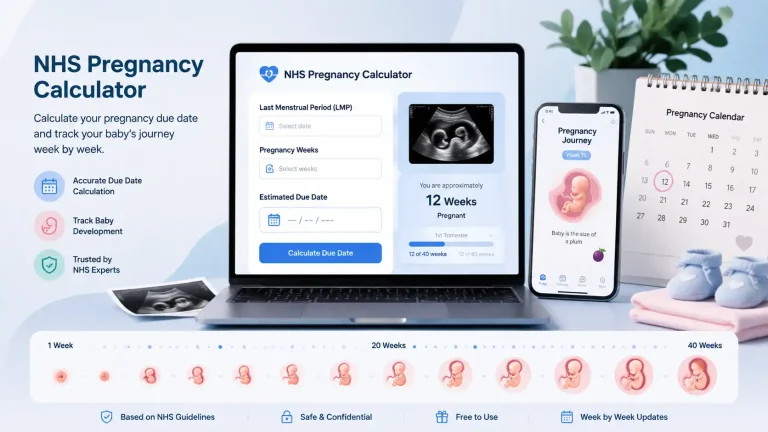
A pregnancy calculator makes this process easier. Instead of counting weeks and days manually, you can enter your last menstrual period and get an estimated due date, pregnancy week, and other useful dates.
However, a calculated due date is an estimate, not a guaranteed birth date. Your menstrual cycle may differ from the typical 28-day cycle, ovulation can occur at different times, and an early ultrasound may change the estimated date.
What Is the Calculation of Pregnancy?
Pregnancy calculation involves determining the age of your pregnancy and estimated date of delivery.
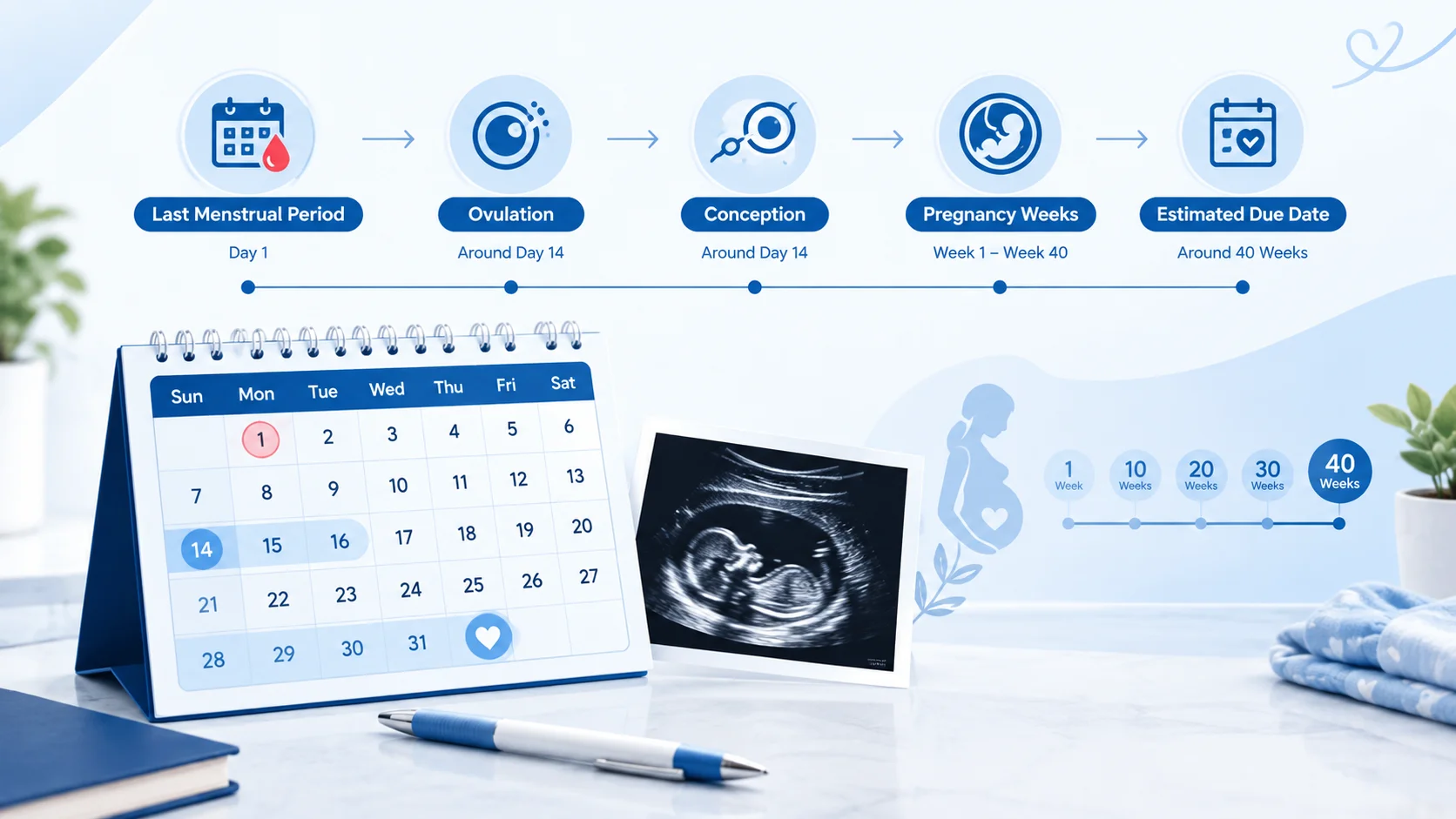
Healthcare providers usually determine gestational age based on the date of your last menstrual period, not the date of conception. This can be confusing due to the fact that conception typically takes place later, but pregnancy dating is based on a system.
For instance, if the first day of your last period was January 1, your pregnancy dating should start on January 1. The actual due date is then determined from this starting date.
This is useful since there isn’t a known date of conception for many people. What information do you need?
For a basic pregnancy calculation, you usually need:
- The first day of your last menstrual period
- Your average menstrual cycle length, if it differs from 28 days
- The current date
If you do not remember your last period or your cycles are irregular, the estimate may be less reliable. In that situation, discuss your dates with a healthcare professional.
How Does a Pregnancy Calculator Work?
A pregnancy calculator uses your menstrual dates to estimate your gestational age and due date.
The traditional calculation assumes a pregnancy length of approximately 280 days, or 40 weeks, from the first day of the last menstrual period.
A simplified calculation looks like this:
Estimated due date = first day of last menstrual period + 280 days
For someone with a cycle that is longer or shorter than 28 days, the estimated date may need adjustment.
Example of pregnancy calculation
Suppose the first day of your last menstrual period was January 1.
A basic calculation adds approximately 280 days:
January 1 + 280 days = estimated due date
The result gives you an approximate date around which your baby may arrive.
That does not mean labor will happen exactly on that date. Pregnancy commonly lasts between 37 and 42 weeks when counted from the first day of the last period.
How Can I Calculate My Pregnancy Due Date?
The easiest way is to use a pregnancy calculator.
Put the first day of your last period into the calculator. If your cycle isn’t 28 days, you can use the calculator’s option for cycle length when available.
- The calculator then can estimate:
- When you are expecting your baby to arrive.
- The number of weeks pregnant you are
When you’re approximately how far along you are in your pregnancy.
The estimated number of days until your baby is born.
You can use the above same 280-day calculation method if it is a manual calculation.
Keep in mind that the answer is an approximation. If you’re not sure about your dates, you might get more detail from an ultrasound. gestational age.
Why Is Pregnancy Counted From the Last Period?
You might wonder why pregnancy is counted from a menstrual period when conception usually happens later.
The exact date of conception is often difficult to identify. Ovulation does not necessarily occur on the same day for every person or every cycle.
The first day of the last menstrual period provides a practical reference point for pregnancy dating. MedlinePlus explains that gestational age is measured from the first day of the last menstrual cycle.
This means the first couple of weeks included in pregnancy dating occur before conception would normally take place.
That is why the number of pregnancy weeks can seem higher than the time since conception.
Methods for Calculating the Estimated Due Date
There is more than one way to estimate a due date.
1. Last menstrual period
The LMP method uses the first day of your last menstrual period.
It is one of the simplest ways to estimate an expected due date, especially when your menstrual cycles are regular and you know the date accurately.
The basic calculation uses approximately 40 weeks from the first day of the last period.
2. Menstrual cycle adjustment
Not everyone has a 28-day menstrual cycle.
If your cycle is consistently longer or shorter, the estimated date may be adjusted. Some pregnancy calculators allow you to enter your cycle length for this reason. The NHS calculator, for example, includes cycle-length adjustment.
3. Ultrasound dating
An ultrasound can provide another way to estimate gestational age.
During an early dating scan, measurements of the developing baby can help estimate how far along the pregnancy is. The NHS states that a dating scan around 10 to 14 weeks can help determine how far along a pregnancy is and work out the estimated due date.
If an ultrasound estimate differs from the menstrual-date estimate, your healthcare professional can determine which dating information should be used.
4. Assisted reproduction dates
Pregnancies resulting from assisted reproductive procedures can have more specific dating information because the timing of certain procedures may be known.
If your pregnancy resulted from fertility treatment, use the dates provided by your fertility or maternity team rather than relying only on a general online calculation.
How Accurate Is a Pregnancy Due Date?
Do not consider a due date to be a definite date.
The calculation can be influenced by the following:
- Uncertain LMP dates
- Irregular menstrual cycles
- Different ovulation timing
This is because of changes in early fetal development.
The advantages and disadvantages of menstrual dating compared to ultrasound dating
The NHS says that a normal pregnancy lasts between 37 and 42 weeks from the first day of the woman’s last period.
That’s why your baby isn’t expected to come in on the predicted due date.
Consider the due date as a helpful calendar reminder, not a hard-and-fast date.
Can My Due Date Change?
Yes, your estimated due date can change.
For example, you may initially calculate your due date using the first day of your last period. Later, an ultrasound may provide a different estimate based on measurements of the developing baby.
The NHS explains that an ultrasound can provide a better estimate of how many weeks pregnant you are, and the originally calculated due date may be adjusted according to ultrasound measurements.
A change in your estimated due date does not automatically mean something is wrong. Pregnancy dating is an estimation process, and better information can sometimes change the estimate.
What If I Do Not Know My Last Period Date?
You can still discuss pregnancy dating with a healthcare professional.
Some people do not remember the exact first day of their last period. Others have irregular cycles, recently stopped hormonal contraception, or have bleeding patterns that make the date difficult to identify.
In these situations, an ultrasound may help estimate gestational age.
The NHS recommends speaking with a midwife or GP if you do not know or are unsure of the first day of your last period.
Do not try to force an exact due date from an uncertain date. A healthcare professional can help determine the most appropriate estimate.
What If I Already Know My Due Date?
If your healthcare professional has already given you an estimated due date, you generally do not need to calculate another date simply for comparison.
Instead, you can use your known due date to understand your pregnancy timeline.
For example, you can estimate:
- Your current pregnancy week
- Your trimester
- Approximate time remaining
- Important prenatal appointments
- Expected pregnancy milestones
Your healthcare provider’s dating information should take priority over a general online calculator when the two differ.
Understanding Pregnancy Weeks
Pregnancy is usually discussed in weeks rather than only months.
This makes it easier for healthcare professionals to describe pregnancy progression and monitor development.
For example:
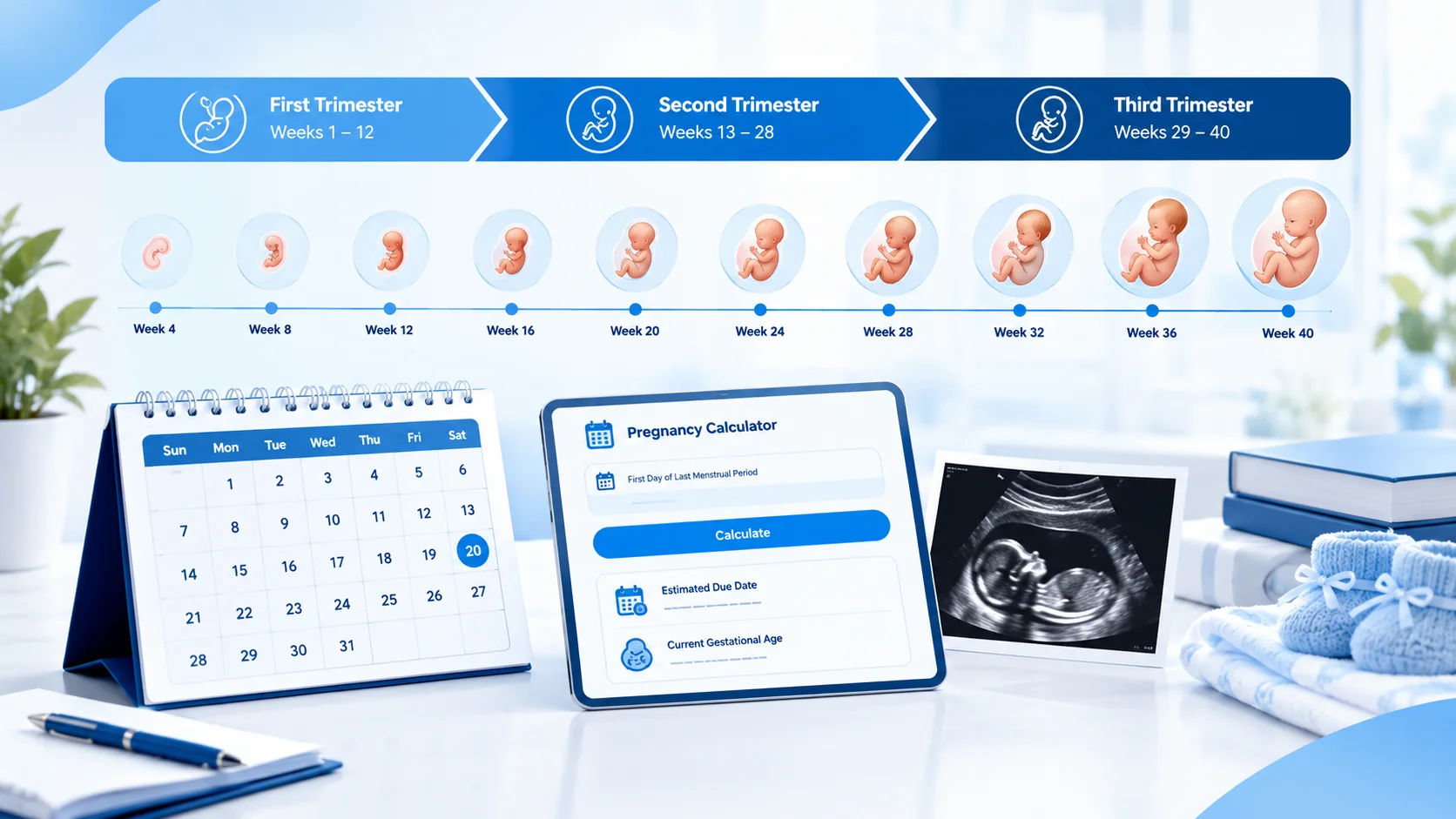
First trimester: approximately weeks 1–12
Second trimester: approximately weeks 13–26
Third trimester: approximately week 27 onward
Exact definitions can vary slightly between resources, so your maternity provider’s terminology should be followed.
Pregnancy development also changes significantly from week to week. MedlinePlus explains that gestational age is measured in weeks from the first day of the last menstrual cycle.
Track Your Baby’s Development
A pregnancy calculator can tell you where you are on the pregnancy calendar, but it cannot replace prenatal care.
As pregnancy progresses, healthcare professionals monitor factors such as fetal growth, maternal health, and other aspects of pregnancy.
Ultrasound examinations can also provide information about fetal development. The NHS explains that the dating scan is used to assess how far along the pregnancy is and check the baby’s development.
You can use your estimated pregnancy week as a general reference when reading about fetal development.
However, every pregnancy is different. Online week-by-week information should not be used to diagnose a medical problem.
Pregnancy Calculation vs. Conception Date
Pregnancy dating and conception dating are not exactly the same thing.
The pregnancy calculation normally begins with the first day of the last menstrual period. Conception generally occurs later.
That difference is one reason someone may be described as being four weeks pregnant even though conception happened more recently.
Because the exact conception date is often uncertain, medical dating commonly uses gestational age rather than trying to identify the precise moment of conception.
What Can Affect a Pregnancy Calculation?
Your estimated date may be affected by several circumstances.
Irregular periods
If your cycles vary considerably, calculating from LMP may be less precise.
An uncertain LMP date
A difference of several days in the recorded start date can change the calculated estimate.
Longer or shorter cycles
A 28-day cycle is often used as the basic reference, but actual cycles vary.
Early ultrasound findings
An early ultrasound may provide additional information for pregnancy dating and can sometimes lead to a revised estimated due date.
Fertility treatment
When conception occurs through assisted reproduction, known treatment dates may provide important dating information.
When Should You Contact a Healthcare Professional?
An online pregnancy calculator is useful for estimating dates, but it is not a substitute for prenatal care.
Contact a qualified healthcare professional for personalized advice about your pregnancy, especially if:
- You are unsure whether you are pregnant
- You do not know your last menstrual period
- Your menstrual cycles are highly irregular
- Your estimated dates differ significantly from clinical dating
- You have concerns about your pregnancy
- You experience symptoms that worry you
If you have a positive pregnancy test and plan to continue the pregnancy, arranging appropriate prenatal care is important.
(FAQs)Frequently Asked Questions A
How do I calculate pregnancy weeks?
Pregnancy weeks are generally counted from the first day of your last menstrual period. A pregnancy calculator can use that date to estimate your current gestational age.
How is the estimated due date calculated?
A basic calculation estimates the due date as approximately 280 days, or 40 weeks, from the first day of the last menstrual period. Cycle length and ultrasound findings can affect the estimate.
Can I calculate my due date without knowing my last period?
You may still be able to estimate pregnancy dating through clinical assessment and ultrasound. If you do not know your LMP date, speak with a healthcare professional.
Is the pregnancy calculator exact?
No. A pregnancy calculator provides an estimate. Babies can be born before or after the calculated due date, and pregnancy commonly lasts from 37 to 42 weeks when counted from the first day of the last period.
Can an ultrasound change my due date?
Yes. An ultrasound, particularly an early dating scan, may provide a different estimate of gestational age and may lead to an adjusted due date.
How many weeks is a full-term pregnancy?
Pregnancy is commonly dated to around 40 weeks from the first day of the last menstrual period. However, normal pregnancy length can vary, with the NHS describing pregnancy as normally lasting from 37 to 42 weeks from that starting point.
Final Thoughts on Pregnancy Calculation
The calculation of pregnancy gives you a practical way to estimate your pregnancy week and expected due date. Starting with the first day of your last menstrual period is the simplest approach, while cycle length and ultrasound information can provide additional context.
Your estimated due date is not a fixed appointment with the calendar. It is a useful estimate that helps you understand your pregnancy timeline and prepare for the arrival of your baby.
For a quick estimate, enter your dates into a pregnancy calculator. For personalized pregnancy dating or concerns about your pregnancy, use the information from your midwife, doctor, or other qualified healthcare professional as your primary guide.