GST vs Discount vs Percentage Calculator
Calculations involving prices, percentages, taxes, and discounts can become confusing when you try to do everything manually. A small mistake can change the final amount, especially when you are comparing products, checking invoices, calculating savings, or working out tax-inclusive prices.
That is where online calculators can help.
A GST vs. Discount vs. Percentage Calculator may look similar at first glance, but each tool solves a different type of problem. Understanding the difference can help you choose the right calculator and get an accurate result without spending time on complicated formulas.
In this guide, we will compare these three calculators, explain what each one does, show practical examples, and discuss when you should use each tool.
What Is a GST Calculator?
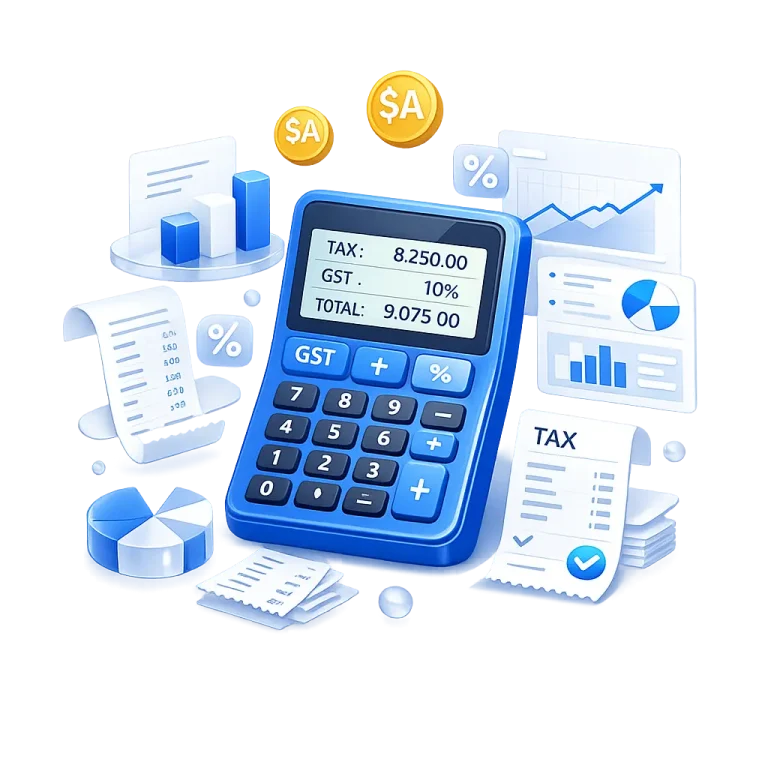
A GST calculator is designed to help you calculate Goods and Services Tax on a product or service price.
GST is a consumption tax applied to many goods and services. The exact GST rate and rules depend on the country or tax system you are working with.
A GST calculator can usually help you determine:
- GST amount
- Price before GST
- Price including GST
- Tax-exclusive price
- Tax-inclusive price
- Total amount after adding GST
For example, suppose a product costs $200 before GST and the applicable GST rate is 10%.
The GST would be
$200 × 10% = $20
The total price, including GST, would therefore be
$200 + $20 = $220
Instead of performing these calculations manually, you can enter the amount and GST rate into a GST calculator.
This becomes particularly useful when you need to calculate tax for multiple products or quickly check an invoice.
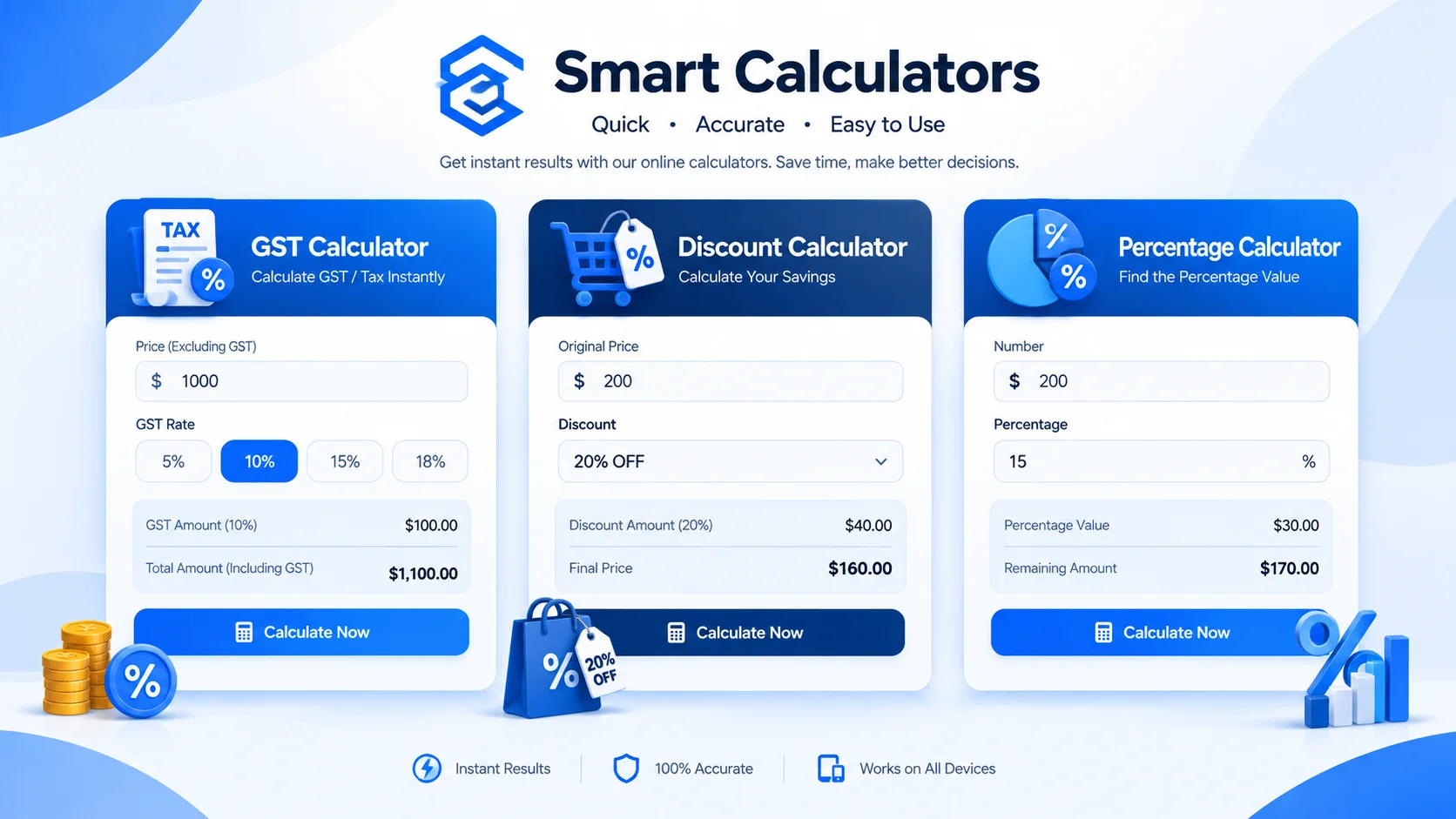
What Is a Discount Calculator?
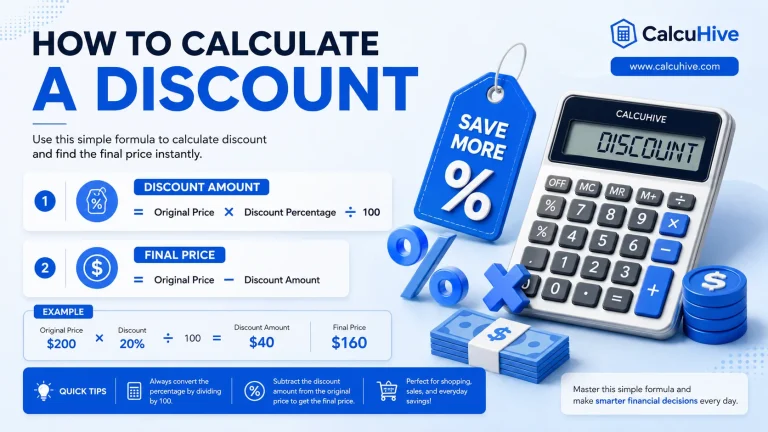
A discount calculator helps you determine how much money you save when a percentage discount is applied to an original price.
Retailers commonly use percentage-based discounts such as
- 5% off
- 10% off
- 15% off
- 20% off
- 25% off
- 50% off
For example, imagine a jacket has an original price of $120 and is advertised at 25% off.
First, calculate the discount:
$120 × 25% = $30
Then subtract the discount from the original price:
$120 − $30 = $90
The customer saves $30 and pays $90.
A discount calculator performs these steps automatically.
This is useful when shopping online, comparing promotions, checking sale prices, or determining how much you will actually pay after a discount.
What Is a Percentage Calculator?
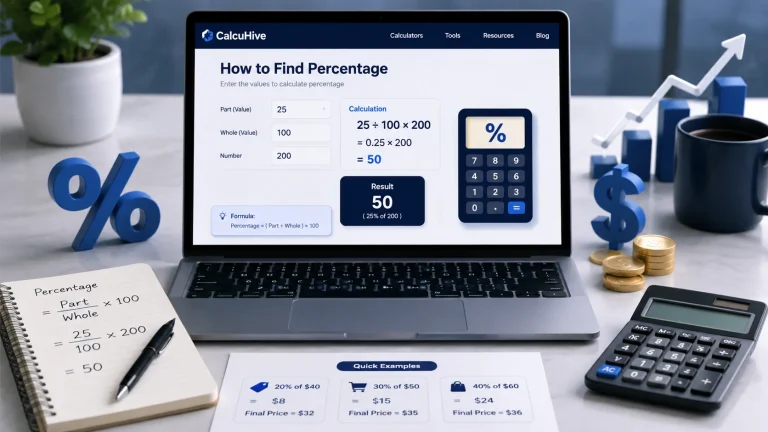
A percentage calculator is a more general-purpose tool.
Unlike a GST calculator or discount calculator, it is not limited to taxes or price reductions. It can be used for many different percentage-related calculations.
For example, you may want to calculate:
- What percentage one number is of another
- A percentage increase
- A percentage decrease
- A percentage of a number
- The difference between two percentages
- Changes in prices or values
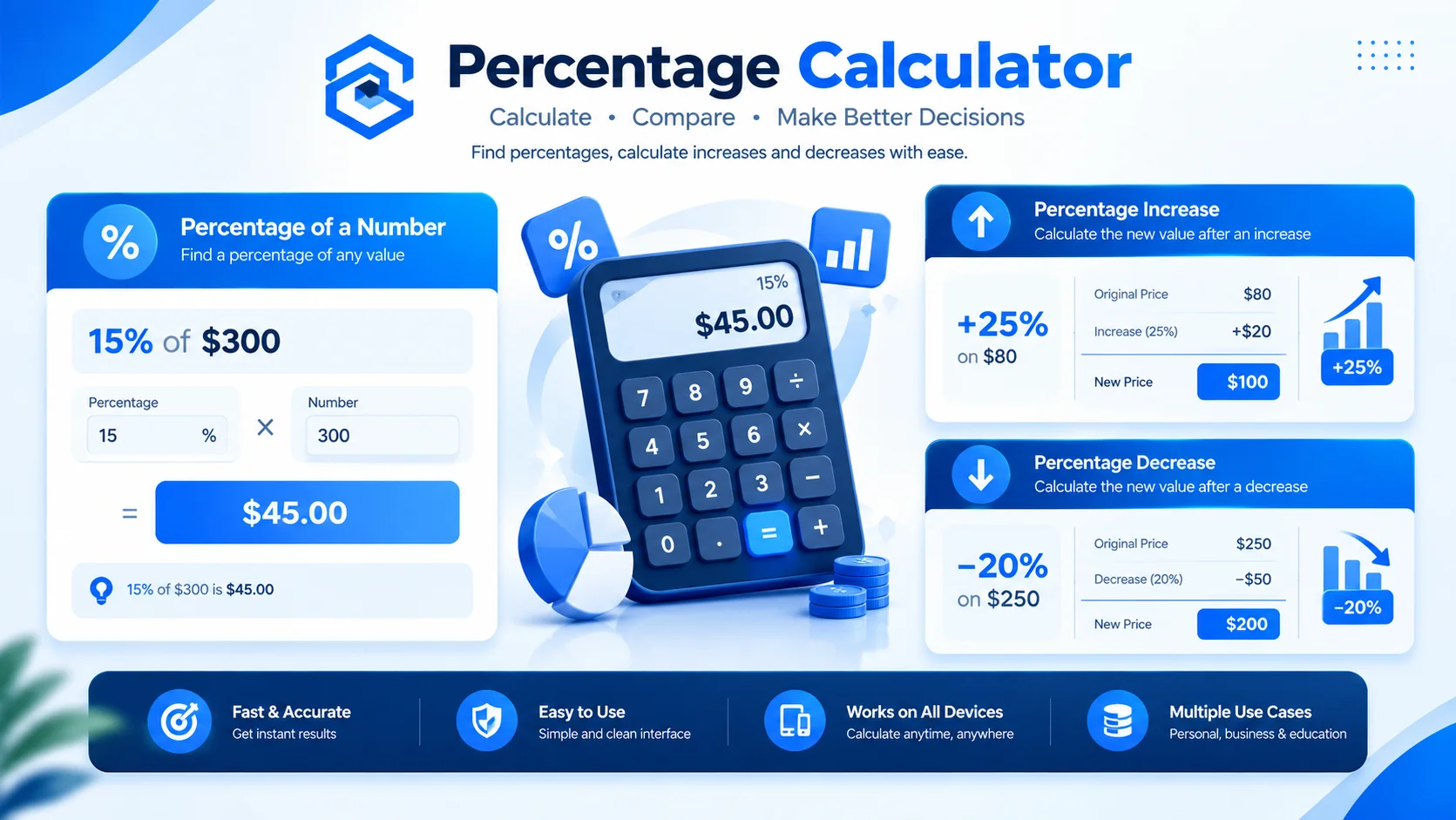
Suppose you want to calculate 15% of $300.
The calculation is
$300 × 15 ÷ 100 = $45
So, 15% of $300 is $45.
A percentage calculator can make this process much faster, particularly when the numbers become larger or the calculation involves several steps.
GST vs Discount vs Percentage Calculator
Although all three tools involve percentages, their purposes are different.
| Calculator | Main Purpose | Typical Use |
|---|---|---|
| GST Calculator | Calculate GST and total prices. | Tax and invoices |
| Discount Calculator | Calculate savings and sale prices. | Shopping and promotions |
| Percentage Calculator | Perform general percentage calculations. | Everyday math and comparisons |
The easiest way to choose the correct calculator is to identify the question you are trying to answer.
If your question involves tax, use a GST calculator.
If your question involves a sale or price reduction, use a discount calculator.
If your question involves a general percentage calculation, use a percentage calculator.
When Should You Use a GST Calculator?
A GST calculator is useful whenever you need to add or remove GST from a price.
For example, a business may receive an invoice showing a price before tax. The business needs to determine the GST amount and final cost.
Consider a service priced at $750 before GST with a 10% GST rate.
The GST is:
$750 × 10% = $75
The total becomes
$750 + $75 = $825
A GST calculator can provide these figures quickly.
You can also use a GST calculator when the displayed price already includes GST and you need to determine the underlying price before tax. This requires a different calculation from simply adding GST, which is one reason an online calculator can be helpful.
When Should You Use a Discount Calculator?
A discount calculator is most useful when you know the original price and discount percentage.
Imagine a laptop costs $1,000, and a retailer offers a 15% discount.
The discount is
$1,000 × 15% = $150
The sale price is
$1,000 − $150 = $850
Without a calculator, this is still relatively simple. However, shopping decisions can become more complicated when you compare several products with different prices and discount rates.
For example:
- Product A: $500 with 10% off
- Product B: $650 with 20% off
- Product C: $800 with 25% off
A discount calculator allows you to quickly determine the actual prices and savings.
This makes it easier to compare promotions based on their final prices rather than relying only on the advertised percentage.
When Should You Use a Percentage Calculator?
A percentage calculator is useful when the calculation does not specifically involve GST or a discount.
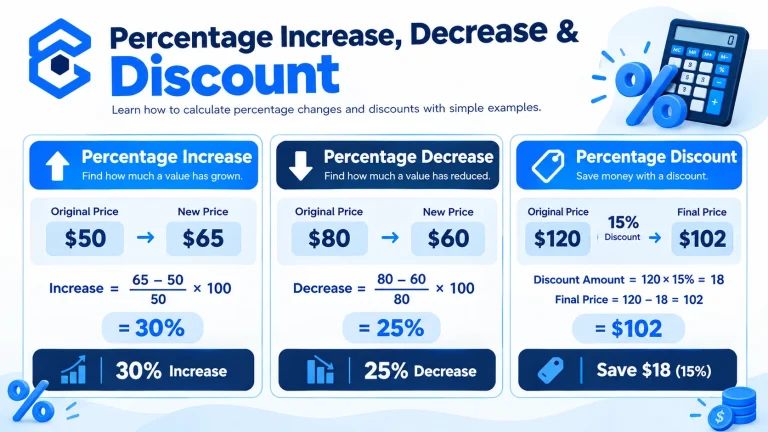
For example, suppose your monthly sales increased from $4,000 to $5,000.
The increase is
$5,000 − $4,000 = $1,000
To calculate the percentage increase:
($1,000 ÷ $4,000) × 100 = 25%
Your sales increased by 25%.
This type of calculation can be useful for business reports, budgeting, school assignments, financial comparisons, statistics, and everyday decisions.
Are GST, Discounts, and Percentages the Same Thing?
No.
Although GST and discounts are often expressed as percentages, they represent different concepts.
A percentage is a mathematical way of expressing a proportion out of 100.
A discount represents a reduction from an original price.
GST represents a tax applied according to the applicable tax rules.
For example, 10% can represent many different things.
You might calculate:
10% of $500 = $50
But if 10% represents a discount, you subtract $50 from the original price.
If 10% represents GST being added to a tax-exclusive price, you add $50 instead.
The percentage is the same, but the purpose of the calculation is different.
Can You Use a Percentage Calculator Instead of a Discount Calculator?
Technically, yes.
You can calculate a discount manually using a percentage calculator.
For example, to find a 20% discount on $250:
$250 × 20% = $50
Then:
$250 − $50 = $200
However, a dedicated discount calculator can be more convenient because it is designed specifically for this task.
It may display the original price, discount amount, discount percentage, and final price together.
That reduces the number of manual steps.
Can You Use a Percentage Calculator for GST?
You can calculate the GST amount using percentage mathematics, but a dedicated GST calculator is usually more convenient.
For example, if the GST rate is 10% and the price is $400:
$400 × 10% = $40
The total is
$400 + $40 = $440
The calculation is straightforward.
However, GST calculations can become more complicated when you are working backward from a GST-inclusive price. A dedicated GST calculator can handle the relevant calculation more directly.
Which Calculator Is Best for Shopping?
For shopping, a discount calculator is generally the most directly relevant tool.
Suppose you see a product listed for $250 with a 30% discount.
The discount amount is
$250 × 30% = $75
The final price is
$250 − $75 = $175
If the store offers several promotions, calculating each final price can help you compare the actual cost.
You can also use a percentage calculator when you want to understand the savings as a percentage or compare price changes between products.
Which Calculator Is Best for Business?
Businesses may use all three calculators depending on the task.
A business might use a GST calculator for:
- Invoices
- Tax calculations
- Product pricing
- Service charges
- GST-inclusive prices
A discount calculator can help with:
- Sales promotions
- Customer discounts
- Wholesale pricing
- Seasonal offers
- Clearance pricing
A percentage calculator can help with:
- Revenue changes
- Profit margins
- Growth rates
- Percentage increases
- Percentage decreases
- Business comparisons
Therefore, there is no single calculator that replaces all three.
Each tool addresses a different calculation.
Why Online Calculators Are Useful
Manual calculations are not always difficult, but they can become repetitive.
Online calculators provide a faster way to handle common mathematical problems.
They can also reduce mistakes caused by:
- Entering the wrong formula
- Forgetting to divide by 100
- Subtracting the wrong amount
- Confusing tax-inclusive and tax-exclusive prices
- Rounding numbers incorrectly
A good calculator should provide a clear result and make the calculation easy to understand.
For everyday calculations, speed and clarity can be just as important as the mathematics itself.
GST Calculator, Discount Calculator, or Percentage Calculator?
The answer depends on your calculation.
Choose a GST calculator when you need to calculate tax or determine a GST-inclusive or GST-exclusive amount.
Choose a discount calculator when you need to calculate a price reduction, savings, or sale price.
Choose a percentage calculator when you need to perform a broader percentage calculation.
For example:
Need to calculate tax?
Use a GST calculator.
Need to calculate a sale price?
Use a discount calculator.
Need to calculate percentage growth?
Use a percentage calculator.
Need to find a percentage of a number?
Use a percentage calculator.
Understanding this difference can save time and prevent calculation errors.
(FAQs) Frequently Asked Questions
What is the difference between a GST calculator and a discount calculator?
A GST calculator calculates tax added to or included in a price, while a discount calculator calculates a price reduction and the final sale price.
Can a percentage calculator calculate discounts?
Yes. A percentage calculator can determine the discount amount, but a dedicated discount calculator makes the process faster by calculating the savings and final price together.
Can I use a percentage calculator to calculate GST?
Yes. You can calculate the GST amount using the applicable GST rate and product price. A GST calculator is more convenient for tax-specific calculations.
Which calculator should I use to calculate a sale price?
Use a discount calculator when you know the original price and discount percentage and want to find the savings and final price.
What is a percentage calculator used for?
A percentage calculator can be used for percentage increases, decreases, percentages of numbers, and many other everyday percentage calculations.
Final Thoughts
GST calculators, discount calculators, and percentage calculators are all calculators that involve numbers but which solve different problems.
A GST calculator is designed to aid in tax calculations. A discount calculator is a mathematical instrument that is used to determine the amount that is being discounted or saved. A percentage calculator can process more types of percentage calculation.
When it comes to adding, subtracting, multiplying, or dividing everyday numbers, it’s a lot easier when you know what tool to use.
These calculators will make common calculations much faster if you’re comparing prices, calculating discounts, making tax calculations, or calculating percentages regularly.
You may use the appropriate calculator for speedy and accurate calculations rather than repeatedly performing calculations manually using formulas.
Use CalcuHive’s GST Calculator, Discount Calculator, and Percentage Calculator for easy calculations and fast results of common calculations.