Peptide Dosage Calculator: A Complete Guide for 2026
Peptides are getting plenty of attention in medical research, weight management, and fitness circles. But there’s a problem. Understanding a peptide’s label, strength, and measurement units can be confusing, especially when online advice conflicts with product instructions.
A peptide dosage calculator can help explain the math behind peptide concentration and measurement. However, calculating a number is not the same as knowing whether a medicine is safe, approved, or suitable for you. That distinction matters more than many websites admit.
In this guide, you’ll learn what a peptide calculator does, how milligrams differ from milliliters, why reconstitution requires care, and what to check before trusting an online tool. We’ll also discuss biosynth peptide calculator searches, retatrutide dosage calculator queries, and common calculation mistakes.
The goal is simple: help you understand the numbers without turning an online calculation into a substitute for professional medical advice.
Quick Answer
A peptide dosage calculator is an online tool that helps users understand peptide quantities, concentration, and related measurement units. Some tools also display mathematical conversions. However, a calculator cannot determine a safe dose or verify product quality. For prescription medicines, use the exact instructions from your prescriber and dispensing pharmacist.
Important medical note: This article provides general educational information, not an individual treatment plan. Never use a calculator to choose an injection dose, prepare an unapproved product, or change a prescribed treatment.
Table of Contents
What Is a Peptide Dosage Calculator?
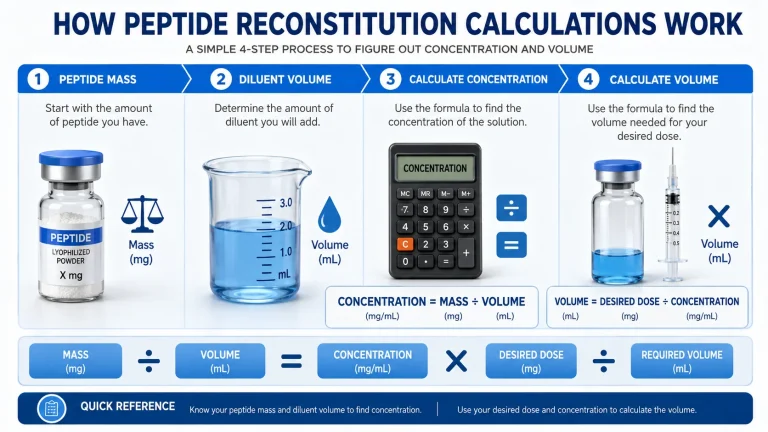
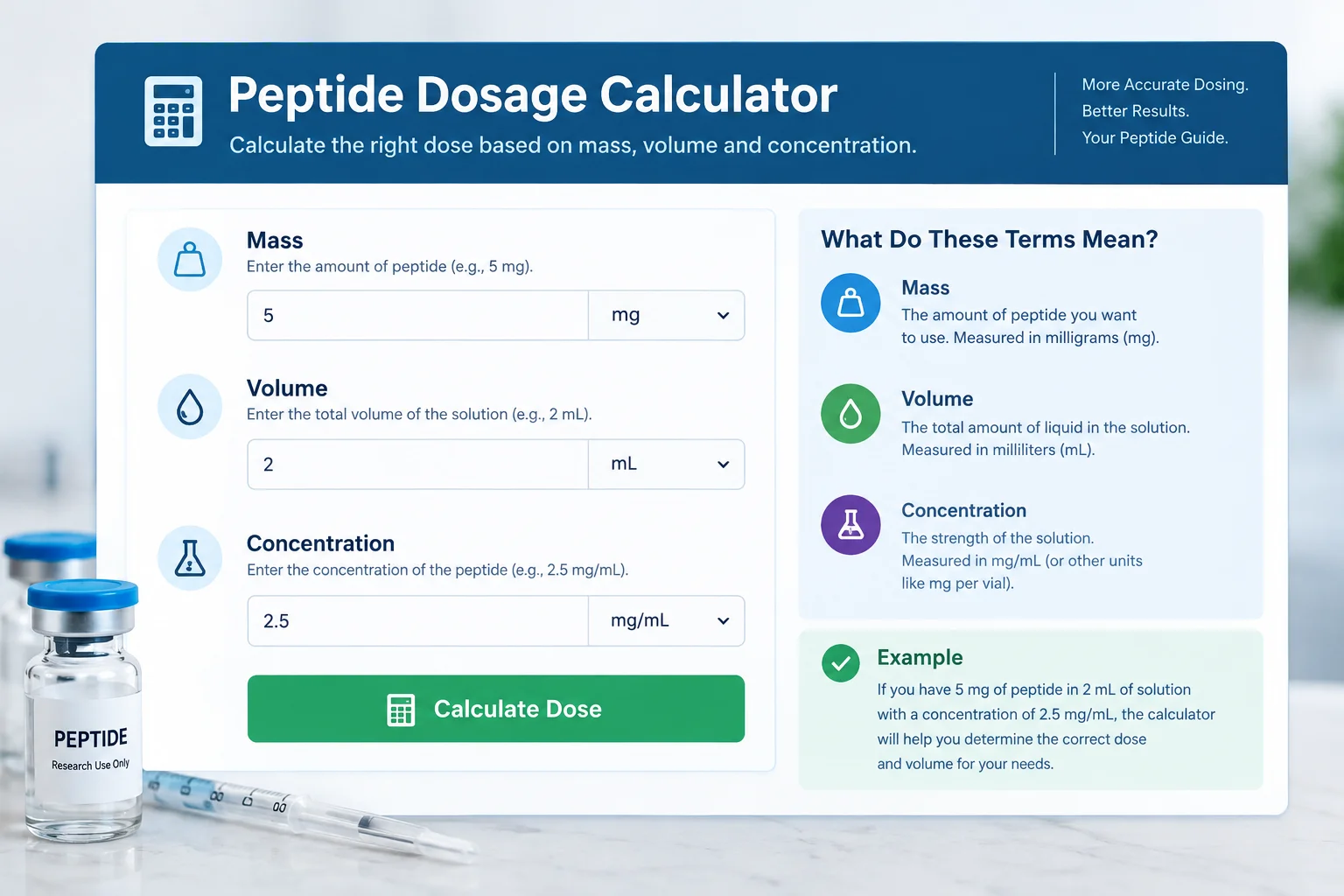
A peptide dosage calculator is a digital tool designed to simplify mathematical calculations involving peptide quantities and concentrations. Depending on its features, it may help explain the difference between a product’s stated mass, its liquid volume, and its concentration.
Peptides are short chains of amino acids. Some occur naturally in the body, while others are developed for research or medical use. Certain peptide-based medicines have approved medical uses, but that does not mean every product marketed online has been tested or approved.
A calculator works with the information entered by its user. It does not independently test a product, confirm its ingredients, or establish whether a treatment is appropriate.
What Can a Peptide Calculator Help You Understand?
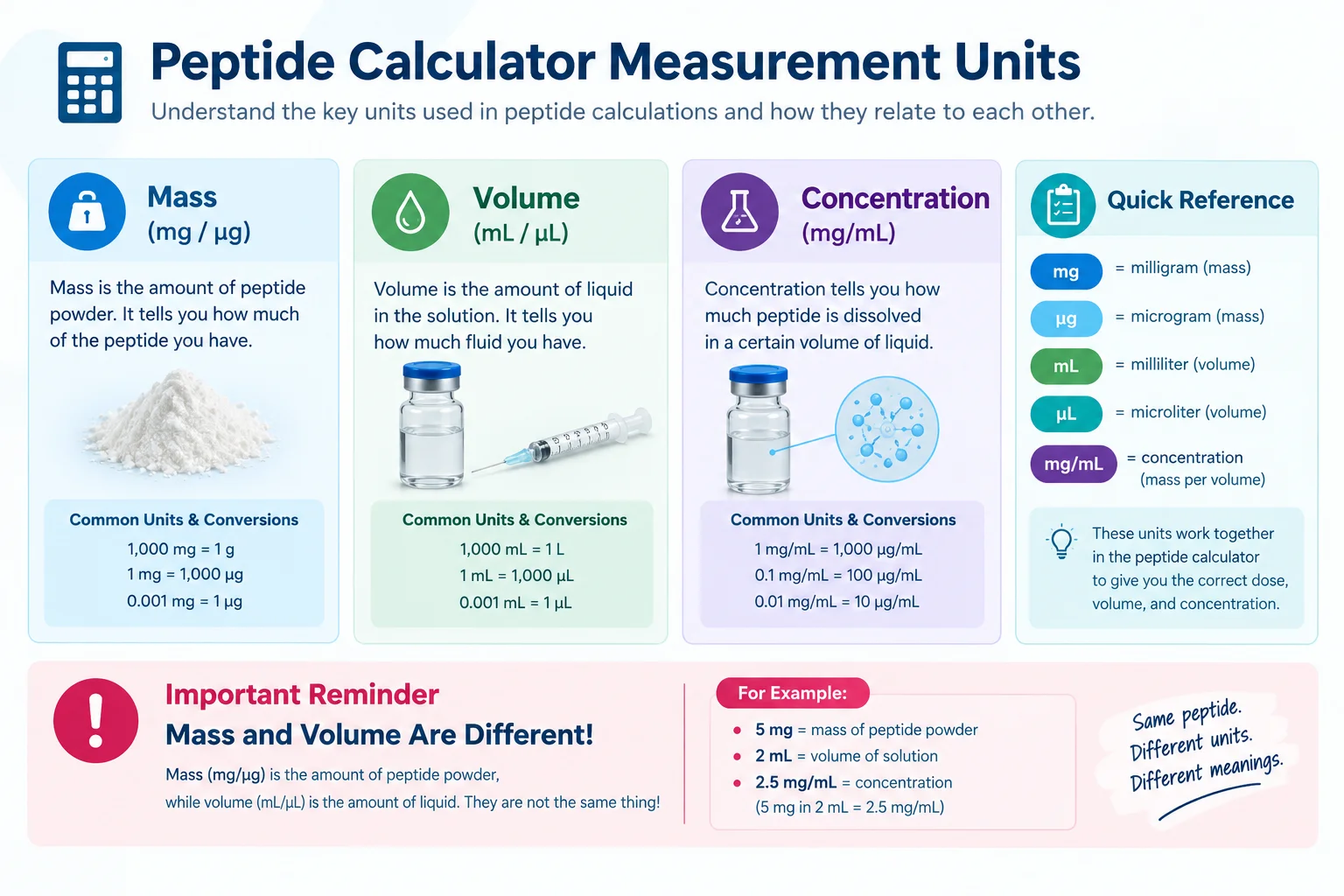
Depending on the tool, it may help you explore:
- Mass: The quantity of a substance, commonly expressed in milligrams (mg) or micrograms (mcg).
- Volume: The amount of liquid, commonly expressed in milliliters (mL).
- Concentration: The amount of a substance contained in a stated volume.
- Unit conversions: Mathematical relationships between measurement units.
- Calculation checks: Whether entered numbers and displayed results are mathematically consistent.
For example, a classroom exercise might describe a harmless solution containing 10 grams of sugar in 2 liters of water. Its concentration is 5 grams per liter. That is a basic mathematical relationship, not a medicine preparation instruction.
What Can It Not Tell You?
A calculator cannot determine the correct treatment for your body. It cannot establish a safe starting dose, recommend a dose increase, predict side effects, or confirm that an online product contains what its label claims.
Key takeaway
- A calculator handles numbers, not medical decisions.
- Product identity and concentration must come from reliable documentation.
- A mathematically correct answer can still be unsafe to use.
Direct answer: A peptide dosage calculator helps with calculations, but it cannot establish a safe or appropriate medical dose.
How Do Peptide Calculations and Measurement Units Work?
Peptide calculations often involve three separate ideas: mass, volume, and concentration. Mixing them up can lead to serious errors, particularly when people interpret instructions for injectable medicines.
The U.S. Food and Drug Administration (FDA) has documented dosing errors involving compounded injectable semaglutide. Some reports involved confusion between milligrams, milliliters, and syringe units. The agency also reported cases in which calculation errors led to substantially larger doses than intended.
This illustrates a basic lesson: knowing the mathematics is useful, but understanding the exact product instructions is essential.
What Is the Difference Between mg, mcg, mL, and Units?
| Measurement | What it describes | Important distinction |
|---|---|---|
| Milligram (mg) | Mass | Measures the quantity of a substance |
| Microgram (mcg) | Mass | One milligram equals 1,000 micrograms |
| Milliliter (mL) | Liquid volume | Does not tell you how much active substance is present |
| Concentration | Mass per volume | Depends on the substance quantity and stated liquid volume |
| Syringe units | A calibrated syringe scale | Do not automatically represent milligrams or a universal volume |
A common source of confusion is assuming that a milliliter and a milligram mean the same thing. They do not. One describes volume, while the other describes mass.
Syringe markings introduce another layer of complexity. Their meaning depends on the syringe design and scale. Never assume that a particular number of syringe units equals a particular quantity of peptide.
How Does Concentration Relate to Mass and Volume?
In basic mathematics, concentration describes how much material exists within a given volume.
For a general educational example, imagine a sealed laboratory sample whose documentation states that it contains 12 grams of a substance in 3 liters of solution. The concentration is 4 grams per liter.
That calculation describes the sample’s concentration. It does not establish how much anyone should consume, inject, or otherwise use.
For medicines, the correct interpretation depends on the approved product information, the actual formulation, and the directions provided by the treating professional. Different products can have different concentrations, even when their labels look similar.
Key takeaway
- Mass, volume, and concentration describe different things.
- Syringe markings are not interchangeable with milligrams.
- Use verified product information rather than assumptions or online comments.
Direct answer: Correct peptide calculations depend on understanding the units and confirming the actual product concentration.
How Does a Peptide Reconstitution Calculator Work?
A peptide reconstitution calculator is designed to address questions about the relationship between a substance and a liquid used to prepare a solution. The term appears frequently in searches for peptide calculator tools, but the word reconstitution deserves careful attention.
Reconstitution is not simply a math exercise. For medicines, it can involve sterility, compatibility, storage conditions, stability, and product-specific instructions. An arithmetic result alone cannot resolve those issues.
Some products are supplied as ready-to-use liquids, while others require preparation by a qualified professional. The correct process depends on the exact medicine and its approved or professionally supplied instructions.
Why Does Reconstitution Require Caution?
Several factors can affect whether a preparation is appropriate:
- The identity and strength of the supplied product.
- The type and amount of diluent specified in the official instructions.
- Whether the ingredients are compatible.
- Sterile handling and contamination risks.
- Storage requirements and the permitted period of use after preparation.
These details cannot be safely guessed from a product name or a social media tutorial.
The FDA explains that compounded drugs are not FDA-approved and do not undergo the same premarket review for safety, effectiveness, and quality as approved medicines. Poor-quality or contaminated products can cause serious harm.
That does not mean every compounded medicine is inappropriate. Compounding can serve legitimate medical needs. It does mean that patients should obtain products through appropriate professional channels and follow product-specific guidance.
What Should You Check Before Trusting a Calculator?
Before relying on a peptide-related tool, check whether it explains its limitations and clearly identifies the measurements it accepts.
Look for transparent formulas, clearly labeled units, and warnings against using the output to choose a treatment. Avoid tools that promise guaranteed results or recommend treatment amounts without knowing a person’s medical history.
If you have a prescribed medicine that requires preparation, ask your pharmacist to confirm the instructions for that exact product. Do not rely on a generic calculator to replace those directions.
Key takeaway
- Reconstitution involves more than calculating concentration.
- Compatibility, sterility, storage, and product identity matter.
- A qualified pharmacist should clarify any uncertainty about preparing a medicine.
Direct answer: A peptide reconstitution calculator can explain mathematical relationships, but it cannot confirm that a preparation method is safe.
Is a Retatrutide Dosage Calculator Safe to Use?
A “retatrutide dosage calculator” is a search term used by people looking for information about the investigational medicine retatrutide. However, finding a calculator online does not mean that a validated, approved dosing schedule exists for general public use.
Retatrutide is an investigational medicine being studied for its potential effects on metabolic health and body weight. Investigational treatments require careful evaluation through clinical research. Their safety, effectiveness, and appropriate use cannot be established by an online calculator.
Regulatory status can change, so readers should check current information from the relevant medicines regulator and clinical-trial sources rather than relying on a seller’s claims.
Why Should You Avoid Unverified Retatrutide Dosing Charts?
An online chart may appear precise without being medically reliable. It might omit important details about the product, the research setting, eligibility criteria, or the limits of available evidence.
A calculator cannot determine whether a product sold under the name retatrutide is authentic, sterile, correctly formulated, or suitable for a particular person.
Be especially cautious of websites that combine product sales with dosing advice or encourage people to adjust their own treatment. Marketing language is not evidence of approval, safety, or clinical benefit.
If you are considering an investigational treatment, discuss the evidence and available options with a qualified clinician. In the United States, official FDA information and ClinicalTrials.gov are useful starting points for checking regulatory information and registered studies.
Key takeaway
- Retatrutide-related search results are not proof of an approved dosing schedule.
- Never treat an online chart as a personal prescription.
- Confirm current research and regulatory information through reliable sources.
Direct answer: A retatrutide dosage calculator cannot establish a safe dose or replace professional guidance about an investigational medicine.
What Should You Know About Biosynth Peptide Calculators and Other Tools?
People searching for a biosynth peptide calculator may be looking for help with peptide-related calculations, laboratory work, or product information. The exact purpose depends on the tool they have found.
Before using any branded calculator, confirm its publisher, intended audience, and documented features. A tool designed for laboratory research may not be suitable for interpreting a prescription medicine. Similarly, a generic peptide calculator dosage page may not support the formulation or units shown on your product label.
How Can You Evaluate a Peptide Calculator?
Use this checklist when reviewing an online tool:
- Identify the publisher. Check whether the tool comes from a recognized scientific organization, healthcare provider, or other clearly identified source.
- Read the intended-use statement. Confirm whether it is for education, laboratory research, or clinical support.
- Check the units. Make sure the displayed measurements and definitions are clear.
- Look for documented methods. Reliable tools explain their assumptions and calculation limits.
- Review safety warnings. A tool should not pretend to diagnose conditions or prescribe treatment.
- Confirm important results independently. Ask a qualified professional to verify any calculation that affects medicine use.
Be wary of tools that request unnecessary personal information or present sales recommendations as medical advice.
What About Peptide Calculator mg Searches?
The phrase peptide calculator mg usually reflects a desire to understand quantities expressed in milligrams. However, knowing a product’s mass does not automatically reveal its concentration or establish a suitable treatment amount.
For example, two containers may each list the same total mass while having different formulations or preparation requirements. The number alone does not tell you whether the products are equivalent.
Key takeaway
- Check a tool’s publisher, intended use, and limitations.
- A brand name does not guarantee clinical validation.
- Milligrams describe mass, not a universal dosing instruction.
Direct answer: Choose peptide calculation tools for transparent, clearly defined mathematical tasks, and leave treatment decisions to qualified healthcare professionals.
What Are the Most Common Peptide Calculation Mistakes?
Many calculation mistakes begin with a simple assumption: if the numbers look right, the result must be right. Unfortunately, the arithmetic may be correct even when the information entered is wrong.
The FDA’s alerts about compounded injectable medicines show why this matters. Confusion about measurement units and differences in product concentration have contributed to serious dosing errors, including cases requiring hospital care.
Common Mistakes to Avoid
Confusing mass with volume. Milligrams and milliliters describe different properties. A number expressed in one unit cannot be substituted directly for the other.
Assuming all products have the same concentration. Similar names or packaging do not guarantee identical formulations.
Treating syringe units as a universal measurement. Syringe scales vary, and their markings must be interpreted using the appropriate instructions.
Trusting unverified product labels. A calculator cannot confirm that a product contains the stated ingredient or strength.
Copying instructions from online forums. Another person’s instructions may refer to a different product, formulation, or medical situation.
Ignoring storage and preparation requirements. A mathematically correct calculation cannot make a contaminated, degraded, or improperly prepared product safe.
What Should You Do If a Result Looks Wrong?
Stop before using the result. Check the original documentation and contact the dispensing pharmacist or prescribing clinician.
Do not repeatedly change the entered numbers until the calculator produces an answer that looks plausible. If you have already taken or injected an incorrect amount, seek prompt medical advice. Contact emergency services if severe symptoms develop.
Key takeaway
- Verify the source data before interpreting any result.
- Never guess when product instructions and calculator outputs disagree.
- Seek professional help if an incorrect amount may have been used.
Direct answer: The safest way to prevent calculation errors is to verify the product, units, and instructions with a qualified professional.
How Can You Use Peptide Information Responsibly?
Responsible use begins with separating general education from medical advice. You can learn about peptide chemistry, measurement units, clinical research, and the limits of online tools without choosing a dose or preparing an injectable product yourself.
If a peptide is prescribed to you, use the exact instructions supplied for that medicine. Ask your pharmacist to explain anything unclear, including the product strength, measurement markings, storage conditions, and what to do if you make a mistake.
If a product is marketed as a research chemical or for laboratory use only, do not assume it is suitable for human use. Claims made by sellers, influencers, or anonymous forum users are not a substitute for clinical evidence.
A Practical Safety Checklist
Before acting on peptide-related information, ask yourself:
- Do I know the exact identity and source of the product?
- Is its regulatory status clear in my country?
- Have I confirmed the instructions with a qualified professional?
- Do I understand the units without guessing?
- Am I relying on reliable medical evidence rather than sales claims?
- Do I know whom to contact if something goes wrong?
If you cannot answer these questions confidently, pause and seek clarification.
Where Can You Find Reliable Information?
Start with official regulatory information and peer-reviewed research. In the United States, the FDA publishes safety alerts and information about compounded medicines. ClinicalTrials.gov provides information about registered clinical studies. PubMed helps readers locate biomedical research and reviews.
These sources serve different purposes. A clinical-trial listing does not prove that a treatment is approved, and a published study does not automatically establish that a product sold online is safe.
Key takeaway
- Learn the science without treating a calculator as a prescriber.
- Verify product-specific instructions through qualified healthcare professionals.
- Use regulatory sources and scientific literature to check claims.
Direct answer: Responsible peptide research combines clear calculations, trustworthy evidence, and professional medical guidance.
Frequently Asked Questions About Peptide Dosage Calculators
How does a peptide reconstitution calculator work?
A peptide reconstitution calculator uses entered information to illustrate mathematical relationships between a substance and a solution. However, the calculation cannot verify product identity, sterility, compatibility, or stability. Preparation of a medicine must follow the exact product instructions and guidance from an appropriate healthcare professional.
Is there a reliable retatrutide dosage calculator?
An online calculator cannot establish an approved or safe retatrutide dose. As of October 2026, the FDA states that retatrutide is not a component of an FDA-approved drug and cannot be used in compounding under federal law. Check current information from the FDA and ClinicalTrials.gov, and do not use online dosing charts to self-administer investigational products.
What is a peptide dosage calculator used for?
A peptide dosage calculator helps explain mathematical relationships involving quantities, concentrations, and measurement units. Its features vary by publisher. It cannot determine whether a peptide is safe for you or select a suitable medical dose. For prescribed medicines, follow your clinician’s instructions and ask your pharmacist to verify any unclear measurements.
What does peptide calculator mg mean?
The phrase usually refers to calculating or understanding peptide quantities expressed in milligrams. A milligram measures mass, whereas a milliliter measures volume. Concentration describes the relationship between the amount of a substance and a given volume. These measurements are related, but they are not interchangeable.
Can a peptide calculator tell me how much to inject?
No. A calculator cannot determine an appropriate injection dose, verify a product’s quality, or account for your medical history. If you have a prescription, ask your pharmacist to confirm the exact product instructions and measurement method. Never guess or change a prescribed dose based on an online result.
Conclusion: Use Peptide Calculators With Care
Peptide calculators can make scientific measurements easier to understand. They can help explain mass, volume, concentration, and the mathematics behind laboratory calculations. But numbers are only one part of the picture.
Product quality, regulatory status, preparation requirements, and medical suitability all matter. That is particularly important when researching injectable peptides or investigational medicines such as retatrutide.
Before relying on a result, check the calculator’s purpose, verify the source information, and consult a qualified healthcare professional about medicine-related questions. An online tool should support understanding, not replace sound medical judgment.
Bottom line: A peptide dosage calculator is a mathematical aid, not a prescription or a safety guarantee. Use reliable sources, confirm product-specific instructions, and avoid unverified dosing charts. If a calculation affects an actual medicine, ask your pharmacist or prescriber to check it before taking action.
Have a question about peptide measurement units or how concentration differs from volume? Share your question in the comments so other readers can learn from it, too.