Peptide Sciences Research: Peptides, Safety & Verification
Peptide Sciences is a name associated with the research-peptide market, where peptides and related compounds are supplied for laboratory and scientific investigation. If you are researching Peptide Sciences, the most useful things to understand are what research peptides are, how product identity and purity can be evaluated, and why “research use only” does not mean a product is approved for human use.
Table of Contents
What Is Peptide Sciences?
Peptide Sciences is a name used in connection with suppliers and information platforms serving the research-peptide industry. Current online information associated with the brand describes research peptides, proteins, peptide blends, and related compounds intended for scientific and educational purposes.
The current situation is worth understanding before relying on information found through search engines. A Peptide Sciences site currently states that its public retail storefront operations have been discontinued and that the platform is focused on product verification, official product information, brand protection, and communication with verified partners.
That makes verification especially important when researching the name online. Multiple websites currently use similar Peptide Sciences branding, so readers should not automatically assume that every website appearing in search results is affiliated with the same organization.
What Are Research Peptides?
Peptides are short chains of amino acids. In scientific research, they can be investigated because their structures can interact with biological pathways, receptors, enzymes, or other molecular targets.
Research peptides can be studied in areas such as
- Molecular biology
- Biochemistry
- Cell signaling
- Protein research
- Receptor studies
- Metabolic research
- Drug-development research
- Laboratory assay development
However, a peptide being studied by researchers does not automatically mean it is an approved medicine.
This distinction is particularly important for compounds that appear frequently in online discussions about weight management, muscle growth, recovery, longevity, or other health-related topics.
Research compounds are not automatically medicines.
A research chemical may have scientific interest without having sufficient evidence for routine medical use.
The U.S. Food and Drug Administration has specifically warned that products marketed as “research use only” can still present regulatory and safety concerns when they are actually promoted for human use.
For that reason, research information should not be interpreted as a recommendation for personal treatment.
How Peptide Quality Is Evaluated
One of the most useful concepts when researching peptide suppliers is analytical verification.
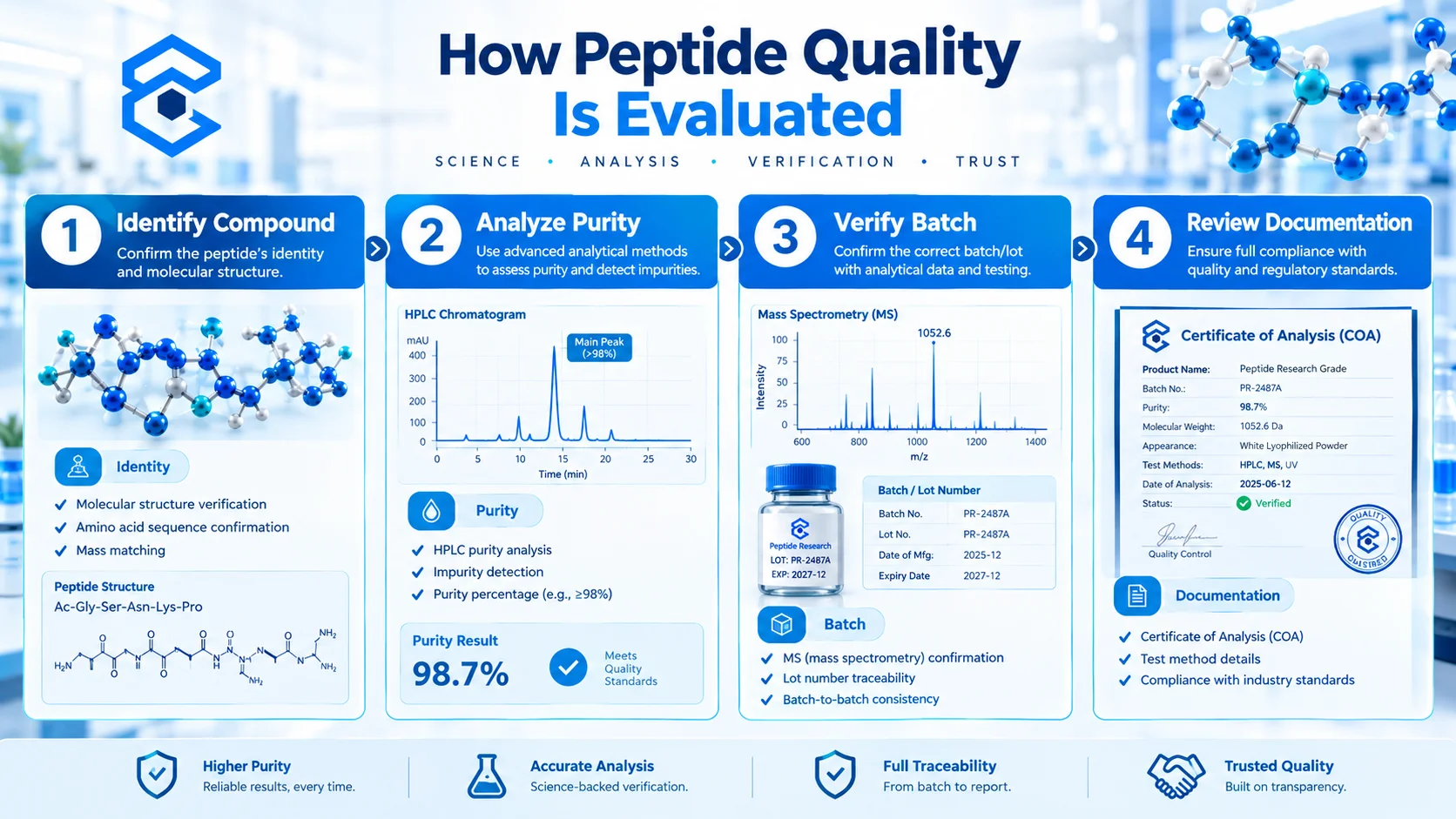
A reputable research workflow may involve testing designed to establish whether the material matches its expected identity and whether the sample meets a stated purity specification.
Two analytical techniques frequently discussed in peptide quality control are
| Test | What it can help evaluate |
|---|---|
| HPLC | Separation and assessment of chemical purity |
| Mass spectrometry | Molecular mass and identity information |
| Certificate of Analysis | Documentation of reported batch testing |
| Batch number | Helps connect a product to specific testing documentation |
The exact testing package can vary between products and laboratories. A claim such as “99% purity” should therefore be treated as a claim that needs supporting documentation rather than as proof of clinical safety.
Why purity is not the same as safety
This is an important distinction that is often missed.
A highly pure compound can still be unsuitable for human use. Purity testing primarily addresses characteristics of the material being tested; it does not automatically establish clinical efficacy, appropriate dosage, long-term safety, or regulatory approval.
The FDA has highlighted safety concerns involving several investigational or compounded peptide substances, including issues involving peptide-related impurities, aggregation, and limited human safety information.
What Is a Certificate of Analysis?
A Certificate of Analysis (COA) is a document associated with a particular batch or lot of a product. Depending on the supplier and testing laboratory, it may include information such as
- Product or compound name
- Batch or lot number
- Reported purity
- Testing method
- Test date
- Molecular-weight information
- Laboratory identification
- Analytical results
A COA is useful because it gives researchers documentation to examine rather than relying solely on a product-page description.
However, a COA should not be treated as a universal guarantee of medical safety.
What should you check on a COA?
When evaluating a laboratory document, compare the information on the certificate with the actual product information.
Look for:
- Matching compound name
- Matching batch or lot number
- Testing date
- Clearly identified analytical methods
- Reported purity or assay results
- Laboratory or testing-provider information
- Consistent product labeling
A mismatch between a product label and its documentation is a reason to stop and investigate rather than assume that everything is correct.
Why Peptide Verification Matters
The popularity of peptides has created a large amount of information online, but not every website using peptide-related terminology is equally reliable.
This is particularly relevant to searches for Peptide Sciences, because current search results contain multiple domains making similar claims about the brand.
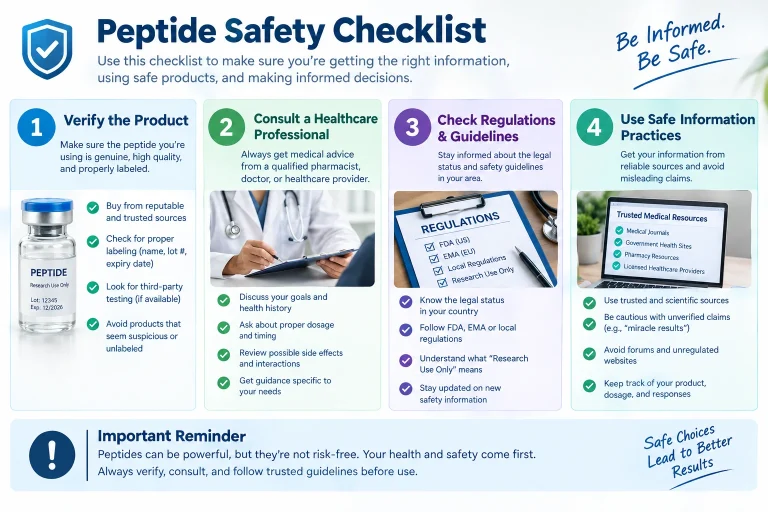
A practical verification checklist
Before trusting information found online, consider:
- Is the website clearly identifying the organization behind it?
- Does it provide a consistent company identity?
- Are product claims supported by analytical documentation?
- Can batch information be independently checked?
- Does the website clearly distinguish research from medical use?
- Does the information contain unrealistic health or performance claims?
- Is the website attempting to imitate another established brand?
Research Use Only vs Human Use
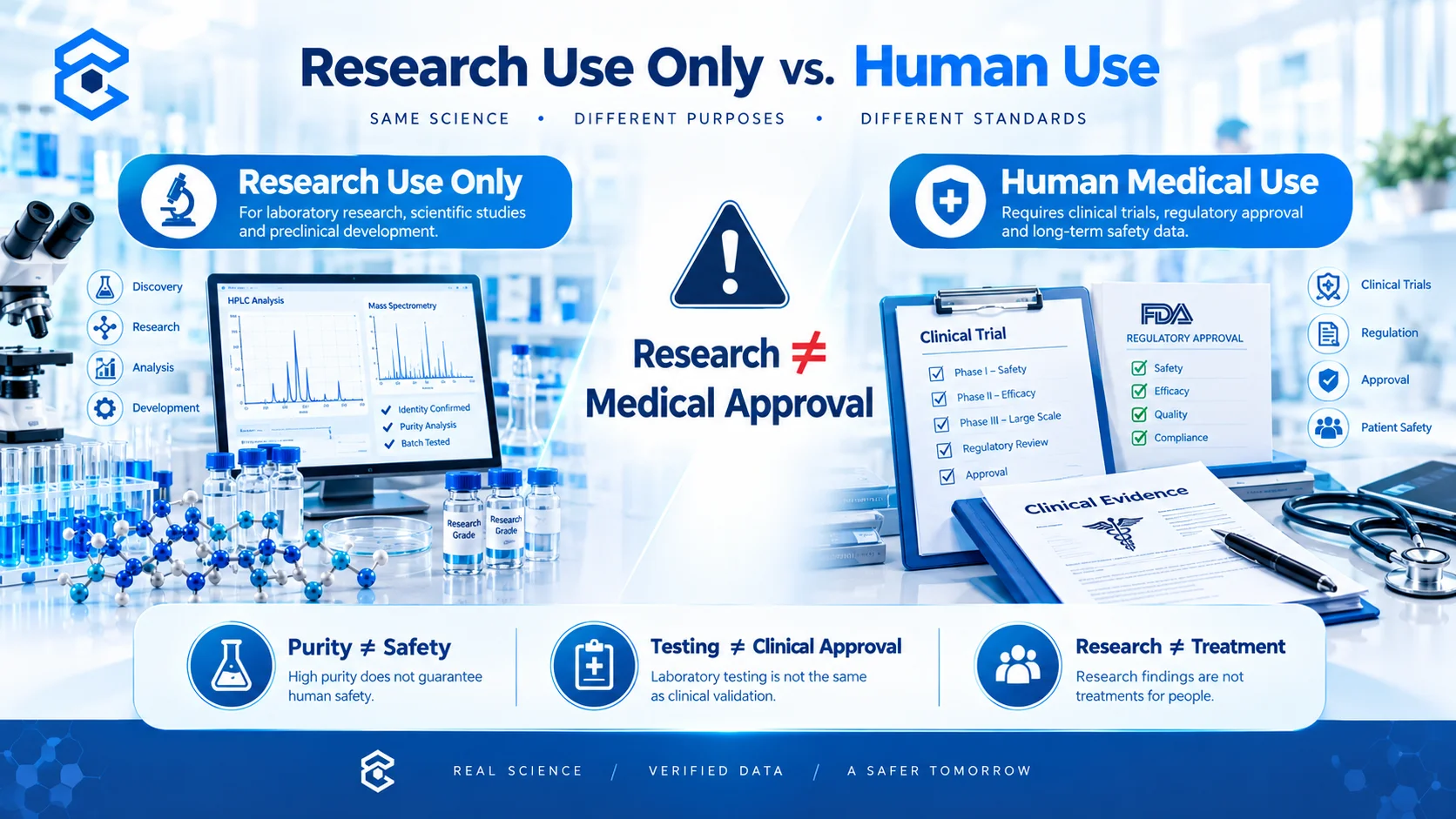
The phrase “research use only” is one of the most important terms to understand when reading peptide websites.
It generally indicates that a product is being presented for laboratory or scientific research rather than as an approved medicine for people.
It does not mean:
- The compound is proven safe for humans.
- The compound is clinically effective.
- The product has been approved as a medicine.
- The stated purity guarantees therapeutic quality.
- A consumer can safely administer the material.
FDA enforcement actions demonstrate why this distinction matters. The agency has taken action against peptide sellers where products labeled for research purposes were nevertheless marketed in ways that indicated intended human use.
For readers in the United States, this is particularly relevant when evaluating online peptide claims.
How to Evaluate a Peptide Supplier
If your interest is scientific research rather than personal treatment, use a structured evaluation process.
Step 1: Identify the exact compound.
Do not rely solely on a nickname or abbreviated product name. Determine the complete compound identity and, where relevant, its sequence or chemical form.
Step 2: Check the documentation.
Look for batch-specific analytical information rather than relying only on general statements about company-wide purity.
Step 3: Examine the testing methods.
HPLC and mass spectrometry are commonly used analytical techniques, but the presence of a test name alone does not prove that every quality characteristic has been established.
Step 4: Separate research claims from medical claims
A supplier describing a compound as being investigated in a particular biological pathway is very different from claiming that it treats a disease.
Step 5: Check regulatory status
If a compound is being considered for human treatment, the relevant question is no longer simply whether it is a “research peptide.” Medical use involves a much higher standard of evidence, regulation, and clinical oversight.
Peptide Calculations and Why Units Matter
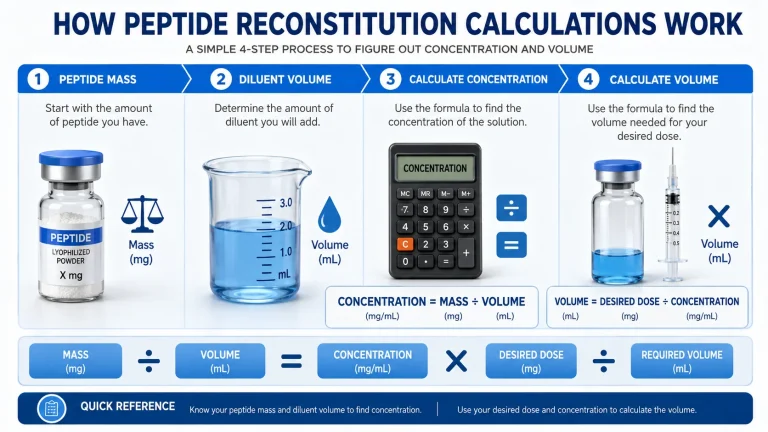
Peptide research can involve measurements such as micrograms, milligrams, molecular weight, concentration, and molar quantities.
Those units should never be treated as interchangeable.
For example:
1 milligram (mg) = 1,000 micrograms (mcg)
This simple conversion is useful when reading scientific documentation, but it should not be interpreted as a dosing recommendation.
If your CalcuHive website has a relevant conversion or calculation tool, this is a natural place for an internal link.
Internal linking cue: Add a link using anchor text such as “unit conversion calculator” where you explain the relationship between mg and mcg.
You could also link readers from this article to your Percentage Calculator when discussing percentages in laboratory reports.
Internal linking cue: Use anchor text such as “percentage calculator” in a short section explaining how percentages are commonly presented in analytical results.
A third useful internal link could point to your Peptide Calculator, provided that page is clearly framed around appropriate research calculations and does not provide instructions for unsafe or unauthorized human administration.
Peptide Sciences and Online Information: What Readers Should Watch For
The peptide market changes quickly, and websites can change domains, ownership, catalogs, and operating models.
That means an old article or forum discussion may no longer accurately describe the current status of a company or website.
For example, current Peptide Sciences-related websites provide different descriptions of their operations, while one current platform explicitly says its public retail storefront has been discontinued.
This creates an important SEO and research lesson: do not treat the first search result as automatically authoritative.
Instead, compare current information, look for official statements, and verify whether a website is actually connected to the organization it claims to represent.
A Safer Way to Research Peptides
For beginners, the most useful approach is to separate three questions:
1. What is the compound?
Understand its molecular identity and what researchers are investigating.
2. What evidence exists?
Look for peer-reviewed research, human clinical evidence where applicable, regulatory information, and credible scientific sources.
3. What is the regulatory status?
Determine whether the substance is an approved medical product, an investigational compound, a research material, or something else.
These questions are more useful than simply asking whether a product is “high quality.”
A product can have analytical documentation and still lack sufficient evidence for medical use.
(FAQs) Frequently Asked Questions
What is Peptide Sciences?
Peptide Sciences is a name associated with the research-peptide industry and scientific research materials. Current information associated with the brand describes research-focused peptides and related compounds, while its current platform states that public retail storefront operations have been discontinued.
Are Peptide Sciences products approved for human use?
Research-use products should not be assumed to be approved medicines. “Research use only” labeling does not establish human safety or clinical approval, and FDA enforcement actions have specifically addressed peptide products marketed in ways suggesting human use.
What is a peptide COA?
A Certificate of Analysis, or COA, is documentation that reports testing information for a product or batch. It may contain details such as purity, analytical methods, batch identification, and test results.
Is peptide purity the same as peptide safety?
No. Purity and safety are different concepts. Analytical purity can provide information about the material tested, but it does not automatically establish clinical safety, effectiveness, or regulatory approval.
Why should I verify a peptide supplier?
Verification matters because multiple websites can appear in search results with similar names, branding, or product claims. Checking the organization’s identity, current official information, and batch documentation can reduce the risk of relying on inaccurate or misleading information.
Can a calculator determine whether a peptide is safe?
No. A calculator can perform mathematical operations, but it cannot establish whether a compound is authentic, sterile, clinically effective, medically appropriate, or legally approved. Those questions require appropriate scientific, medical, and regulatory evaluation.