How to Calculate Percentage of Marks: Easy Calculator & Paper Methods
Calculating percentages is really useful for students and teachers and parents and shoppers and anyone who uses numbers. Whether you want to check your exam result, calculate a discount, find a percentage increase, or simply understand how to calculate percentage of marks, the basic method is surprisingly simple.
You do not need to be a math expert. All you need is a calculator and you can work out percentages in just a few seconds. If you do not have a calculator you can still do it on paper.
The way to calculate percentages is with this formula:
Percentage = (Marks You Got ÷ Total Marks) × 100
For example let us say you got 420 marks out of 500 marks:
(420 ÷ 500) × 100 = 84%
You can use this formula to calculate percentages for individual tests or for your whole exam result or for lots of other things that use percentages. Calculating percentages is the same, for all these things.
What Is a Percentage?
A percentage means a number expressed out of 100. The word “percent” literally refers to “per hundred.”
For example:
50% means 50 out of 100
75% means 75 out of 100
90% means 90 out of 100
100% means the complete amount
When you receive exam marks, your raw score does not always immediately tell you how well you performed. For example, 72 marks could mean 72% if the exam was out of 100, but it would mean 90% if the exam was out of 80.
That is why the total marks are important when calculating a percentage.
How to Calculate Percentage of Marks
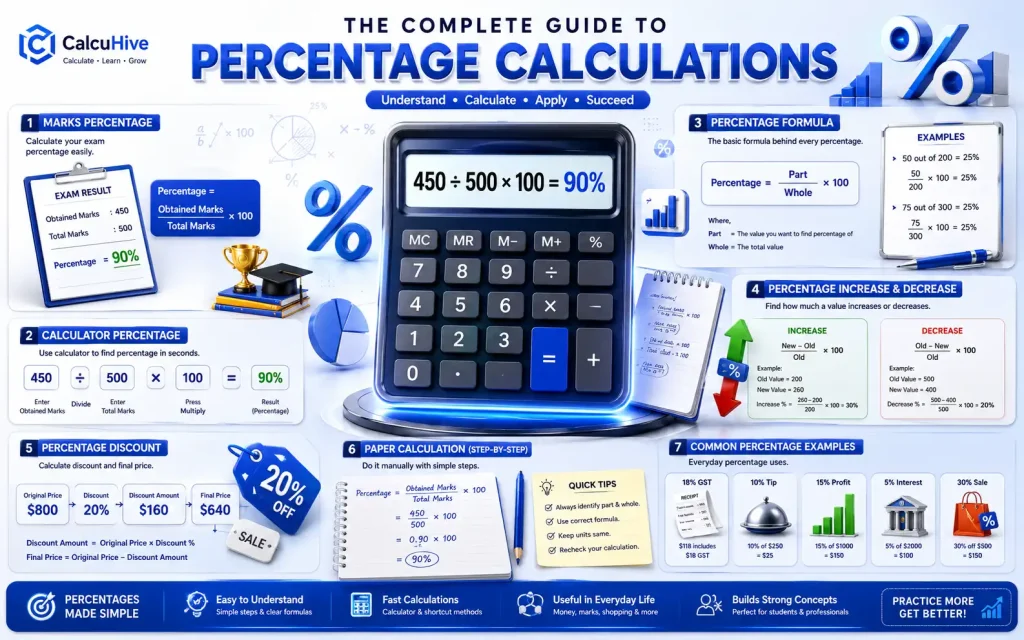
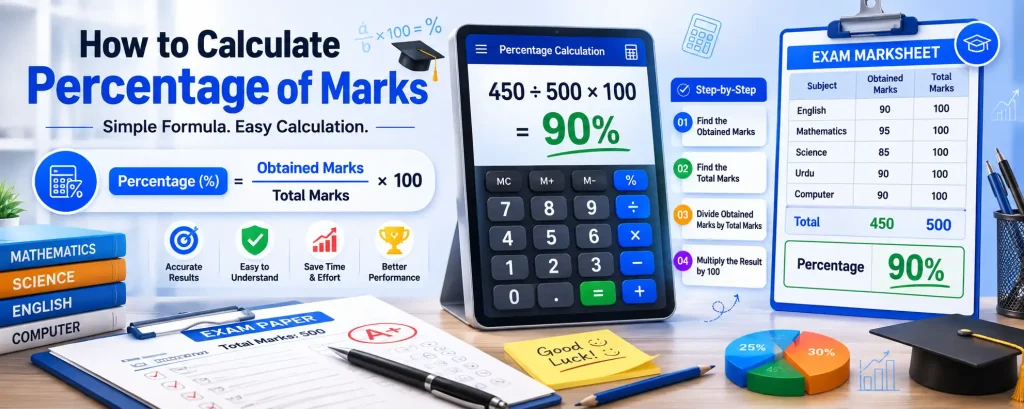
The easiest way to understand how to calculate percentage of marks is to use the standard formula:
Percentage = (Marks Obtained ÷ Total Marks) × 100
There are three simple steps.
Step 1: Find your obtained marks
First, identify how many marks you scored.
For example:
Marks obtained = 450
Step 2: Find the total marks
Next, identify the maximum marks available.
Total marks = 500
Step 3: Apply the formula
Now divide your obtained marks by the total marks and multiply by 100:
(450 ÷ 500) × 100 = 90%
Therefore, the student’s percentage is 90%.
This method can be used for school exams, college examinations, university tests, assignments, quizzes, and many other situations.
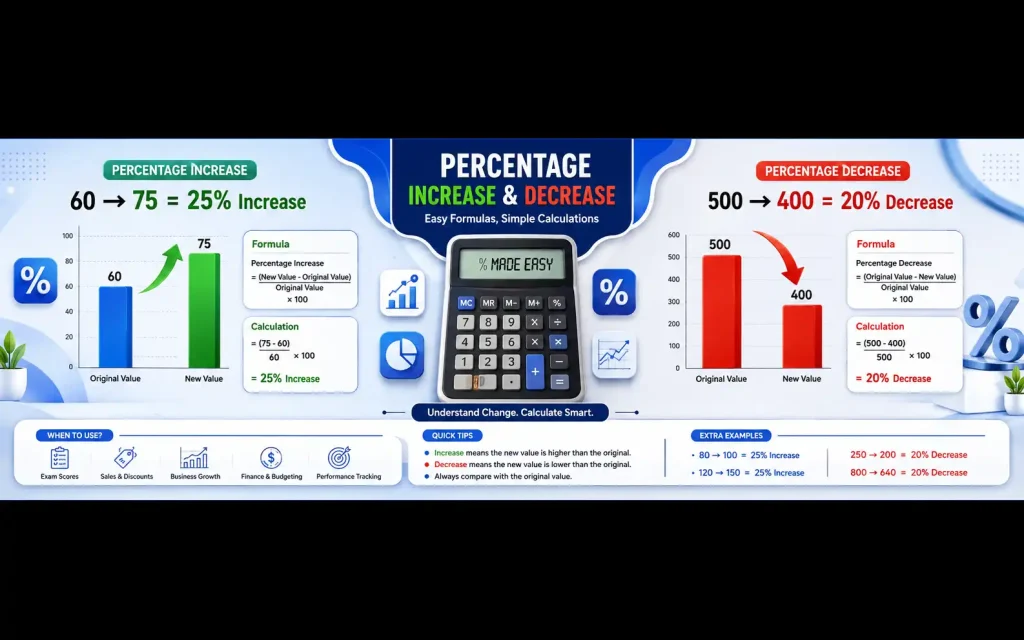
How Do You Work Out a Percentage on a Calculator?
If you are wondering how do you work out a percentage on a calculator, the process is very straightforward.
Suppose you scored 375 marks out of 500.
On a basic calculator, enter:
375 ÷ 500 × 100
The answer will be:
75
Therefore:
375 out of 500 = 75%
You do not necessarily need a special percentage button. A normal calculator with division and multiplication functions is enough.
Another example
Suppose you scored 68 out of 80.
Enter:
68 ÷ 80 × 100
Result:
85%
So, a score of 68 out of 80 is equal to 85%.
The key is to always enter the obtained marks first, divide by the total marks, and then multiply by 100.
How to Count Percentage in Calculator
Many people search for how to count percentage in calculator when they want to convert a score into a percentage quickly.
The basic process is:
Obtained number ÷ Total number × 100
For example, if you have 56 marks out of 70:
56 ÷ 70 × 100 = 80%
Therefore, 56 out of 70 is 80%.
Here are some quick examples:
| Marks Obtained | Total Marks | Percentage |
|---|---|---|
| 45 | 50 | 90% |
| 72 | 80 | 90% |
| 85 | 100 | 85% |
| 160 | 200 | 80% |
| 360 | 400 | 90% |
| 425 | 500 | 85% |
The formula remains exactly the same even when the total marks change.
Percentage Formula for Calculator
The percentage formula for calculator is:
Percentage = (Part ÷ Whole) × 100
For examination marks, it becomes:
Percentage = (Marks Obtained ÷ Total Marks) × 100
You can remember it as:
Obtained ÷ Total × 100
For example:
320 ÷ 400 × 100 = 80%
This is the most important formula to remember if you frequently calculate marks percentages.
How to Calculate Percentage of Marks on Paper
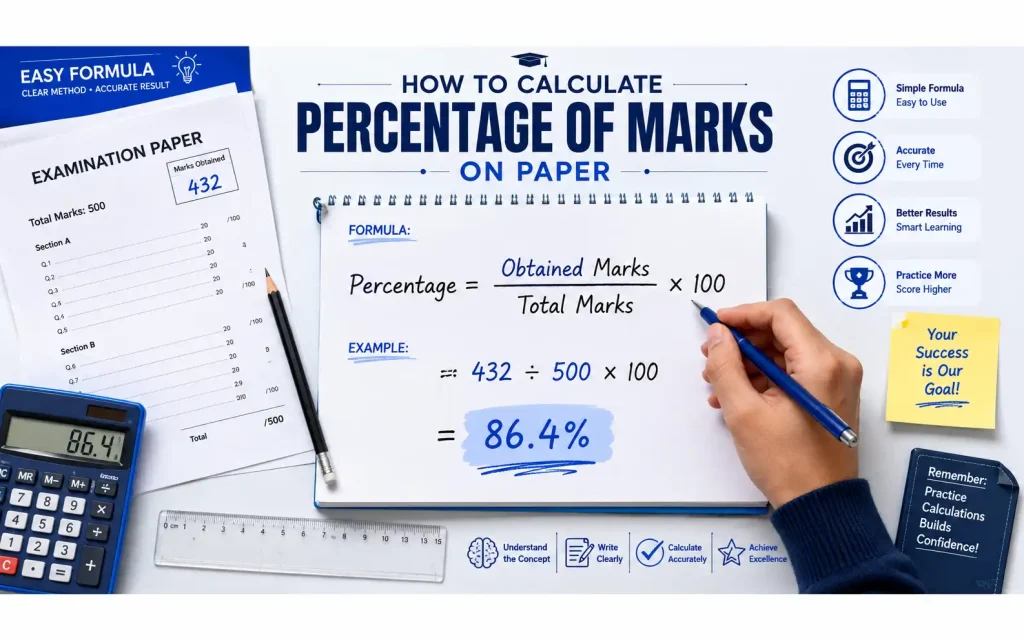
You do not always need a calculator. If you want to know how to calculate percentage of marks on paper, simply write the formula and substitute your numbers.
Imagine a student scores:
Marks obtained = 432
Total marks = 500
Write:
Percentage = (432 ÷ 500) × 100
Now calculate:
432 ÷ 500 = 0.864
Then:
0.864 × 100 = 86.4%
Therefore:
Percentage = 86.4%
This paper method is especially useful during exams when calculators are not allowed.

A simple shortcut
When the total marks are 100, the calculation is extremely easy.
If you score 87 out of 100:
87 ÷ 100 × 100 = 87%
If the total is 1,000, you can still use exactly the same formula:
850 ÷ 1,000 × 100 = 85%
How to Calculate Percentage for Multiple Subjects
When calculating the overall percentage of an examination, you normally need to combine the marks from all subjects.
Suppose a student receives:
- Mathematics: 85/100
- English: 78/100
- Science: 92/100
- Computer: 88/100
- History: 76/100
First add the obtained marks:
85 + 78 + 92 + 88 + 76 = 419
Then add the total marks:
100 + 100 + 100 + 100 + 100 = 500
Now apply the formula:
(419 ÷ 500) × 100 = 83.8%
Therefore, the student’s overall percentage is:
83.8%
For multiple subjects, calculating the percentage from combined obtained and maximum marks is generally the safest approach, particularly when subjects have different maximum marks.
What If Subjects Have Different Total Marks?
Sometimes every subject is not worth the same number of marks.
For example:
- Subject A: 70/100
- Subject B: 45/50
- Subject C: 80/100
- Subject D: 35/50
Add obtained marks:
70 + 45 + 80 + 35 = 230
Add maximum marks:
100 + 50 + 100 + 50 = 300
Now calculate:
(230 ÷ 300) × 100 = 76.67%
So the overall percentage is approximately 76.67%.
This method automatically takes different subject totals into account.
A common mistake is to calculate each subject percentage and then simply average them when the subjects have different maximum marks. Combining the obtained marks and maximum marks first avoids that problem.
How to Calculate Percentage of Marks for School Results
Students often need to calculate their percentage after receiving a marksheet.
For example, suppose a student obtains 880 marks out of 1,100.
Use:
(880 ÷ 1,100) × 100
The result is:
80%
So the student achieved 80% marks.
The exact maximum marks can vary depending on the examination system, board, subject combination, or qualification, so always use the total marks shown on your official marksheet rather than assuming a particular total.
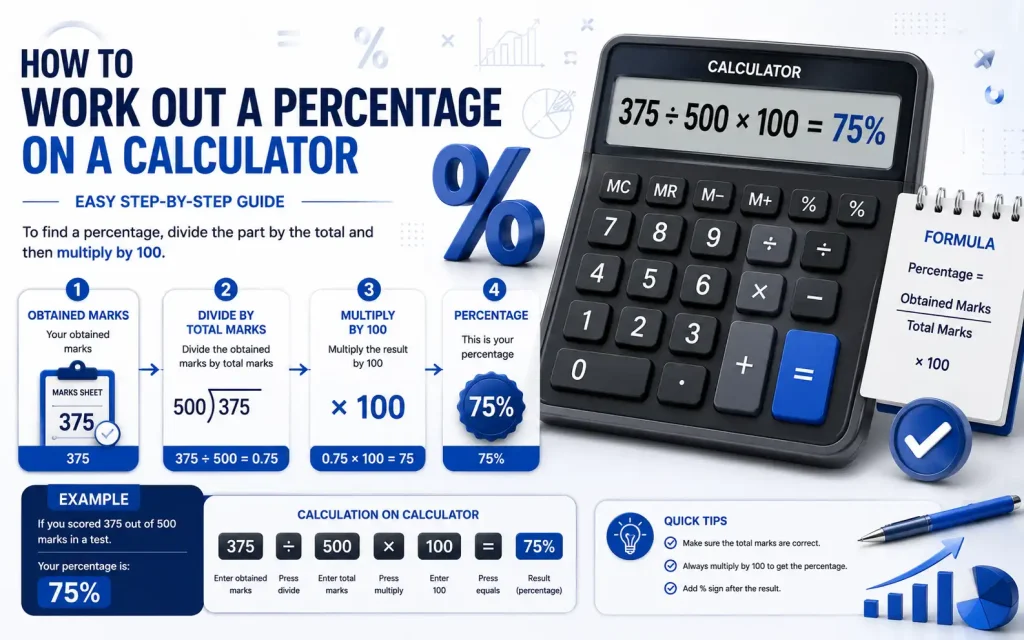
How to Calculate Percentage Increase
Percentage is not only used for exam marks. You can also calculate increases.
The percentage increase formula is:
Percentage Increase = ((New Value − Original Value) ÷ Original Value) × 100
For example, suppose your marks increased from 60 to 75.
First calculate the increase:
75 − 60 = 15
Then:
15 ÷ 60 × 100 = 25%
So your marks increased by 25% compared with the original score.
This calculation is useful for comparing test scores, salaries, prices, sales, website traffic, and many other measurements.
Minus Percentage Calculator: How to Calculate Percentage of Marks
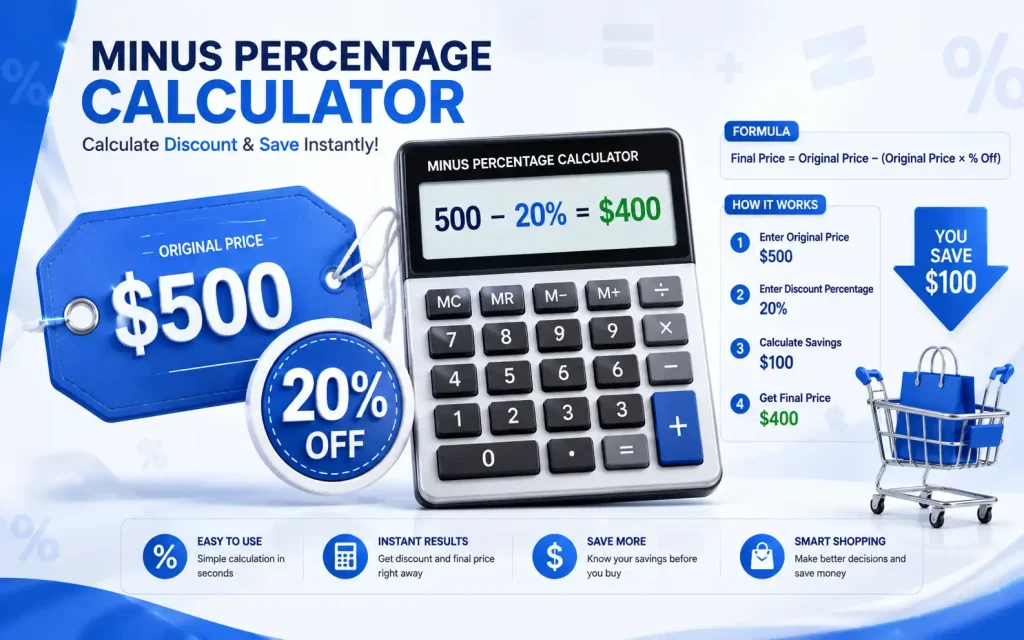
A minus percentage calculator is useful when you want to reduce a number by a certain percentage.
For example, suppose an item costs $500 and you want to reduce it by 20%.
First calculate 20% of $500:
500 × 20 ÷ 100 = $100
Now subtract the reduction:
$500 − $100 = $400
Therefore, the final amount is $400.
There is also a shortcut:
500 × (1 − 20/100)
500 × 0.80 = $400
The same approach works for discounts, price reductions, budget reductions, and other situations where you need to subtract a percentage.
How to Calculate Percentage of Marks
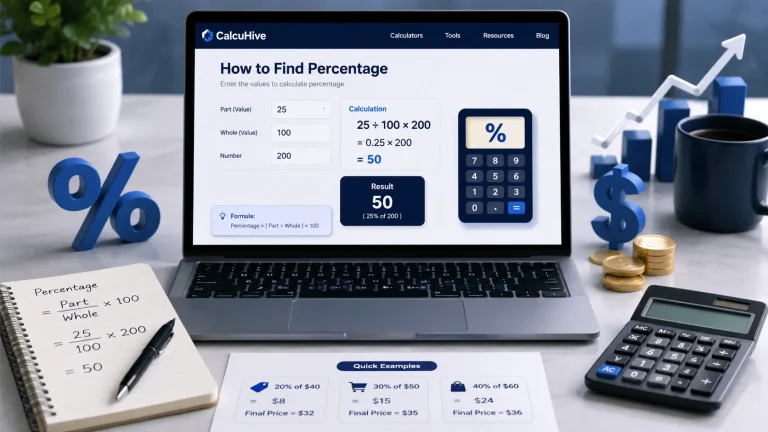
If you are learning how to do percentages in a calculator, start with these common calculations.
Finding a percentage of a number
To find 25% of 200:
200 × 25 ÷ 100 = 50
Answer: 50
Finding what percentage one number is of another
To find what percentage 40 is of 80:
40 ÷ 80 × 100 = 50%
Answer: 50%
Reducing a number by a percentage
To reduce 600 by 15%:
600 × 15 ÷ 100 = 90
Then:
600 − 90 = 510
Answer: 510
Increasing a number by a percentage
To increase 400 by 10%:
400 × 10 ÷ 100 = 40
Then:
400 + 40 = 440
Answer: 440
Once you understand these four patterns, most everyday percentage calculations become much easier.
Can You Calculate Percentage Without a Calculator?
Yes. In fact, understanding the paper method can make calculator calculations easier because you know what the calculator is doing.
For example, calculate 30% of 250 manually.
Since:
30% = 30/100 = 0.30
Then:
250 × 0.30 = 75
Therefore, 30% of 250 is 75.
For marks, use the same principle:
Marks percentage = Obtained marks ÷ Total marks × 100
For example:
72 ÷ 90 × 100 = 80%
You can perform the division manually if necessary and then multiply by 100.
How to Calculate Percentage of Marks
Sometimes the question works in reverse.
Instead of asking for the percentage from marks, you may want to know how many marks are needed for a particular percentage.
Use:
Marks Required = (Percentage × Total Marks) ÷ 100
For example, how many marks are needed to achieve 80% in an exam worth 600 marks?
(80 × 600) ÷ 100 = 480
Therefore, you need 480 marks out of 600 to achieve 80%.
This reverse formula is useful when students set exam targets.
How to Calculate Total Marks From a Percentage
You can also work backward if you know the marks obtained and percentage.
The formula is:
Total Marks = (Marks Obtained × 100) ÷ Percentage
For example, suppose you obtained 450 marks and your percentage is 75%.
(450 × 100) ÷ 75 = 600
Therefore, the total marks were 600.
This is particularly useful when you know your percentage but want to determine the maximum marks.
How to Calculate Love Percentage on Paper
People often look for ways to figure out How to Calculate Percentage of Marks when they want to have fun and see how compatible they are with someone.
The love percentage is not a way to measure if two people are compatible.
It is not like a test score that you get in school.
There is no formula that can tell you how much someone loves you.
If you just want to have fun you can make up a game.
You can rate how you do in areas like:
- Communication: you can give yourself a score from 0 to 20
- Trust: you can give yourself a score from 0 to 20
- Understanding: you can give yourself a score from 0 to 20
- Interests: you can give yourself a score from 0 to 20
- Support: you can give yourself a score from 0 to 20
Then you add up all the scores.
For example let us say you get these scores: 17 for communication 18 for trust 16 for understanding 15 for shared interests and 19 for support.
If you add them up you get 85.
You can say that you have an 85 percent love percentage. This is just for fun.
You should not think that this really measures how much you love someone or if your relationship will work out.
The love percentage is a game it is not real.
The How to Calculate Percentage of Marks, on paper thing is something people do for entertainment it is not a real way to measure love or compatibility.
Common Percentage Calculation Mistakes
Even though percentages are simple, several mistakes happen frequently.
1. Using the wrong total marks
If your exam is out of 500, do not divide by 100.
Use:
Obtained marks ÷ 500 × 100
2. Forgetting to multiply by 100
If you calculate:
400 ÷ 500 = 0.8
The percentage is not 0.8%.
You must multiply by 100:
0.8 × 100 = 80%
3. Adding percentages incorrectly
For multiple subjects, especially subjects with different maximum marks, do not simply average individual percentages without considering their weight.
Use total obtained marks divided by total maximum marks where appropriate.
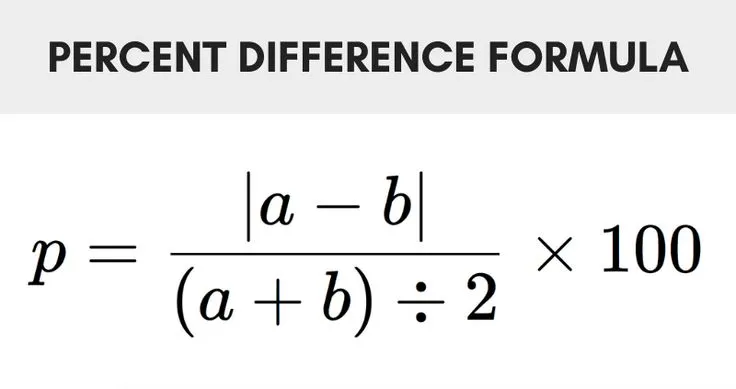
4. Confusing percentage with percentage points
If a score rises from 60% to 70%, the increase is 10 percentage points.
The relative percentage increase is:
(70 − 60) ÷ 60 × 100 = 16.67%
These are two different concepts.
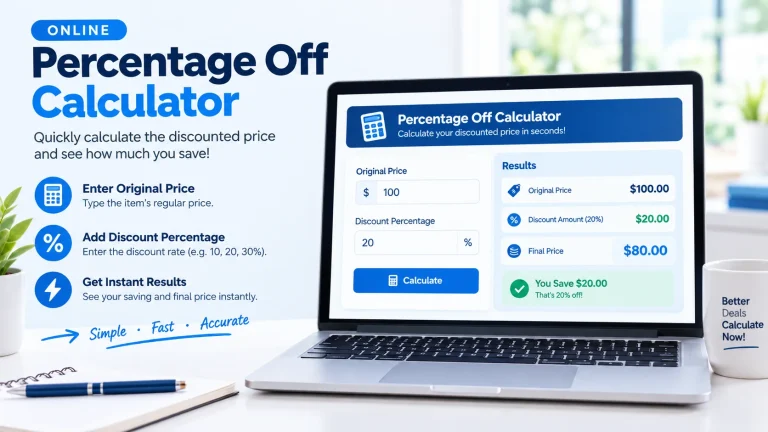
Use an Online Percentage Calculator
If you regularly calculate marks, discounts, increases, or other percentages, an How to Calculate Percentage of Marks can save time and reduce manual errors.
A percentage calculator is especially useful when:
- You have large numbers.
- You need several calculations.
- You are calculating a complete marksheet.
- You need to check your manual calculation.
- You want to calculate a discount.
- You need to find a percentage increase or decrease.
- You want to calculate a target percentage.
For students, the basic process remains simple: enter the marks obtained, enter the total marks, and apply the percentage formula.
You can also use a dedicated percentage calculator on CalcuHive to make everyday percentage calculations faster and easier.
Quick Percentage Formula Cheat Sheet
Keep these formulas handy:
Percentage from marks
Percentage = (Obtained Marks ÷ Total Marks) × 100
Marks from percentage
Marks = (Percentage × Total Marks) ÷ 100
Total marks
Total Marks = (Marks Obtained × 100) ÷ Percentage
Percentage increase
Percentage Increase = ((New − Original) ÷ Original) × 100
Percentage decrease
Percentage Decrease = ((Original − New) ÷ Original) × 100
Percentage of a number
Percentage Amount = Number × Percentage ÷ 100
These formulas cover most everyday percentage problems.
Final Thoughts
Learning how to calculate percehttps://calcuhive.com/percentage-calculator/ntage of marks is useful far beyond school exams. Once you understand the basic formula, you can calculate percentages on paper, use a basic calculator, check your exam results, calculate discounts, compare changes, and work out target marks.
The most important formula to remember is:
Percentage = (Marks Obtained ÷ Total Marks) × 100
For example, if you score 450 out of 500:
(450 ÷ 500) × 100 = 90%
Whether you searched for how to find percent calculator, how do you work out a percentage on a calculator, how to count percentage in calculator, minus percentage calculator, how to do percentages in a calculator, percentage formula for calculator, or how to calculate percentage of marks on paper, the underlying mathematics is the same: identify the part, identify the whole, divide, and multiply by 100.
Once this simple process becomes familiar, percentage calculations become quick, accurate, and much less intimidating.
How do I calculate percentage of marks?
Divide the marks obtained by the total marks and multiply by 100.
What is the formula for calculating marks percentage?
The formula is (Marks Obtained ÷ Total Marks) × 100.
How do I calculate percentage on a calculator?
Enter the obtained marks, divide by the total marks, and multiply the result by 100.
How do I calculate percentage without a calculator?
Divide the obtained marks by the total marks and multiply by 100 manually on paper.
How do I calculate 20% of a number?
Multiply the number by 20 and divide the result by 100.
How to Calculate Percentage of Marks formula?
How to Calculate Percentage of Marks formula is How to Calculate Percentage of Marks