Rent Calculator Victoria: Calculate Your Rent in 2026
Rent in Victoria is usually advertised by the week, but your budget does not always work that way. Your salary may arrive fortnightly, bills arrive monthly, and your lease can run for a full year. That is where a rent calculator Victoria becomes useful.
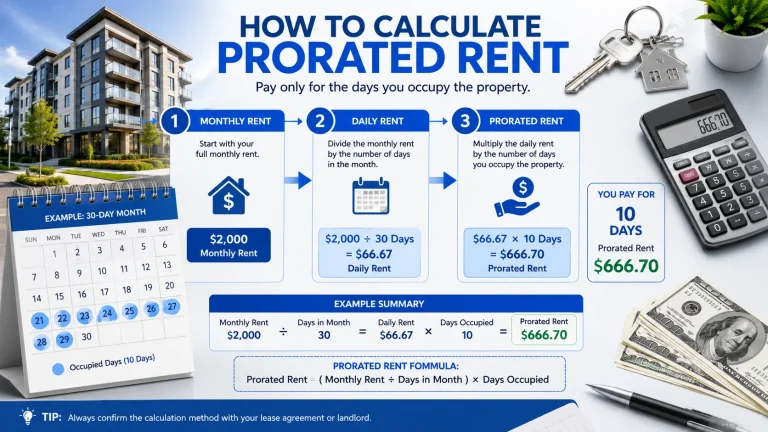
A simple conversion can show what a weekly rental really costs over a month or year. It can also help you estimate rent when moving out part-way through a payment period.
In this guide, you will learn how to convert rent between daily, weekly, fortnightly, monthly, six-monthly, and yearly amounts. You will also learn how Victorian rent, bond, rent increases, and Centrelink Rent Assistance can affect your budget.
Table of Contents
Quick Answer
A rent calculator tool by Victoria converts your rental amount between different payment periods so you can understand the real cost of a property. For example, $500 per week equals $26,000 per year. The calendar-month figure is about $2,166.67 because a year has 365 days, not four weeks per month. Always check current Victorian rental rules before making a legal or financial decision.
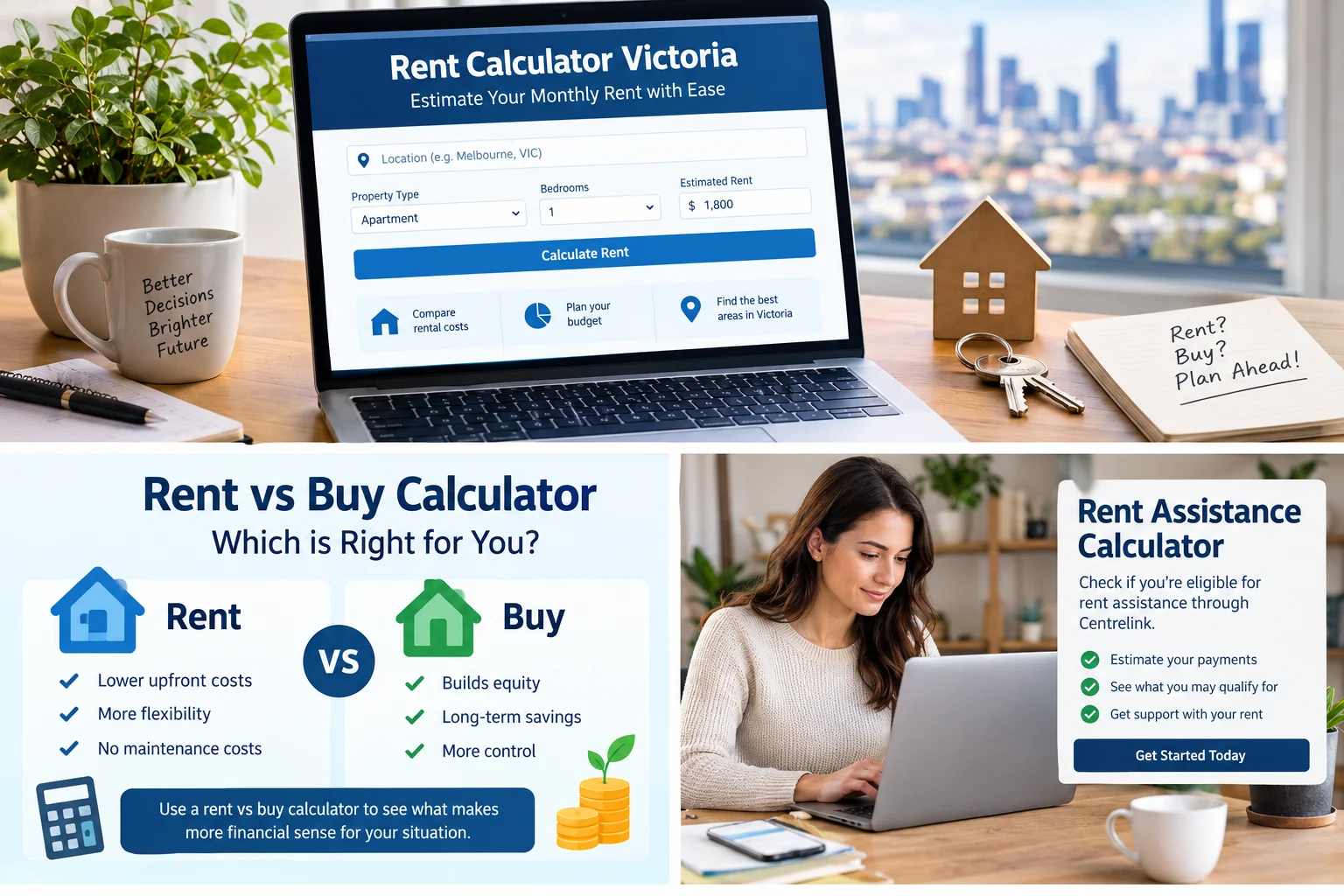
What does a rent calculator Victoria tool actually do?
A rent calculator converts one rental period into another without making you do the math manually. This matters because weekly rent does not translate into a simple four-week monthly figure.
Consumer Affairs Victoria provides a rent calculator that can convert rent into daily, weekly, fortnightly, calendar-month, six-month, and yearly amounts. Its calendar-month calculation uses the daily rent and the number of days in a year rather than simply multiplying weekly rent by four.
Direct Answer: A rent calculator helps you compare the same rental cost across different payment periods.
Definition: Calendar-month rent
Calendar-month rent means the amount of rent that applies to a normal calendar month. It is not the same as four weeks of rent.
For example, suppose a property costs $500 per week.
The yearly cost is:
$500 × 52 = $26,000
The daily cost is:
$26,000 ÷ 365 = $71.23
The calendar-month cost is:
$26,000 ÷ 12 = $2,166.67
That difference is easy to miss when browsing real estate listings.
Why this matters when comparing properties
Imagine two listings:
| Property | Weekly Rent | Approx. Annual Rent |
|---|---|---|
| Property A | $500 | $26,000 |
| Property B | $550 | $28,600 |
| Property C | $600 | $31,200 |
| Property D | $650 | $33,800 |
A $50 weekly difference sounds small.
Over a year, it becomes $2,600.
That is why looking only at the weekly number can hide the bigger picture.
Key Takeaway
- Weekly rent × 52 gives the annual rental cost.
- Calendar-month rent is not simply weekly rent × 4.
- Use a calculator before comparing different real estate listings.
How do you calculate weekly rent into monthly and yearly rent?
The easiest way to calculate rent is to start with the weekly amount and convert it into an annual figure first.
Direct Answer: Multiply weekly rent by 52 to estimate the yearly cost, then divide the yearly amount by 12 for an average monthly figure.
Here is the basic formula:
Annual rent = Weekly rent × 52
Then:
Monthly rent = Annual rent ÷ 12
Example: $450 weekly rent
Suppose you find an apartment advertised for $450 per week.
Annual rent:
$450 × 52 = $23,400
Average monthly rent:
$23,400 ÷ 12 = $1,950
Daily rent using a 365-day year:
$23,400 ÷ 365 = $64.11
Fortnightly rent:
$450 × 2 = $900
So the same property can be viewed like this:
| Payment period | Amount |
|---|---|
| Daily | $64.11 |
| Weekly | $450 |
| Fortnightly | $900 |
| Average monthly | $1,950 |
| Six months | $11,700 |
| Yearly | $23,400 |
This is the sort of calculation a rent per month calculator should make simple.
Why you should not use four weeks for a month
A common mistake is:
$450 × 4 = $1,800
That looks reasonable, but it only represents four weeks.
A year has 52 weeks, while 12 months contain more than 48 weeks. Using four weeks for every month therefore understates the yearly cost.
Consumer Affairs Victoria uses a 365-day calculation for its calendar-month rent conversion.
Key Takeaway
- Convert weekly rent to yearly rent first.
- Divide annual rent by 12 to get the average monthly amount.
- Do not assume every month contains exactly four weeks.
How can a rent calculator Does Victoria have a tool to help with a rental budget?
A good rental budget should look beyond the advertised weekly price. Rent is usually the largest housing expense, but it is not the only cost you may face.
Direct Answer: Use your rental calculation to estimate the full housing cost before deciding whether a property fits your budget.
Start with your expected annual rent.
Then add other regular housing costs.
Build a simple rental budget.
For example, imagine you are considering a property at $600 per week.
Annual rent:
$600 × 52 = $31,200
Average monthly rent:
$31,200 ÷ 12 = $2,600
Now add estimated household expenses:
| Expense | Example monthly amount |
|---|---|
| Rent | $2,600 |
| Electricity | $150 |
| Gas | $70 |
| Internet | $80 |
| Water or other costs | $50 |
| Contents insurance | $30 |
| Total example | $2,980 |
These figures are examples, not official Victorian averages. Your actual costs will depend on the property, household, provider, usage, and rental agreement.
Think about the upfront money too.
Moving into a rental can require more cash than one week’s rent.
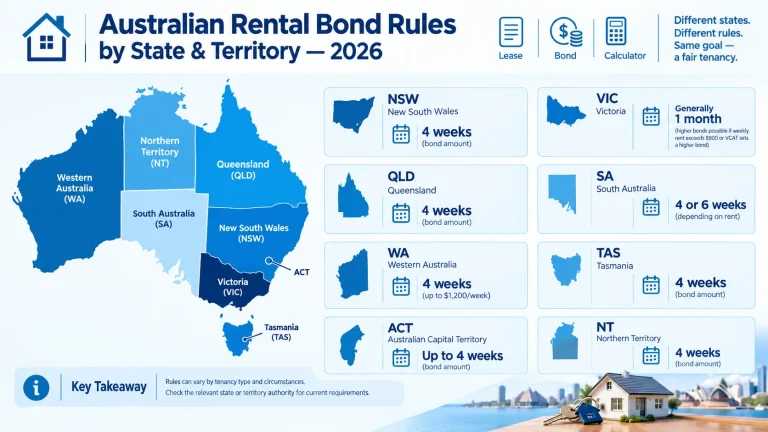
Consumer Affairs Victoria says that, in most cases, a bond cannot exceed one month’s rent unless the weekly rent is above $900 or another permitted exception applies.
Rent in advance also has rules.
For most residential rentals, a rental provider cannot ask for more than one month’s rent in advance. If rent is paid weekly, the limit is generally 14 days. Different rules apply where weekly rent exceeds $900.
That means your move-in budget should account for more than the advertised weekly figure.
A practical affordability check
Before applying for a property, calculate:
- Weekly rent.
- Annual rent.
- Average monthly rent.
- Expected utilities.
- Bond.
- Rent in advance.
- Moving costs.
- Emergency savings.
That gives you a much clearer picture.
Key Takeaway
- Calculate yearly rent before judging affordability.
- Budget for utilities and upfront rental costs.
- Never assume the weekly listing price represents your entire housing expense.
How does rent compare with Centrelink Rent Assistance in Victoria?
People searching for a rent assistance calculator or rent assistance Centrelink calculators are usually trying to answer a different question: “How much help might I receive with my housing costs?”
That calculation depends on your circumstances.
Direct Answer: Centrelink Rent Assistance depends on your eligible payment, accommodation type, rent, and personal circumstances, so a simple rent calculator cannot determine your final entitlement.
Services Australia says rent assistance is an extra payment for eligible people who receive certain government payments and pay eligible accommodation costs.
You do not normally submit a separate rent assistance claim. Services Australia checks eligibility when you claim an eligible payment or update your accommodation details.
Who may qualify?
Eligible payments can include:
- Age Pension
- JobSeeker Payment
- Parenting Payment
- Youth Allowance
- Austudy
- Carer Payment
- Disability Support Pension
- Family Tax Benefit Part Above the base rate
- Other qualifying payments
Eligibility rules can vary, especially for younger people.
Your accommodation type also matters.
Services Australia lists private housing, community housing, defence housing, some retirement or lifestyle villages, and certain board-and-lodging arrangements among eligible accommodation types.
How much rent assistance can you receive?
The amount is linked to your rent and circumstances.
As of 20 September 2026, Services Australia states that for certain income-support customers, a single person’s fortnightly rent must be more than $157.80 to receive Rent Assistance, while the maximum rate applies once fortnightly rent reaches $456.20. The maximum listed payment is $223.80 per fortnight for that category.
These rates can change.
Services Australia updates Rent assistance rates on 20 March and 20 September each year.
So, if you are using a rent assistance Centrelink calculator, treat the result as an estimate and check your current Services Australia information.
Example
Suppose your rent is
$600 per week
Your fortnightly rent is
$600 × 2 = $1,200
That tells you your housing cost.
It does not automatically mean you will receive the maximum rent assistance payment. Your eligible Centrelink payment, household situation, accommodation type, and other rules still matter.
Key Takeaway
- Rent assistance is separate from ordinary rent conversion.
- Services Australia assesses eligibility based on your circumstances.
- Always use current Centrelink and Services Australia information for payment estimates.
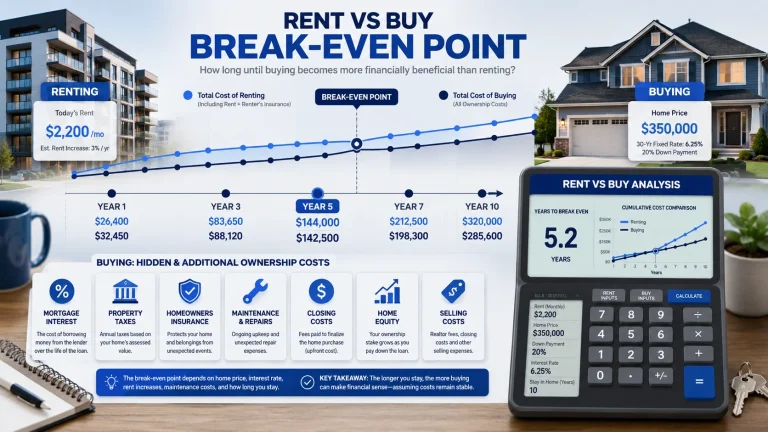
Is a rent vs. buy calculator useful in Victoria?
Yes. A rent vs buy calculator can be useful when you are deciding whether continuing to rent makes more sense than buying a property.
But there is a trap.
Comparing annual rent with a mortgage repayment alone is not a proper rent-versus-buy analysis.
Direct Answer: A rent vs. buy comparison should include the full cost of owning a property, not just the mortgage payment.
Costs renters should compare
Renters may mainly consider:
- Rent
- Utilities
- Contents insurance
- Moving costs
- Rental increases
Home buyers may face:
- Mortgage interest
- Principal repayments
- Stamp duty or other purchase costs
- Council rates
- Home insurance
- Repairs
- Maintenance
- Owners’ corporation fees
- Buying and selling costs
The comparison becomes much more useful when you look at the total cost over several years.
A simple example
Imagine renting costs:
$600 per week
That is:
$31,200 per year
Now imagine buying a property requires mortgage repayments of $3,000 per month.
That equals:
$36,000 per year
At first glance, renting appears cheaper by $4,800 per year.
But that does not mean renting is automatically the better financial choice.
The owner is building equity through the principal portion of the mortgage. The renter keeps the flexibility of renting and avoids many ownership costs.
There is no magic winner.
What about rising rents?
Rent trends matter too.
The Australian Bureau of Statistics reported that national rental prices increased 3.6% in the 12 months to August 2026. The ABS linked ongoing rental inflation to factors including sustained low vacancy rates in many capital cities.
That figure is an Australia-wide measure, not a prediction of what your Victorian property will cost next year.
Still, it shows why a long-term housing comparison should consider possible rent changes.
Beginner vs expert approach
| Beginner approach | Better approach |
|---|---|
| Compare rent with mortgage payment | Compare total housing costs |
| Look at one year | Consider several years |
| Ignore purchase costs | Include buying and selling costs |
| Assume rent stays unchanged | Test different rent increases |
| Ignore investment opportunity | Consider what happens to your savings |
Key Takeaway
- A rent vs buy calculator is a planning tool, not a crystal ball.
- Compare total ownership costs with total rental costs.
- Test different rent and property-price scenarios before deciding.
How do Victorian rent increases affect your calculations?
A rental calculation can become outdated after a rent increase. That is why you should check your current rent whenever your agreement changes.
Direct Answer: Victorian rental providers must follow specific rules when increasing rent, including notice and calculation requirements.
Consumer Affairs Victoria states that rental providers generally must give renters at least 90 days’ notice using the required Notice of proposed rent increase form.
For many agreements, rent cannot be increased more than once every 12 months.
There are also rules for fixed-term agreements.
A rental provider generally cannot increase rent during a fixed term unless the agreement allows it and explains how the increase will be calculated.
Example of a rent increase
Suppose your current rent is:
$550 per week
Your rental provider proposes a $30 increase.
New weekly rent:
$580
Old annual rent:
$550 × 52 = $28,600
New annual rent:
$580 × 52 = $30,160
Annual difference:
$30,160 − $28,600 = $1,560
So a seemingly small $30 weekly increase adds $1,560 per year.
That is why recalculating rent after an increase is worth five minutes of your time.
Can you challenge a high increase?
Consumer Affairs Victoria provides a process for renters who believe a proposed increase is higher than the market range.
From 31 March 2026, additional considerations apply when Consumer Affairs Victoria and VCAT assess rent increases.
A renter can request a rent assessment or investigation in certain circumstances.
Do not rely on a calculator alone if you believe an increase breaks rental laws. Check the official Victorian guidance.
What changed in October 2026?
Victoria is also introducing further rental-law changes on 13 October 2026.
These include strengthened rules around bond claims, records relating to minimum rental standards, and fees charged by certain third-party businesses.
Because rental law changes over time, an article like this should be reviewed regularly.
Key Takeaway
- Recalculate your budget after every rent increase.
- Victorian rental providers generally need to provide 90 days’ notice.
- Check Consumer Affairs Victoria if an increase appears excessive or invalid.
How much bond and rent in advance might you need?
The weekly rent tells only part of the story when you are moving into a Victorian rental.
Direct Answer: Most Victorian renters should plan for bond and rent in advance, subject to the limits and exceptions set by Victorian rental law.
For many standard residential rentals, the maximum bond is generally one month’s rent when weekly rent is $900 or less.
If weekly rent exceeds $900, different rules apply.
Example with $600 weekly rent
Suppose your rent is:
$600 per week
Four weeks of rent equals:
$600 × 4 = $2,400
A one-month bond under the standard limit would therefore be approximately:
$2,400
But remember that a calendar month can contain more than four weeks. Do not confuse a four-week amount with a precise calendar-month calculation.
Consumer Affairs Victoria says that when you start renting, you may also need to pay rent in advance.
For most rentals, a provider cannot ask for more than one month’s rent in advance. When rent is paid weekly, the limit is generally 14 days. Properties with weekly rent above $900 are treated differently.
Bond protection
The Residential Tenancies Bond Authority, commonly known as the RTBA, holds Victorian rental bonds.
Consumer Affairs Victoria also notes that eligible renters can use the Portable Rental Bond Scheme to transfer existing bond money to a new rental property.
From 9 September 2026, eligible renters can also choose to pay bond money directly to the RTBA after giving the required written notice before the lodgement process begins.
Before you sign a lease
Check:
- Weekly rent.
- Payment frequency.
- Bond amount.
- Rent required in advance.
- Rent increase terms.
- Included utilities.
- Condition report.
- Any additional agreement conditions.
A cheap-looking rental can become expensive when the upfront numbers are unclear.
Key Takeaway
- Budget for bond and rent in advance.
- A standard Victorian bond is generally capped at one month’s rent when weekly rent is $900 or less.
- Check the current rules before paying or signing anything.
What are the most common rent calculation mistakes?
The biggest rent mistakes are usually simple maths errors rather than complicated financial problems.
Direct Answer: Most rental calculation mistakes happen when people confuse weekly, monthly, annual, and calendar-month figures.
Mistake 1: Multiplying weekly rent by four
This is the classic one.
$500 × 4 = $2,000
That does not represent an average calendar month.
The annual figure is:
$500 × 52 = $26,000
Average monthly amount:
$26,000 ÷ 12 = $2,166.67
Mistake 2: Forgetting the yearly cost
A $25 weekly difference sounds tiny.
Over 52 weeks:
$25 × 52 = $1,300
Always check the annual number.
Mistake 3: Confusing rent with Rent Assistance
A rent calculator tells you what you pay.
A Rent Assistance calculation looks at whether you qualify for government support and how much you may receive.
They are related, but they are not the same calculation.
Mistake 4: Ignoring rent increases
A budget based on today’s rent may look comfortable.
Then the rent changes.
Build some breathing room into your budget instead of running the numbers down to the last dollar.
Mistake 5: Trusting old rental-law information
Victorian rental rules can change.
For example, the minimum notice period for rent increases changed to 90 days from 25 November 2025, and further changes are scheduled for October 2026.
Old blog posts can therefore give you outdated advice.
Myth-Busting: “Monthly rent is always four times weekly rent.”
No.
That shortcut creates a four-week figure, not a true average calendar-month amount.
Quick Checklist
Before applying for a rental, check:
- Weekly rent
- Fortnightly cost
- Monthly equivalent
- Annual cost
- Bond
- Rent in advance
- Utilities
- Possible rent increases
- Centrelink eligibility, if relevant
- Current Victorian rental rules
Key Takeaway
- Never judge affordability from weekly rent alone.
- Calculate annual and monthly equivalents.
- Verify current rules before relying on legal or Centrelink information.
How can you use a rent calculator before choosing a property?
The best time to calculate rent is before you apply, not after you sign the lease.
Direct Answer: Use a rent calculator to turn a rental listing into a clear housing budget before committing to the property.
Here is a simple process.
Step 1: Find the advertised weekly rent
Check the property listing and write down the exact amount.
For example:
$625 per week
Step 2: Calculate the annual cost
$625 × 52 = $32,500
That is the basic annual rent before other housing costs.
Step 3: Calculate the average monthly cost
$32,500 ÷ 12 = $2,708.33
Now you have a useful figure for a monthly household budget.
Step 4: Calculate your upfront requirement
Estimate your bond and required rent in advance according to the applicable Victorian rules.
Do not assume every property follows exactly the same arrangement.
Step 5: Compare the property with alternatives
Use the same process for several real estate listings.
| Property | Weekly | Annual | Average Monthly |
|---|---|---|---|
| A | $575 | $29,900 | $2,491.67 |
| B | $625 | $32,500 | $2,708.33 |
| C | $675 | $35,100 | $2,925.00 |
| D | $725 | $37,700 | $3,141.67 |
Suddenly the difference between listings becomes much easier to see.
Step 6: Add the non-rent costs
Include utilities, transport, insurance, internet, moving expenses, and other regular costs.
That gives you a more realistic housing budget.
What about real estate listings?
Real estate listings often use weekly rent because it is the standard way many Australian rental properties are advertised.
That makes sense for comparing properties quickly.
But your personal budget may work better with monthly or annual numbers.
That is where an online calculator earns its keep.
Key Takeaway
- Calculate every property using the same method.
- Compare annual costs, not just weekly prices.
- Include upfront and recurring expenses before applying.
Frequently Asked Questions About Rent Calculator Victoria
How do I calculate weekly rent into monthly rent?
Multiply weekly rent by 52 and divide the result by 12. For example, $500 per week equals $26,000 per year, or approximately $2,166.67 per month.
Question: How much is $600 rent per week per month?
Answer: $600 per week equals $31,200 per year. Dividing that by 12 gives an average monthly cost of $2,600.
Question: Is monthly rent the same as four weeks of rent?
Answer: No. Four weeks contains only 28 days. A calendar-month calculation accounts for the full 365-day year, so it produces a different amount.
Question: Can I use a rent calculator for Centrelink Rent Assistance?
Answer: You can use a rent calculator to work out your rental cost, but it cannot determine your final Centrelink Rent Assistance entitlement. Services Australia assesses eligibility using your payment, accommodation, rent, and personal circumstances.
Question: How much bond can a landlord charge in Victoria?
Answer: For most standard residential rentals, the bond generally cannot exceed one month’s rent when weekly rent is $900 or less. Different rules apply when weekly rent exceeds $900 and in some special rental arrangements.
Question: How much rent can I afford in Victoria?
Answer: There is no single rent limit that works for everyone. Start with your after-tax income, subtract essential expenses, then test the annual rental cost against your remaining budget. Leave room for utilities, transport, emergencies, and rent increases.
What should you remember when calculating rent in Victoria?
Rent can look deceptively simple on a property listing. A weekly number appears on the screen, you like the house, and your brain starts planning where the sofa will go.
Slow down.
The better approach is to convert that weekly number into monthly and yearly costs before making a decision.
A rent calculator Victoria tool can help you compare properties, understand your cash flow, estimate move-in costs, and check how a rent increase changes your yearly budget.
For a $600 weekly rental, the annual rent is $31,200, while the average monthly amount is $2,600. That gives you a much clearer view than the weekly figure alone.
You should also keep Victorian rental rules separate from simple calculations. Bond limits, rent in advance, rent increases, and Rent Assistance involve rules that can change.
Bottom Line
A weekly rental price is only the starting point. Convert it into annual and monthly figures, then add utilities, bond, rent in advance, and other housing expenses. If you receive an eligible Centrelink payment, check whether Rent Assistance may apply. For legal questions, rely on current Consumer Affairs Victoria guidance. Finally, compare several properties using the same calculations so you can see the real difference between them.
Ready to check your rental cost? Use the CalcuHive rent calculator to convert your rent into the period that makes sense for your budget.
If this guide helped you understand Victorian rental costs, share it with someone who is comparing properties or preparing to move.