Rent vs Buy Calculator: Which Is Better in 2026?
Renting is usually better when you need flexibility, have a smaller down payment, or may move within a few years. Buying can make more financial sense when you plan to stay longer, can afford the upfront costs, and want to build home equity.
A rent vs buy calculator helps you compare these choices using your rent, home price, mortgage rate, down payment, taxes, insurance, maintenance, and expected time in the home.
Table of Contents
What Is a Rent vs Buy Calculator?
A rent vs buy calculator is a financial comparison tool that estimates whether renting a home or purchasing one may be more cost-effective over a selected period.
Instead of looking only at your monthly rent or mortgage payment, the comparison can include:
- Monthly rent
- Home purchase price
- Down payment
- Mortgage interest rate
- Loan term
- Property taxes
- Homeowners insurance
- Mortgage insurance
- Maintenance and repairs
- Closing costs
- Expected home appreciation
- Expected rent increases
- Investment returns on money that would otherwise be used for a down payment
- How long you expect to stay in the property
This matters because a $2,000 mortgage payment isn’t automatically cheaper than $2,000 rent. Homeownership comes with additional expenses, while renting allows you to keep your savings more liquid.
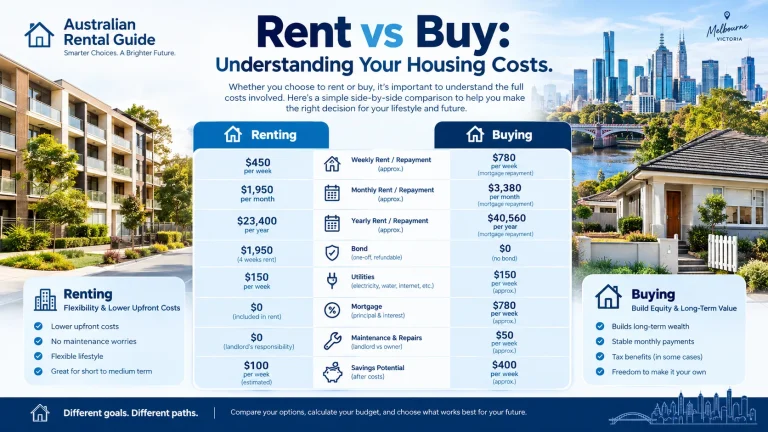
Renting vs Buying: What Should You Compare?
The simplest mistake is comparing rent to the mortgage payment alone.
A more realistic comparison looks at the total financial impact of each choice.
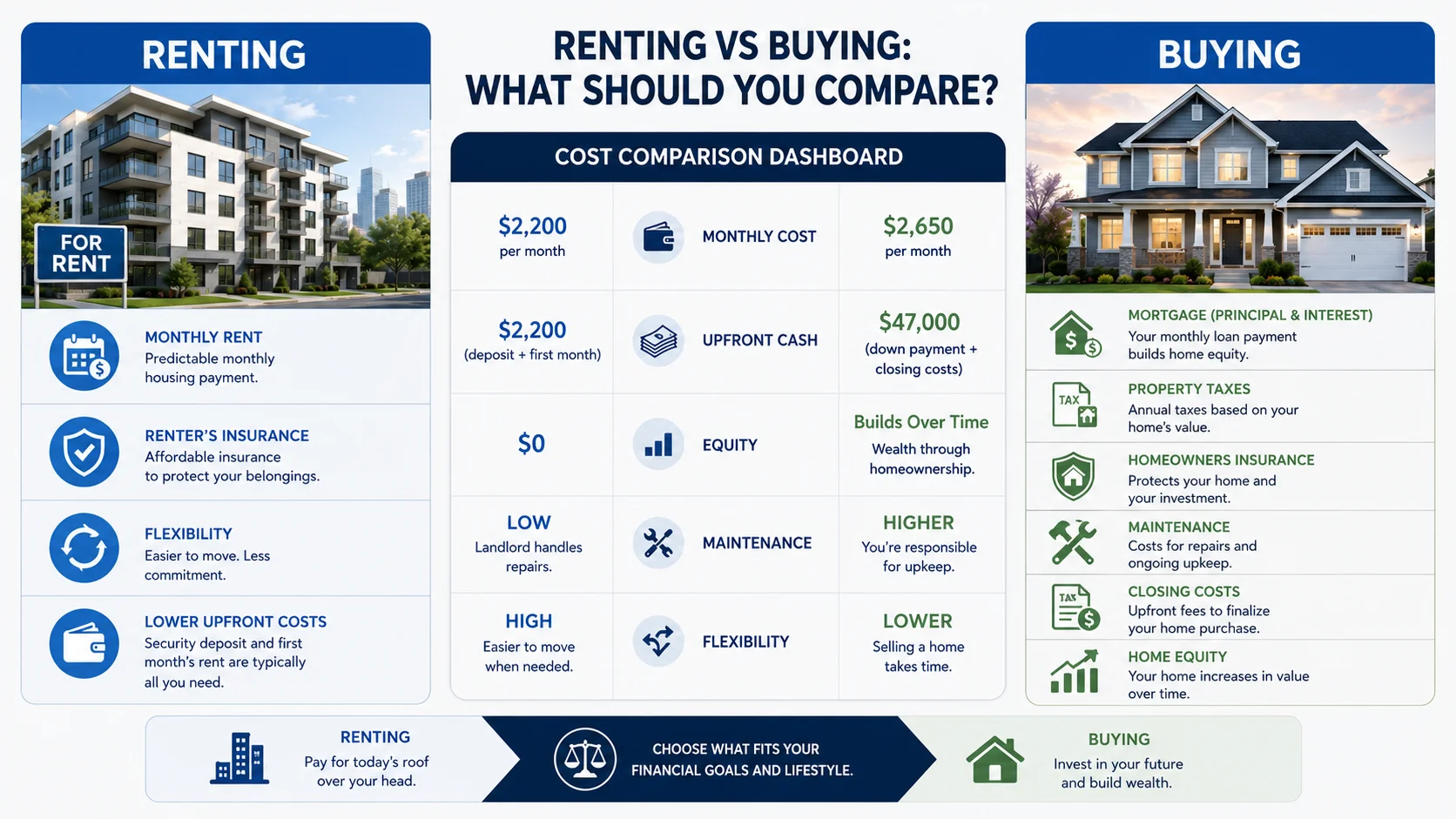
| Cost or Factor | Renting | Buying |
|---|---|---|
| Monthly housing payment | Rent | Principal + interest |
| Property taxes | Usually included indirectly | Yes |
| Home insurance | Usually renter’s insurance | Homeowners insurance |
| Maintenance | Usually landlord’s responsibility | Homeowner’s responsibility |
| Upfront cash | Deposit + fees | Down payment + closing costs |
| Equity building | No | Yes |
| Flexibility | Usually higher | Usually lower |
| Selling costs | None | Potentially significant |
| Investment opportunity | More cash may remain available | Cash tied up in property |
A good comparison should consider both cash flow and wealth building.
For example, homeowners gradually build equity as they repay mortgage principal. Renters don’t build property equity, but they may have more money available to invest elsewhere.
How a Rent vs Buy Calculator Works
A calculator typically compares the estimated financial cost of renting with the estimated cost of owning over a specific period.
1. Enter your current rent.
Start with your monthly rent.
For example:
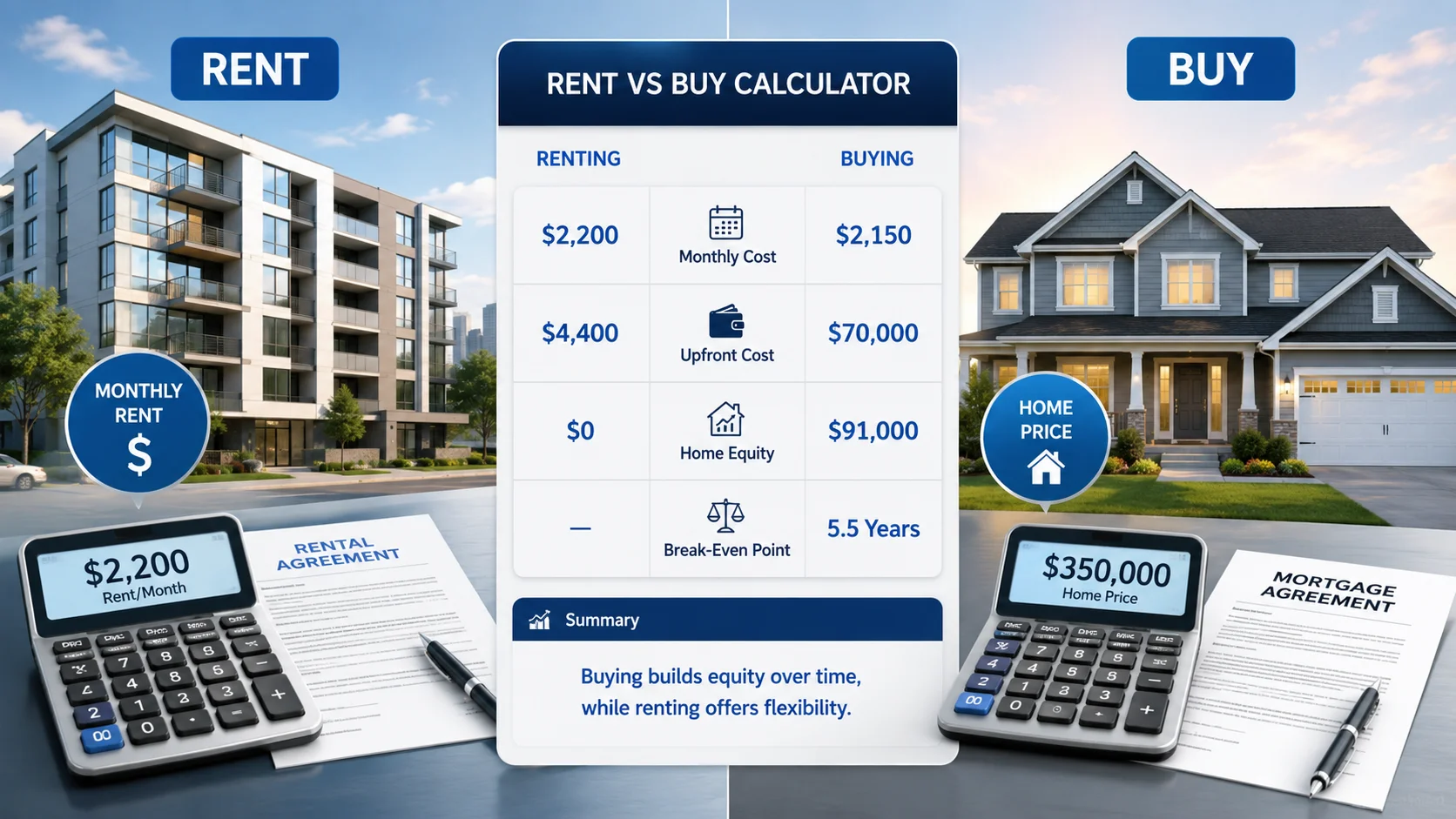
Monthly rent: $2,200
You may also estimate future rent increases. If rent rises by 3% per year, the amount you pay five years from now could be substantially higher than your starting rent.
2. Enter the home purchase price.
Next, enter the price of the property you’re considering.
For example:
Home price: $350,000
The calculator can then estimate the mortgage based on your down payment and interest rate.
3. Add your down payment.
Suppose you plan to put 20% down:
$350,000 × 20% = $70,000
Your mortgage amount would then be approximately:
$350,000 − $70,000 = $280,000
The larger the down payment, the smaller the mortgage balance, although putting more money into the property also means less cash remains available for other investments or emergencies.
4. Enter the mortgage rate and loan term.
A mortgage calculator generally uses your interest rate and loan term to estimate principal and interest.
For example, a 30-year mortgage produces a different payment and total interest cost than a 15-year mortgage.
Your actual rate depends on factors such as credit profile, loan type, lender, down payment, and market conditions.
5. Include ownership costs.
This is where a basic rent-versus-mortgage comparison becomes much more useful.
Consider:
- Property taxes
- Homeowners insurance
- HOA fees
- Mortgage insurance
- Maintenance
- Repairs
- Utilities that differ from your rental
- Closing costs
These expenses can materially change the result.
Example: Renting vs Buying a $350,000 Home
Consider a hypothetical renter who currently pays $2,200 per month.
They are considering purchasing a $350,000 home with a 20% down payment.
Their estimated financing would be:
- Home price: $350,000
- Down payment: $70,000
- Mortgage: $280,000
- Loan term: 30 years
The mortgage principal-and-interest payment would need to be calculated using the actual interest rate.
But that’s only the starting point.
The homeowner may also have property taxes, homeowners insurance, maintenance expenses, HOA fees, and closing costs.
Meanwhile, the renter keeps the $70,000 that would otherwise become a down payment. That money has an opportunity cost: it could potentially remain in savings or be invested.
This is one of the most useful ways to think about renting versus buying:
Buying doesn’t just cost a monthly payment; it also commits a large amount of capital to the property.
Likewise, renting doesn’t mean that all of your unused money automatically becomes profit. Rent can rise, and renters still need to account for moving expenses, deposits, and other housing costs.
When Renting May Be Better
Renting can make financial and practical sense in several situations.
You may move within a few years.
Buying a home involves transaction costs when you purchase and potentially when you sell.
If you buy a property and sell relatively soon afterward, these costs can consume a meaningful portion of any equity you have built.
For someone expecting to relocate for work, education, family reasons, or lifestyle changes, renting may provide valuable flexibility.
You don’t have enough cash for upfront costs
Buying requires more than a down payment.
Depending on the transaction, buyers may need money for:
- Closing costs
- Inspection
- Appraisal
- Moving
- Initial repairs
- Furniture
- Emergency reserves
Using almost all of your savings to purchase a home can leave you financially vulnerable.
Comparable rent is substantially cheaper.
If a similar property costs much more to own each month than to rent, renting may be attractive—especially if you invest the difference responsibly.
The key word is invest.
Simply spending the monthly difference doesn’t create the same potential wealth-building benefit.
You value flexibility
Renting can make it easier to change neighborhoods, cities, or housing arrangements without selling a property.
For people who prioritize flexibility, this benefit can be worth more than a purely financial calculation suggests.
When Buying May Be Better
Buying can become more attractive when several conditions line up.
You plan to stay for a long time.
The longer you stay, the more time you have to spread the upfront transaction costs over your ownership period.
You also have more time to repay mortgage principal and potentially benefit from property appreciation.
Neither outcome is guaranteed, but time can make the economics of ownership more favorable.
You can comfortably afford the full ownership cost.
Don’t base your decision on whether you can technically qualify for a mortgage.
Instead, consider whether you can comfortably afford:
Mortgage + taxes + insurance + maintenance + HOA + other housing costs
while still maintaining an emergency fund and continuing your other financial goals.
You want to build home equity.
Part of each mortgage payment may go toward reducing the loan balance.
That reduction increases your ownership stake in the property, assuming other factors remain unchanged.
Over time, this can become an important component of household wealth.
You expect housing costs to remain manageable.
A fixed-rate mortgage can provide greater payment predictability for principal and interest than a rental arrangement where rent can increase over time.
However, taxes, insurance, maintenance, and other ownership costs can still change.
The Break-Even Point Explained
One of the most useful outputs from a rent vs buy calculator is the estimated break-even point.
The break-even point is the approximate time when buying becomes financially competitive with renting under the assumptions used by the calculator.
For example, a hypothetical analysis might suggest that buying becomes favorable after seven years.
That does not mean you should automatically buy if you expect to stay for seven years.
The result depends heavily on assumptions such as:
- Home price
- Mortgage rate
- Rent growth
- Home appreciation
- Maintenance costs
- Investment returns
- Property taxes
- Insurance
- Closing costs
- Selling costs
Change one major assumption and the break-even period can change significantly.
A better question than “Which is cheaper?”
Ask:
“How long do I expect to stay, and what happens to my money under each option?”
That question produces a much more useful financial comparison.
Hidden Costs People Forget
A particularly useful way to evaluate the decision is to create a housing friction budget.
This is the money you expect to spend because you own the property but that isn’t obvious from the mortgage payment.
Your housing friction budget can include:
- Annual maintenance
- Unexpected repairs
- HOA increases
- Insurance increases
- Property tax increases
- Appliance replacement
- Roof or HVAC repairs
- Closing costs
- Selling expenses
For example, a homeowner may have a comfortable mortgage payment but face a large repair bill during an inconvenient year.
Renters generally transfer many major maintenance responsibilities to the landlord, although rent pricing can reflect those costs indirectly.
This “friction budget” is a useful reality check because the cheapest theoretical scenario isn’t always the easiest scenario to afford in real life.
How to Use a Rent vs Buy Calculator
Follow these steps for a more realistic comparison.
Step 1: Gather your rental information
Write down:
- Current monthly rent
- Expected annual rent increase
- Renter’s insurance
- Utilities you pay separately
- Expected length of stay
Step 2: Gather purchase information.
You’ll need:
- Home price
- Down payment
- Mortgage interest rate
- Loan term
- Property tax estimate
- Homeowners insurance
- HOA fees, if applicable
- Maintenance estimate
Step 3: Include upfront costs
Don’t forget:
- Down payment
- Closing costs
- Inspection
- Appraisal
- Moving expenses
- Initial repairs
Step 4: Choose a realistic time period.
Compare the two options over the period you actually expect to live in the home.
You might run separate scenarios for:
- 3 years
- 5 years
- 7 years
- 10 years
This can reveal how sensitive your decision is to the length of ownership.
Step 5: Test different scenarios
Don’t rely on one set of assumptions.
Try a conservative scenario with lower home appreciation and higher maintenance costs.
Then test a more optimistic scenario.
If buying only looks attractive under highly optimistic assumptions, that’s useful information.
If it remains competitive under conservative assumptions, the decision may be more robust.
Rent vs Buy Calculator: What the Result Really Means
A calculator should support your decision, not make it for you.
If buying appears cheaper, ask:
- Can I afford the upfront cash?
- Will I still have an emergency fund?
- How long will I stay?
- Can I handle repairs?
- What happens if property taxes or insurance increase?
If renting appears cheaper, ask:
- Will I invest the money I don’t spend on a down payment?
- How much could rent increase?
- Do I need the flexibility that renting provides?
- Am I comfortable not building home equity?
The strongest decision is usually the one that works across several reasonable scenarios—not just the one that produces the lowest number in a single calculation.
Final Takeaway
The rent-versus-buy decision isn’t simply about finding the lower monthly payment. A useful analysis considers cash flow, upfront costs, equity, opportunity cost, flexibility, maintenance, and how long you expect to stay.
Use a rent vs buy calculator to run several realistic scenarios rather than relying on one prediction. If the numbers still favor one option after you test different rent increases, maintenance costs, appreciation assumptions, and time horizons, you’ll have a much stronger basis for making your housing decision.
Frequently Asked Questions
Is a rent vs buy calculator accurate?
A rent vs buy calculator can provide a useful estimate, but it cannot predict the future. Results depend on assumptions such as rent increases, home appreciation, mortgage rates, maintenance, taxes, insurance, investment returns, and how long you remain in the property.
Is it cheaper to rent or buy a house?
There is no universal answer. Renting may be cheaper over shorter periods or in markets where rents are relatively low compared with home prices. Buying may become more attractive for people who stay in the same property for many years and can comfortably manage the full cost of ownership.
How long should you stay in a house before buying makes sense?
There is no fixed number of years that works for everyone. A longer ownership period generally gives you more time to spread purchase and selling costs and build equity, but the right period depends on your local market, financing, property costs, and personal circumstances.
Does a mortgage payment equal the cost of owning a home?
No. A mortgage payment may include principal and interest, but homeowners can also pay property taxes, insurance, HOA fees, mortgage insurance, maintenance, repairs, and other expenses. These costs should be included when comparing buying with renting.
Is renting a waste of money?
No. Rent pays for housing and flexibility without requiring you to take responsibility for many ownership costs. Renting can also allow you to keep money available for savings or investments. Whether renting is financially preferable depends on your circumstances and how you use the money you don’t put into a property.
What is the biggest mistake when comparing renting and buying?
The biggest mistake is comparing monthly rent only with the mortgage payment. A better analysis compares the total cost of housing, upfront cash requirements, opportunity cost of the down payment, equity accumulation, expected time in the home, and potential selling costs.