How Stacked Discounts Work: A Simple Guide
Imagine you see a jacket marked 20% off, then discover an extra 10% coupon at checkout. It sounds like a 30% bargain. Surprisingly, it is not. The second reduction applies after the first one has already lowered the price.
That small distinction can change what you actually pay. Once you understand how stacked discounts work, you can compare promotions confidently, avoid misleading mental math, and calculate your real savings before reaching the checkout.
How Do Stacked Discounts Work?
Stacked discounts are applied one after another, not added together. For example, 20% off followed by 10% off gives a 28% effective discount. On a $100 purchase, the first discount reduces the price to $80, and the second reduces it to $72.
Table of Contents
What Are Stacked Discounts?
Stacked discounts happen when a seller applies two or more reductions to the same purchase in sequence. For example, a store might offer 20% off during a sale and allow members to claim another 10% discount. Each percentage works on the price remaining after the previous reduction.
Here is the important part: the discounts usually compound sequentially rather than adding together. Therefore, a 20% discount followed by 10% does not remove 30% from the original price. The second discount has a smaller base.
Why Don’t Stacked Discounts Add Together?
The easiest way to understand how stacked discounts work is to imagine a $100 item. A 20% reduction removes $20 and leaves $80. Then, the extra 10% applies to that $80 rather than the original $100.
That second reduction equals $8. You therefore pay $72 and save $28 overall. Although the advertised percentages total 30%, your actual saving equals 28%. The difference comes from calculating each percentage against a different price.
How Do You Calculate Stacked Discounts?
Calculating stacked discounts becomes straightforward once you convert each percentage into its remaining-price multiplier. A 20% reduction leaves 80%, which becomes 0.80. A 10% reduction leaves 90%, giving you 0.90. Multiply those factors together to find the final price.
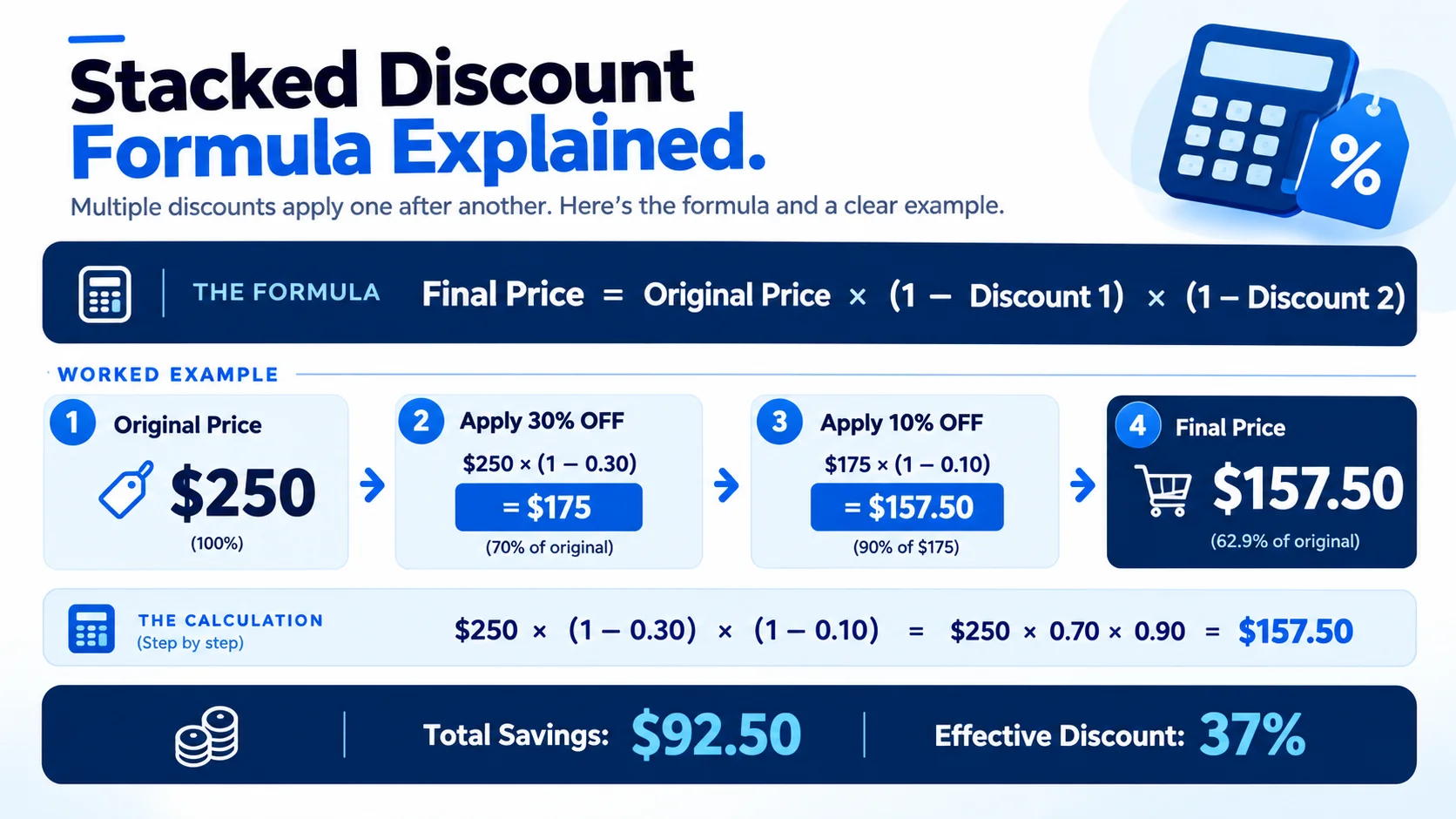
The general formula is
Final Price = Original Price × (1 − d₁/100) × (1 − d₂/100)
For three or more percentage discounts, continue multiplying the remaining-price factors. This approach explains how stacked discounts work without relying on guesswork or simply adding promotional percentages.
Effective Discount Formula
Effective Discount = (1 − Final Price ÷ Original Price) × 100
Example:
If a $100 item becomes $72 after two discounts:
(1 − 72 ÷ 100) × 100 = 28%So the effective discount is 28%.
A Simple Stacked Discount Example
Suppose a $250 pair of shoes receives a 30% sale discount followed by an additional 10% coupon. First, subtract 30% from $250. That leaves $175. Next, apply 10% to $175, producing another $17.50 reduction.
Your final price becomes $157.50. You saved $92.50 altogether. That equals a 37% effective discount rather than 40%. The arithmetic looks modest, yet that four-point difference becomes substantial when you make larger purchases.
Three Discounts on One Purchase
Consider a $500 television with 20%, 10%, and 5% discounts applied sequentially. After 20%, the price falls to $400. The 10% reduction then brings it to $360. Finally, 5% removes $18, leaving $342.
Your total saving is $158, equivalent to 31.6% of the original price. This example shows why how stacked discounts work matters when several promotions appear together. Small percentages can produce a meaningful combined reduction without ever adding directly.
| Original Price | Discounts | Final Price | Effective Discount |
|---|---|---|---|
| $100 | 20% + 10% | $72 | 28% |
| $250 | 30% + 10% | $157.50 | 37% |
| $500 | 20% + 10% + 5% | $342 | 31.6% |
What Is the Effective Discount?
The effective discount tells you the single percentage that produces the same final price as several sequential reductions. It gives shoppers a much clearer way to compare different promotions that use different combinations of coupons, sales, or member offers.
For example, a 20% discount followed by 10% produces a final multiplier of 0.80 × 0.90 = 0.72. Therefore, you keep 72% of the original price and save 28%. That 28% figure is the effective discount.
Does Discount Order Matter?
Here is a useful twist: when you apply only percentage-based discounts to the same price, changing their order does not alter the final result. A 20% discount followed by 10% produces the same final amount as 10% followed by 20%.
The intermediate prices will look different, however. That distinction matters when a promotion includes minimum spending requirements, fixed-dollar coupons, exclusions, or other conditions. In those cases, the promotional rules can change the outcome.
For example:
$100 × 0.80 × 0.90 = $72
$100 × 0.90 × 0.80 = $72
The order changes the intermediate price, but the final price remains the same when both discounts are percentage-based.
Percentage Discounts vs Fixed Coupons
Percentage discounts and fixed-dollar coupons behave differently. A 20% discount changes according to the current price, while a $20 coupon removes the same dollar amount regardless of whether the item costs $100 or $500.
For example, applying 20% off to $200 leaves $160. A further $20 coupon brings the price to $140. However, if the $20 coupon applies first, the percentage reduction becomes $36. That leaves $144 instead. Here, order genuinely matters.
What Happens When Sales Tax Is Added?
Taxes generally enter the calculation after discounts, although the exact treatment depends on the jurisdiction and retailer. Therefore, you should distinguish between the discounted price and the final checkout amount.
Suppose your discounted purchase costs $72 and the applicable tax rate is 8%. The tax equals $5.76, making the checkout total $77.76. A discount does not automatically mean your final receipt equals the discounted sticker price.
The exact tax calculation can vary by location, product type, and retailer. Check the applicable tax rules or the seller’s checkout calculation when the final amount matters.
How Can You Compare Two Stacked Deals?
When two promotions look similar, ignore the headline percentages for a moment. Instead, calculate the final amount you would actually pay. This method prevents a flashy “extra 20% off” message from automatically appearing better than another offer.
For example, compare 30% off followed by 10% with a straight 35% discount. The stacked offer produces a 37% effective reduction. Therefore, despite having smaller-looking individual percentages, it actually provides the better mathematical discount.
Common Mistakes With Stacked Discounts
The biggest mistake is simply adding the percentages together. Shoppers also sometimes calculate every discount against the original price, which exaggerates the savings. Another frequent error involves treating a fixed-dollar coupon like a percentage discount.
You should also check whether the retailer permits discounts to stack at all. Some stores restrict coupons, exclude clearance products, or apply promotions only to specific categories. The mathematics can be correct while the promotional assumptions are wrong.
When Should You Use a Stacked Discount Calculator?
A calculator becomes especially useful when several discounts appear on the same purchase. Rather than performing repeated calculations manually, you can enter the original price and each percentage to see the final amount and effective savings.
This becomes even more valuable for expensive purchases. A small calculation error on a $20 item may not matter much. On a $2,000 appliance, however, misunderstanding how stacked discounts work could create a surprisingly large difference.

Final Takeaway
The key lesson is simple: stacked percentage discounts work one after another. Each reduction applies to the price left by the previous one. Consequently, 20% plus 10% creates a 28% effective discount rather than 30%.
Once you understand the pattern, promotional pricing becomes much easier to decode. Check the final price, calculate the true saving, and read the offer conditions carefully. That simple habit can keep attractive-looking deals from fooling your wallet.
Frequently Asked Questions (FAQ)
Is 20% off plus 10% off equal to 30% off?
No. The second 10% applies to the price after the first 20% reduction. For a $100 item, 20% leaves $80, then 10% removes $8. You therefore pay $72 and receive a 28% effective discount, not 30%.
Does the order of percentage discounts matter?
No, provided both discounts are purely percentage-based and apply to the same price. Multiplication produces the same final result in either order. However, order can matter when a deal includes fixed-dollar coupons, spending thresholds, taxes, or special promotional rules.
How do you calculate three stacked discounts?
Multiply the remaining-price factors for each discount. For 20%, 10%, and 5%, use 0.80 × 0.90 × 0.95. The result is 0.684, meaning you pay 68.4% of the original price and receive a 31.6% effective discount.
Can a fixed coupon stack with percentage discounts?
Sometimes. It depends entirely on the retailer’s promotional terms. Unlike percentage reductions, a fixed coupon removes a specific dollar amount. Therefore, applying it before or after percentage discounts can produce different final prices.
Are stacked discounts always available?
Not necessarily. Retailers decide which promotions can combine. Some allow sale discounts plus member coupons, while others block coupon stacking. Always check the offer’s terms before assuming multiple discounts will apply to the same purchase.
What is the easiest way to check stacked savings?
Start with the original price and apply every percentage reduction sequentially. For larger purchases or several discounts, a stacked discount calculator can reduce manual errors and show the effective percentage alongside the final price.