20 Weeks From Today: January 24, 2027
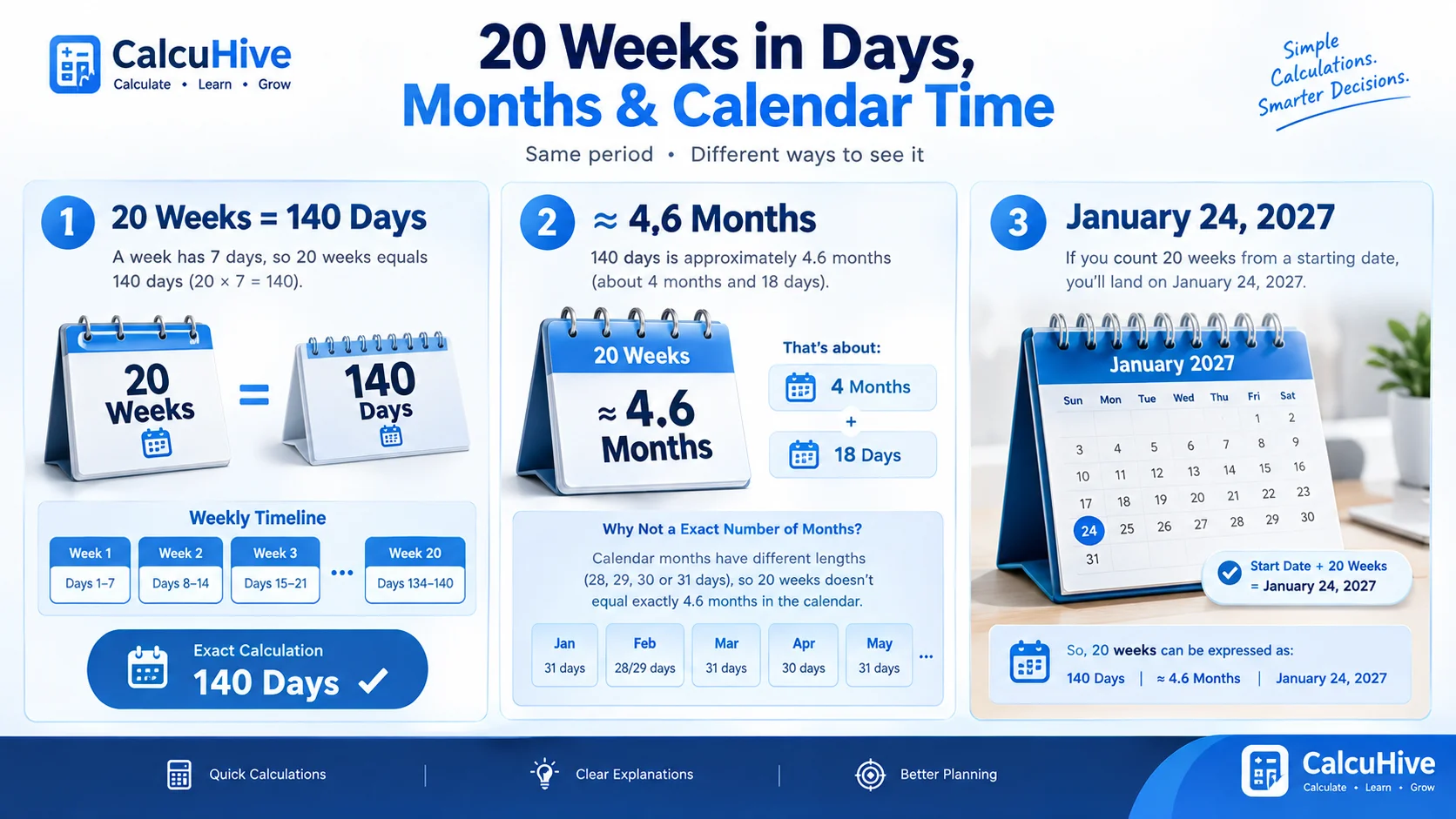
If today is September 6, 2026, then 20 weeks from today is January 24, 2027. Twenty weeks equals 140 days, so adding 140 days to September 6, 2026, gives Sunday, January 24, 2027.
Whether you are planning an event, tracking a deadline, calculating a future milestone, or checking a pregnancy timeline, knowing how to calculate weeks from a specific date can make planning much easier.
Table of Contents
What Date Is 20 Weeks From Today?
Using September 6, 2026, as today:
| Calculation | Result |
|---|---|
| Today | September 6, 2026 |
| Number of weeks | 20 weeks |
| Number of days | 140 days |
| Date: 20 weeks later | January 24, 2027 |
| Day of the week | Sunday |
So, 20 weeks from September 6, 2026, is January 24, 2027.
The calculation is straightforward because one week always contains seven days. Therefore, 20 weeks × 7 days = 140 days.
Is 20 weeks exactly 5 months?
Not exactly. A week is a fixed seven-day period, while calendar months have different lengths.
Twenty weeks is 140 days, which is approximately 4.6 calendar months. Depending on the dates being compared, people may casually describe 20 weeks as around 4½ to 5 months, but a date calculation should use the exact number of days.
How to Calculate 20 Weeks From Today
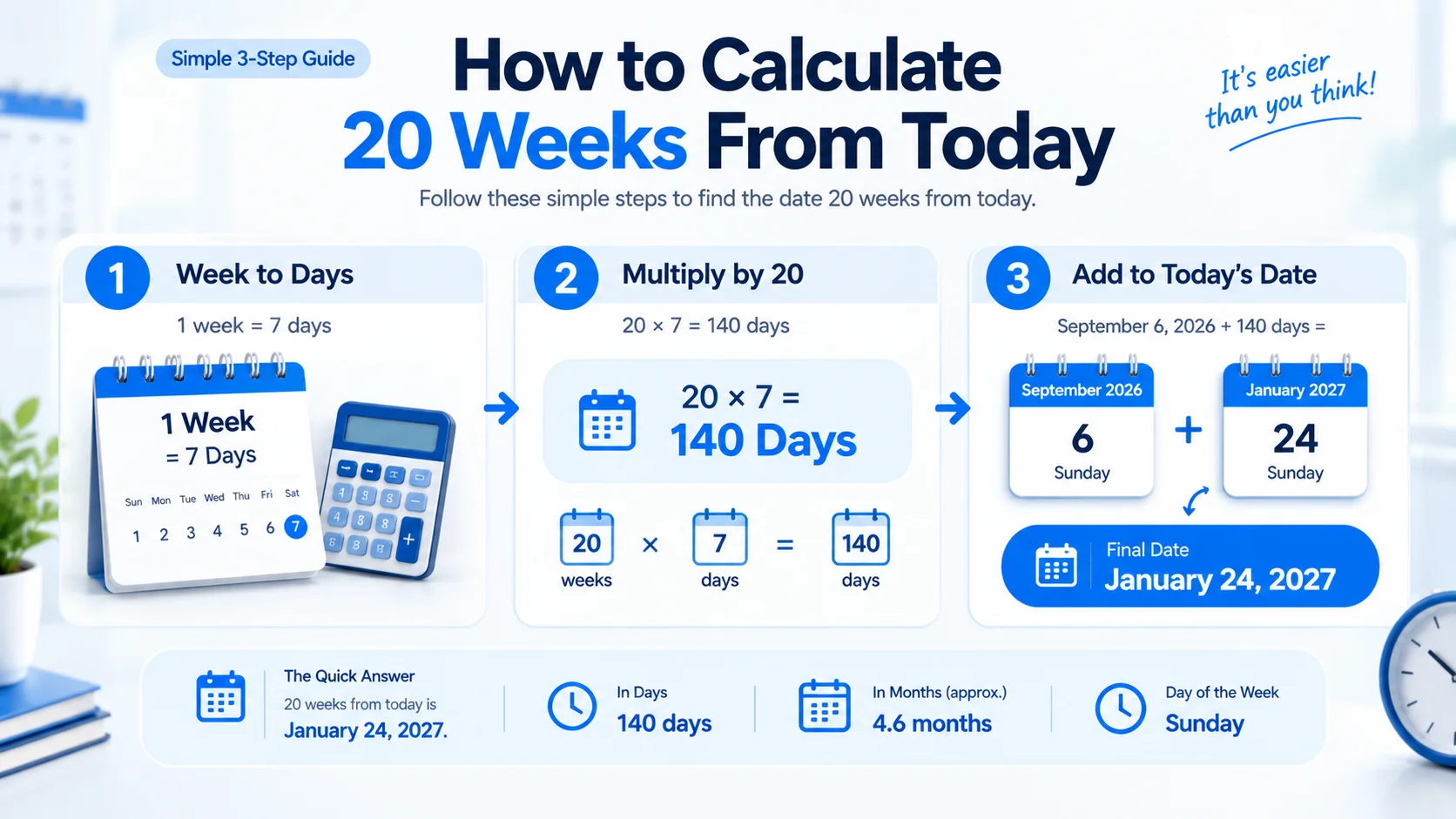
You can calculate a date 20 weeks in the future using a simple three-step method.
Step 1: Start with today’s date.
For this example, the starting date is
September 6, 2026
Step 2: Convert weeks into days.
There are seven days in one week:
20 × 7 = 140 days
So the calculation requires moving forward exactly 140 days.
Step 3: Add 140 days.
Adding 140 days to September 6, 2026, results in:
January 24, 2027
This method works regardless of whether the starting date falls at the beginning, middle, or end of a month.
20 Weeks From Today in Days and Months
Understanding the same period in different units can make the result easier to interpret.
20 weeks in days
Twenty weeks contains exactly:
20 × 7 = 140 days
So the most precise simple conversion is 140 days.
20 weeks in months
There is no exact fixed conversion between weeks and calendar months because months vary from 28 to 31 days.
Using an average month length, 20 weeks is roughly 4.6 months. For practical calendar planning, however, it is better to calculate from the starting date rather than converting weeks into months.
20 weeks in hours
If you need the period for a project or scheduling calculation:
140 days × 24 hours = 3,360 hours
That means 20 weeks represents 3,360 hours, ignoring daylight-saving clock changes when calculating elapsed calendar time.
20 Weeks From Today’s Calendar
Here is a simple month-by-month view of the calculation:
| Period | Approximate progress |
|---|---|
| September 6 → October 6 | 1 month |
| October 6 → November 6 | 2 months |
| November 6 → December 6 | 3 months |
| December 6 → January 6 | 4 months |
| January 6 → January 24 | Remaining days |
| Final date | January 24, 2027 |
The calendar-month approach demonstrates why saying that 20 weeks equals exactly five months can be misleading. The precise answer comes from adding 140 days, not from treating every month as four weeks.
What day will it be 20 weeks from today?
The answer is Sunday, January 24, 2027.
An easy way to verify the weekday is to remember that adding a whole number of weeks does not change the day of the week. Since September 6, 2026, is a Sunday, 20 weeks later is also a Sunday.
Why 20 Weeks Can Be Useful for Pregnancy Planning
Additionally, the term “20 weeks from today” might be included in pregnancy planning queries. Weeks make it easier to talk about progression in pregnancy than months.
For instance, if you have someone who is comparing a future date and a pregnancy timeline, they would want to know how many weeks is between two dates.
But a 20-week calendar calculation is not identical to pregnancy weeks. Preparing dates in pregnancy are based on a known point, rather than adding 20 weeks to the present day.
Use the right pregnancy calculator and note the appropriate pregnancy date, not today’s date.
Why pregnancy dates are often measured in weeks
Weeks make pregnancy tracking more consistent because they provide a standardized seven-day unit. Healthcare providers generally discuss pregnancy progress in weeks and days rather than relying only on calendar months.
For example, “20 weeks pregnant” identifies a much more specific point in a pregnancy timeline than simply saying “about five months.”
20 Weeks Before Today
You may also be interested in the reverse calculation.
If today is September 6, 2026, then 20 weeks before today is
April 19, 2026
The calculation is
September 6, 2026 − 140 days = April 19, 2026
This can be useful when checking historical deadlines, appointments, project milestones, previous events, or other date ranges.
20 weeks from today vs 20 weeks ago
These two calculations move in opposite directions:
| Calculation | Date |
|---|---|
| 20 weeks from September 6, 2026 | January 24, 2027 |
| 20 weeks before September 6, 2026 | April 19, 2026 |
Remember that “from today” normally means moving forward, while “ago” or “before today” means moving backward.
Common Date-Counting Mistakes
Calculating a future date seems simple, but a few common mistakes can produce a different answer.
1. Treating four weeks as one month
Four weeks equals 28 days, but most calendar months contain 30 or 31 days. February can contain 28 or 29 days.
For that reason, 20 weeks should not automatically be described as exactly five months.
2. Forgetting that weeks contain seven days
The simplest reliable conversion is
1 week = 7 days
Therefore:
20 weeks = 140 days
3. Counting today as the first full day
For standard date arithmetic, the starting date is generally treated as the reference point, and 140 days are added to it.
This distinction matters around deadlines. If a person says “20 days from today,” they usually mean the date 20 days after today, not today as day one.
4. Using a different starting date
The answer changes every day because “20 weeks from today” depends entirely on the current date.
For example, someone reading this article on a different date should recalculate rather than automatically using January 24, 2027.
A Quick Way to Check Any Future Week Date
If you need to calculate another number of weeks, use this formula:
Future date = Starting date + (Number of weeks × 7 days)
For example:
- 5 weeks = 35 days
- 10 weeks = 70 days
- 15 weeks = 105 days
- 20 weeks = 140 days
- 25 weeks = 175 days
- 30 weeks = 210 days
This approach is particularly useful when you need a quick estimate without manually counting every week on a calendar.
What Is 20 Weeks From September 6, 2026?
Twenty weeks after September 6, 2026, is January 24, 2027.
The period contains exactly 140 days. Because 20 is a whole number of weeks, the future date falls on the same weekday as the starting date: Sunday.
This makes January 24, 2027, the direct answer for anyone using September 6, 2026, as the reference date.
Frequently Asked Questions
What date is 20 weeks from today?
If today is September 6, 2026, then 20 weeks from today is January 24, 2027. Twenty weeks equals 140 days.
How many days are in 20 weeks?
There are exactly 140 days in 20 weeks because one week contains seven days.
Is 20 weeks equal to 5 months?
Not exactly. Twenty weeks is 140 days, which is approximately 4.6 months. Calendar months vary in length, so weeks and months cannot be converted perfectly using a fixed ratio.
What day of the week is 20 weeks from today?
Twenty weeks from September 6, 2026, is Sunday, January 24, 2027. A whole number of weeks later always falls on the same weekday.
What date was 20 weeks before September 6, 2026?
Twenty weeks before September 6, 2026, was April 19, 2026.
How do I calculate a date 20 weeks from another date?
Multiply 20 weeks by seven days to get 140 days, then add 140 days to your starting date. For more complex calculations, a date calculator can perform the calculation automatically.