Mortgage Payment Calculator Estimate Your Monthly Loan Repayments
Buying a home is one of the biggest financial decisions you can make. Before choosing a property or applying for a home loan, it is important to understand how much you may need to repay each month and how much interest you could pay over the life of the loan.
A mortgage payment calculator can make this process much easier. By entering information such as the property price, deposit, loan amount, interest rate, and loan term, you can estimate your regular mortgage payments and compare different borrowing scenarios.
Whether you are buying a home in the USA, UK, or Australia, a mortgage payment calculator can help you understand your potential repayments and make more informed financial decisions.
What Is a Mortgage Payment Calculator?
A mortgage payment calculator is an online financial tool that estimates how much you may need to pay toward a home loan.
You can input the following on the calculator:
The price of a house or dwelling.
Advanced payment or down payment
- Loan amount
- Interest rate
- Mortgage term
- Payment frequency
- Property taxes
- Home insurance
- Mortgage insurance or LMI
- Additional repayments
The calculator then calculates your typical repayment and, in most cases, the interest you will pay over the loan life.
For instance, if you’re thinking about a $400,000 house mortgage, you can also alter the interest rate and term in order to determine the impact on the monthly mortgage payment.
Even a slight adjustment in the interest rate or loan duration can alter the entire loan amount, which is why it’s helpful to use a mortgage payment calculator.
How to Use a Mortgage Payment Calculator
Using a mortgage payment calculator is generally simple. Start by entering the basic information about the property and loan.
1. Enter the Home Price
Enter the purchase price of the property you are considering.
For example:
Home price: $500,000
The currency will depend on where you are buying. A US buyer may use dollars, a UK buyer may use pounds, and an Australian buyer may use Australian dollars.
2. Enter Your Deposit or Down Payment
Next, enter the amount you plan to contribute toward the property.
For example:
Home price: $500,000
Deposit: $100,000
Your estimated loan amount would then be:
$500,000 − $100,000 = $400,000
A larger deposit generally means you need to borrow less, which can reduce your repayments and the amount of interest paid over time.
3. Enter the Interest Rate
The interest rate is one of the most important factors affecting your mortgage repayment.
For example, you might compare:
- 5%
- 5.5%
- 6%
- 6.5%
Testing different rates with a mortgage interest calculator can help you understand how changes in borrowing costs could affect your budget.
4. Select the Loan Term
The loan term is the length of time over which you plan to repay the mortgage.
Common terms vary by country and lender. In the US, 15-year and 30-year mortgages are particularly common. In the UK and Australia, borrowers may also consider terms around 20 to 30 years, depending on their circumstances and lender.
A longer loan term generally produces a lower regular payment but can result in significantly more interest being paid overall.
5. Choose the Payment Frequency
Some calculators allow you to compare monthly, fortnightly, or weekly repayments.
This can be especially useful for borrowers in Australia and the UK, where repayment frequency can vary depending on the mortgage product.
How Is a Mortgage Payment Calculated?
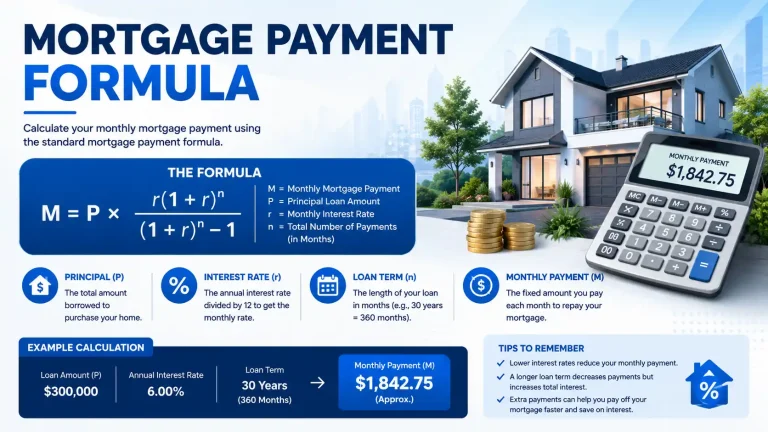
A standard principal-and-interest mortgage payment can be calculated using a mathematical formula.
The basic formula is:
M = P × [r(1+r)ⁿ] ÷ [(1+r)ⁿ − 1]
Where:
- M = regular mortgage payment
- P = principal or loan amount
- r = periodic interest rate
- n = total number of payments
You do not need to calculate this manually when using an online home loan repayment calculator. The calculator performs the calculation automatically.
Keep in mind that an actual mortgage payment may include additional costs such as taxes, insurance, mortgage insurance, lender fees, or other property-related expenses.
What Factors Affect Your Mortgage Repayment?
Several factors can change the amount you pay.
Loan Amount
The more you borrow, the higher your potential repayments will generally be.
Borrowing $300,000 will normally require lower repayments than borrowing $500,000 at the same interest rate and loan term.
Interest Rate
A higher interest rate increases the cost of borrowing.
For example, a loan at 7% will generally cost more in interest than the same loan at 5%, assuming the other terms remain unchanged.
Loan Term
The length of your mortgage also matters.
A shorter loan term can mean higher regular repayments, but you may pay less total interest.
A longer term can make the regular payment more manageable but may increase the total interest paid.
Deposit
Your deposit reduces the amount you need to borrow.
For example:
$600,000 property − $120,000 deposit = $480,000 loan
Reducing the loan amount can lower your repayments and may also affect mortgage insurance requirements depending on the country and lender.
Mortgage Payment Example
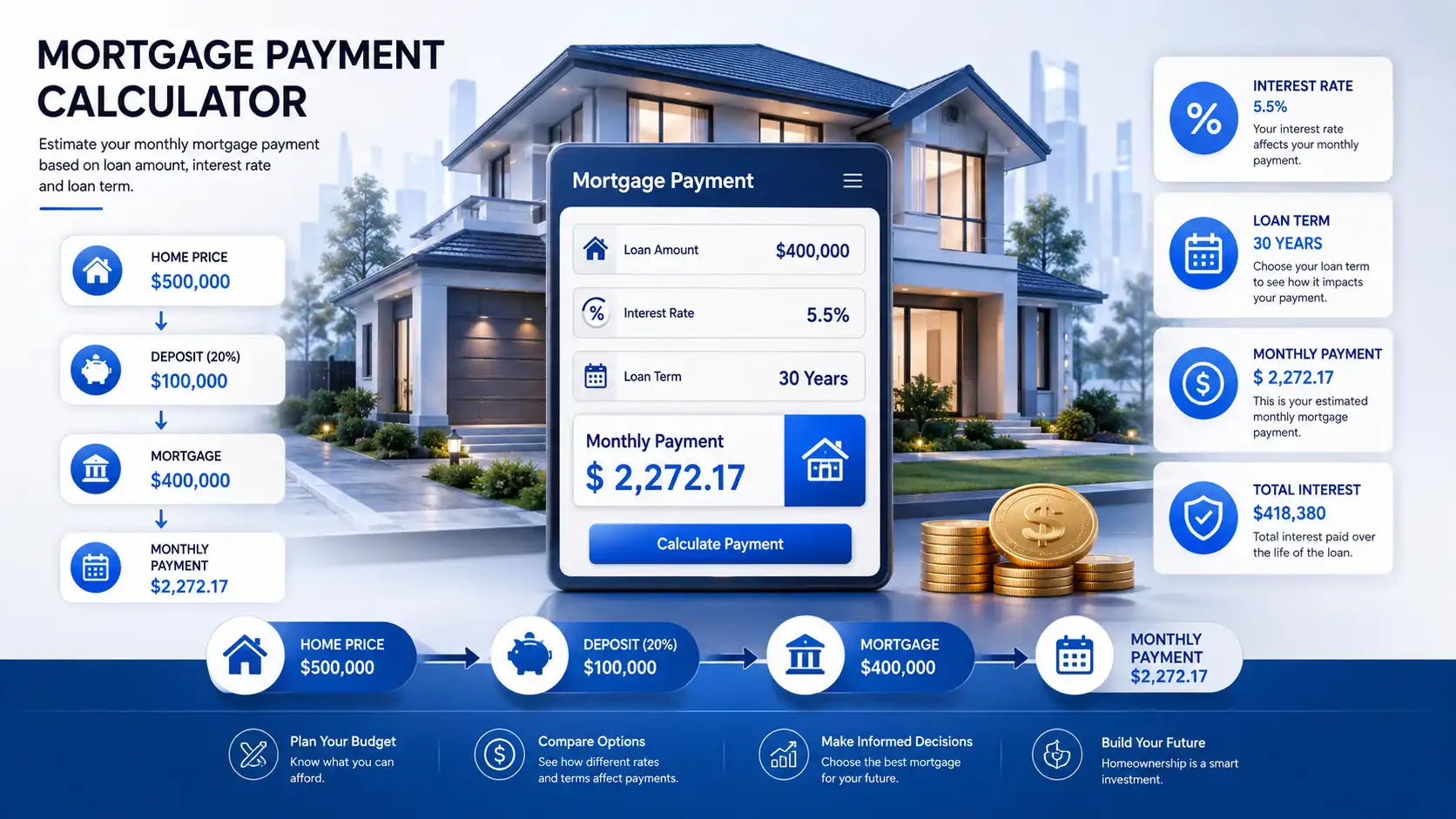
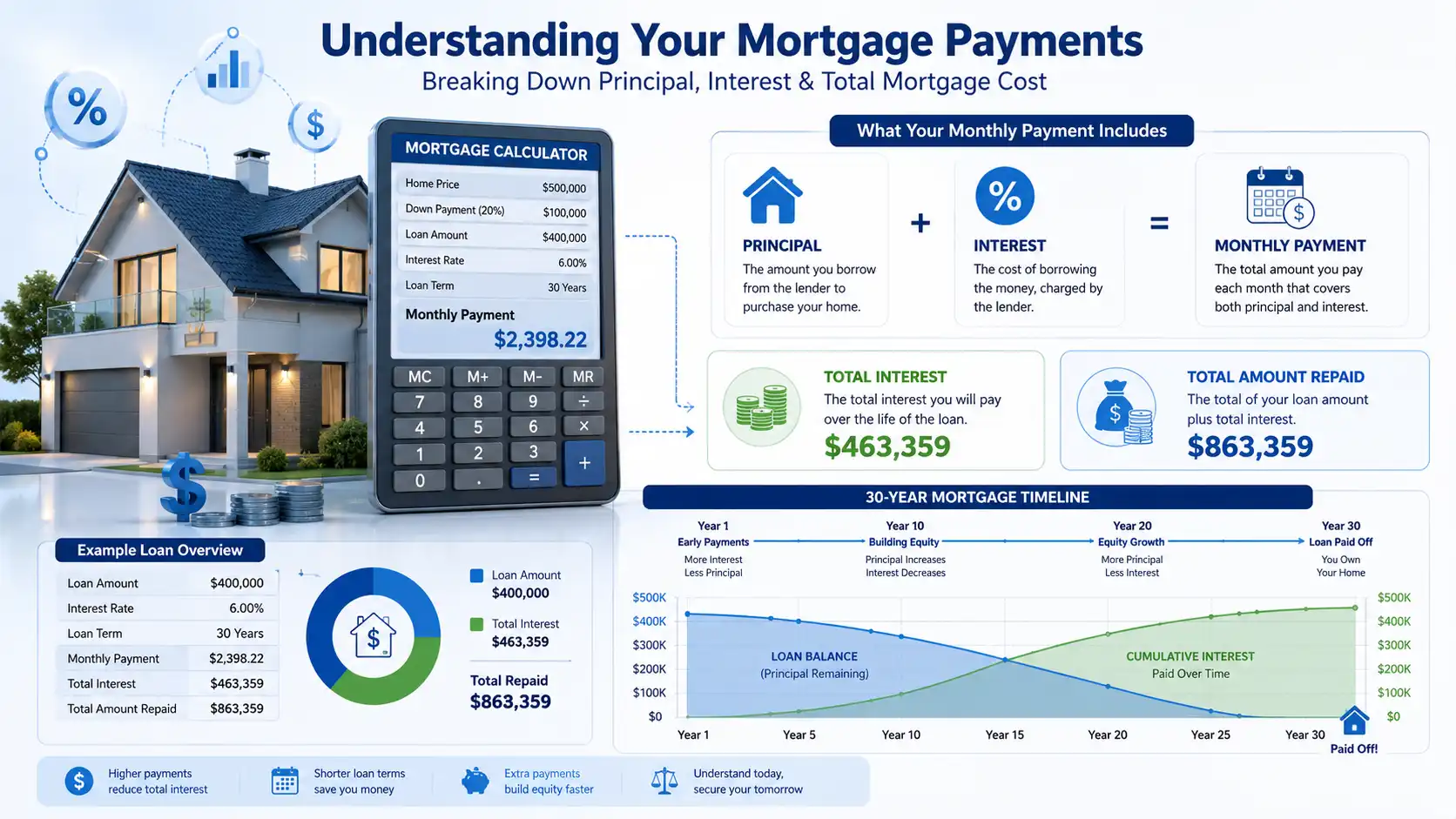
Suppose you are considering a home worth $500,000.
You have a $100,000 deposit, leaving a loan of $400,000.
If the loan has a fixed interest rate and a 30-year repayment period, your estimated payment can be calculated using a mortgage payment calculator.
You can then change individual factors to compare different scenarios.
For example:
Scenario A: $400,000 loan at 5.5% for 30 years
Scenario B: $400,000 loan at 6.5% for 30 years
Scenario C: $400,000 loan at 5.5% for 20 years
The calculator allows you to see how the interest rate and loan term affect the estimated repayment.
This is much more useful than looking at only one repayment figure because it allows you to compare your options before making a borrowing decision.
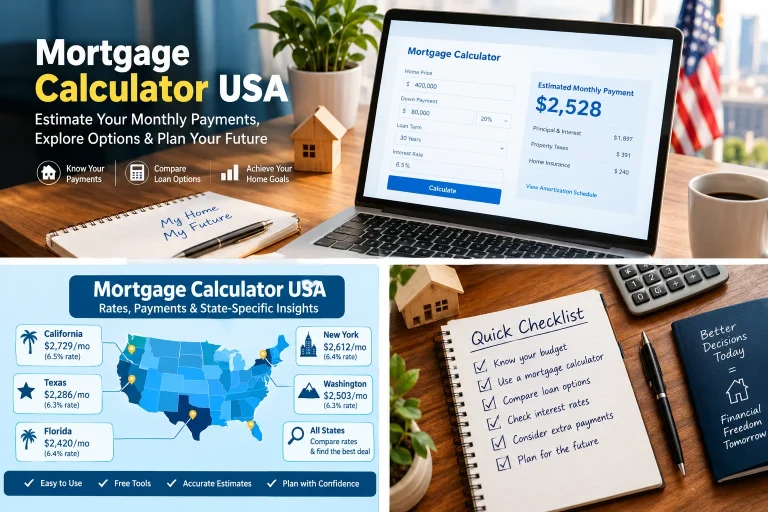
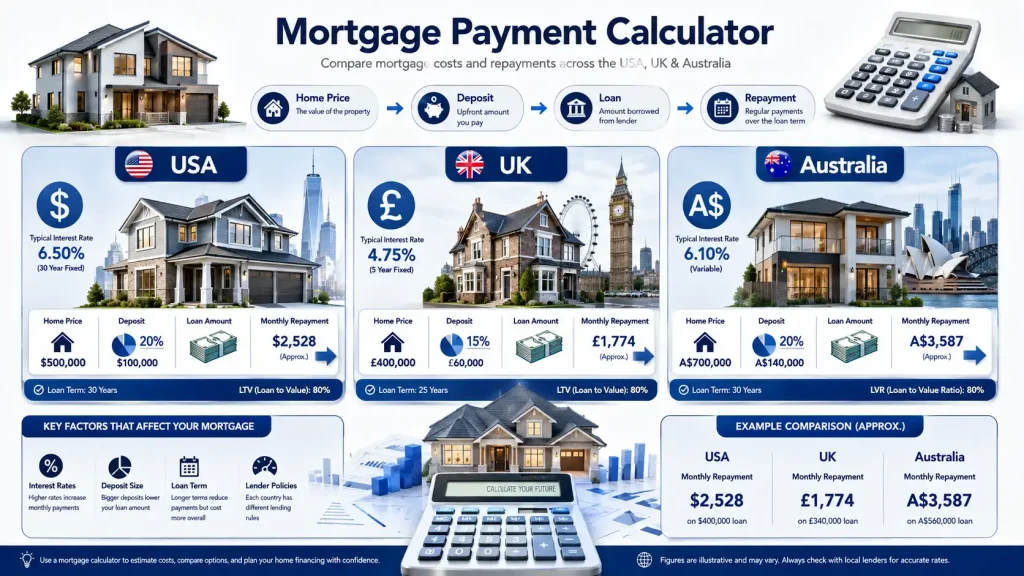
Mortgage Payment Calculator for the USA
Home buyers in the USA can use a mortgage calculator USA to calculate the principal and interest payments.
A common practice for U.S. borrowers is to consider both 15-year and 30-year mortgages. Other expenses, like private mortgage insurance, homeowners insurance, and property taxes, may also be added based on the calculator.
Buying $400,000 house, for instance, may check a 20% down payment with a lower down payment to see how the loan amount and the mortgage insurance payments will impact the cost of the home.
Keep in mind, an online calculation is an estimation. The exact amount you’ll pay for your mortgage is based on the lender, interest rate, term, taxes, insurance and any other applicable expenses.
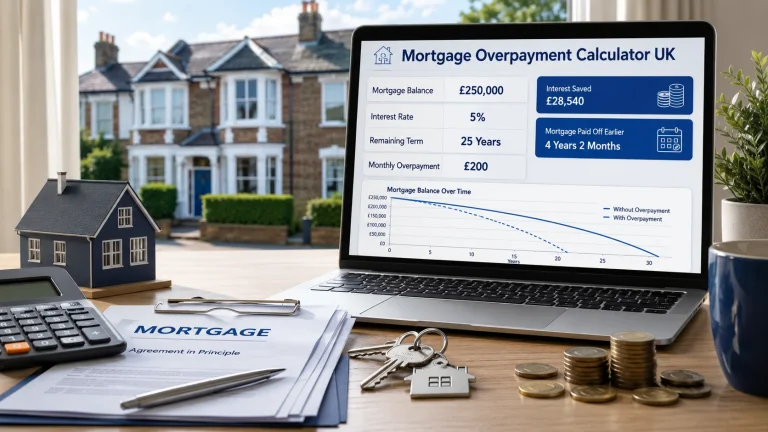
Mortgage Payment Calculator UK
A mortgage calculator UK can help prospective homeowners estimate their mortgage repayments in pounds.
UK borrowers may compare different mortgage terms, interest rates, and deposit amounts before applying for a home loan.
For example, increasing your deposit can reduce the amount you need to borrow. Borrowers may also compare different fixed-rate or variable-rate mortgage scenarios.
When planning a UK home purchase, remember that buying a property can involve additional expenses beyond the mortgage, including taxes, legal costs, valuation costs, and other fees.
Mortgage Payment Calculator Australia
An Australian mortgage calculator can help home buyers estimate potential home loan repayments.
Australian borrowers may compare:
- Home loan amount
- Deposit
- Interest rate
- Loan term
- Weekly repayments
- Fortnightly repayments
- Monthly repayments
- Principal and interest loans
- Interest-only loans
Another important consideration in Australia is Lenders Mortgage Insurance (LMI). Depending on the loan-to-value ratio and lender requirements, LMI may add to the cost of borrowing.
A home loan calculator Australia users can rely on for initial estimates can therefore be useful when comparing different deposit and borrowing scenarios.
However, borrowers should always confirm the actual costs and loan conditions with their lender or qualified financial professional.
What Is the Difference Between a Mortgage Payment Calculator and a Home Loan Calculator?
The terms are often used interchangeably.
A mortgage payment calculator generally focuses on estimating repayments for a mortgage.
A home loan calculator can perform a similar function and may be especially common in countries such as Australia and the UK.
Both can help you estimate:
- Regular repayments
- Total interest
- Total amount repaid
- Effect of changing interest rates
- Effect of changing the loan term
- Effect of changing the deposit
The exact features depend on the calculator you use.
How Much Mortgage Can I Afford?
A mortgage payment calculator tells you what your estimated repayment could be, but it does not automatically determine how much you should borrow.
Your affordability can depend on:
- Household income
- Existing debts
- Living expenses
- Deposit
- Credit history
- Interest rate
- Loan term
- Insurance and taxes
- Other financial commitments
A mortgage affordability calculator can provide a useful starting point, but affordability should be assessed carefully before taking on a long-term financial commitment.
It is important to leave room in your budget for unexpected expenses and potential changes in interest rates or household income.
How Can You Reduce Your Mortgage Payments?
There are several ways borrowers may potentially reduce their mortgage costs.
Increase Your Deposit
A larger deposit means you may need to borrow less.
Compare Interest Rates
Even a relatively small difference in interest rates can affect the total cost of a long-term mortgage.
Consider the Loan Term
A shorter loan term can reduce the total interest paid, although your regular repayments may be higher.
Make Additional Repayments
Where your mortgage terms allow it, additional repayments can potentially reduce the outstanding balance and the interest charged over time.
Compare Loan Options
Before choosing a mortgage, compare the interest rate, fees, repayment structure, flexibility, and other conditions rather than looking at the interest rate alone.
Mortgage Payment vs Total Mortgage Cost
One important reason to use a mortgage payment calculator is that the regular payment does not tell you the entire story.
For example, a mortgage may appear affordable because the monthly payment fits your budget. However, over several decades, the total interest can represent a substantial portion of the amount repaid.
A calculator can help you compare:
Regular repayment → Total interest → Total amount repaid
This gives you a better understanding of the long-term cost of the mortgage.
Is a Mortgage Payment Calculator Accurate?
A mortgage payment calculator can provide a useful estimate, but it should not be treated as a formal loan offer.
The final amount you pay may differ because of:
- Actual lender interest rates
- Loan fees
- Taxes
- Insurance
- Mortgage insurance
- Changes in interest rates
- Repayment structure
- Lender-specific conditions
Use the calculator as a planning and comparison tool, then confirm the final figures with your lender.
Final Thoughts
A mortgage payment calculator is a useful starting point for anyone considering buying a home, refinancing an existing mortgage, or comparing different home loan options.
By changing the loan amount, deposit, interest rate, and repayment term, you can see how different decisions may affect your regular payments and total borrowing cost.
Whether you are searching for a mortgage calculator USA, mortgage calculator UK, or mortgage calculator Australia, the same basic principle applies: understand your potential repayments before committing to a long-term home loan.
Try different scenarios with the CalcuHive Mortgage Calculator, compare your estimated repayments, and use the results as a starting point for making a more informed home-buying decision.
Calculator results are estimates for informational purposes only and should not be considered financial advice or a loan offer. Actual repayments and borrowing costs depend on your lender, loan terms, interest rate, fees, taxes, insurance, and individual circumstances.
Frequently Asked Questions
What is a mortgage payment calculator?
A mortgage payment calculator is an online tool that estimates your regular home loan repayment based on factors such as loan amount, interest rate, and loan term.
How do I calculate my monthly mortgage payment?
Enter your loan amount, interest rate, and loan term into a mortgage payment calculator. The tool can estimate the regular repayment automatically.
Does a mortgage payment calculator include interest?
Most mortgage payment calculators include interest in the estimated principal-and-interest repayment. Some advanced calculators can also estimate additional costs such as taxes, insurance, or mortgage insurance.
Is a mortgage calculator the same in the USA, UK, and Australia?
The basic repayment calculation is similar, but mortgage products, taxes, insurance, fees, and lending rules differ between countries. Always consider local loan conditions when interpreting the result.
Can I use a mortgage payment calculator for refinancing?
Yes. A calculator can help you compare your existing mortgage with a potential new loan by changing the interest rate, balance, term, and repayment frequency.
Does a larger deposit reduce mortgage repayments?
Generally, yes. A larger deposit means you borrow less, which can reduce the regular repayment and total interest, although the exact effect depends on the loan terms.
Should I choose a longer mortgage term?
A longer term can reduce your regular repayment, but it may increase the total interest paid over the life of the loan. Compare different terms using a mortgage payment calculator before deciding.