

How to Calculate Loan Payments LMI and Student Loan Repayments
A loan can be one of the biggest financial commitments you make, whether you are buying a home, purchasing a car, paying for education, or covering another major expense. Before applying for a loan, it is important to understand how much you may need to repay each month and how interest affects the total cost of borrowing.
A loan calculator makes this process easier. By entering the loan amount, interest rate, and loan term, you can estimate your regular repayments and compare different borrowing scenarios.
For Australian borrowers, understanding related costs such as LMI (Lenders Mortgage Insurance) and student loan repayments can also help when planning your finances. This guide explains how loan calculators work, how to calculate loan repayments, what LMI means, and how student loan repayments may affect your budget.
What Is a Loan Calculator?
A loan calculator is an online financial tool that estimates your loan repayments based on several inputs. The most common inputs are:
- Loan amount
- Interest rate
- Loan term
- Repayment frequency
- Deposit or upfront contribution, where applicable
- Additional fees or charges
For example, if you borrow $400,000 at a particular interest rate over 30 years, a loan calculator can estimate your regular repayment.
Using a calculator before applying for a loan can help you understand whether the repayments are affordable and how changing the loan term or interest rate could affect the overall cost.
How Does a Loan Calculator Work?
Most standard loan calculators use a mathematical formula to estimate repayments on an amortising loan.
For a typical principal-and-interest loan, the repayment depends on the amount borrowed, interest rate, and number of repayments.
A simplified monthly repayment formula is:
M = P × [r(1+r)ⁿ] ÷ [(1+r)ⁿ − 1]
Where:
- M = monthly repayment
- P = principal or amount borrowed
- r = monthly interest rate
- n = total number of monthly repayments
You do not normally need to calculate this formula manually. An online loan calculator can perform the calculation instantly.
The calculator can also make it easier to test different scenarios. For example, you could compare a 20-year loan with a 30-year loan or see how repayments change when the interest rate increases.
Why Use a Loan Calculator?
A loan calculator can be useful before taking out a mortgage, personal loan, car loan, or other type of borrowing.
1. Estimate Your Regular Repayments
The most obvious benefit is knowing approximately how much you could repay each month, fortnight, or week.
This can help you build a realistic household budget before making a borrowing decision.
2. Compare Loan Terms
A longer loan term generally reduces the required regular repayment, but you may pay more interest over the life of the loan.
A shorter term can increase regular repayments while potentially reducing the total interest paid.
3. Understand Interest Costs
Your repayment is not normally made up entirely of principal. A portion goes toward interest.
A loan calculator can help demonstrate how the interest rate and loan term influence the total amount repaid.
4. Plan Your Budget
Knowing an estimated repayment can help you determine whether a particular loan fits within your existing income and expenses.
How to Calculate Loan Repayments
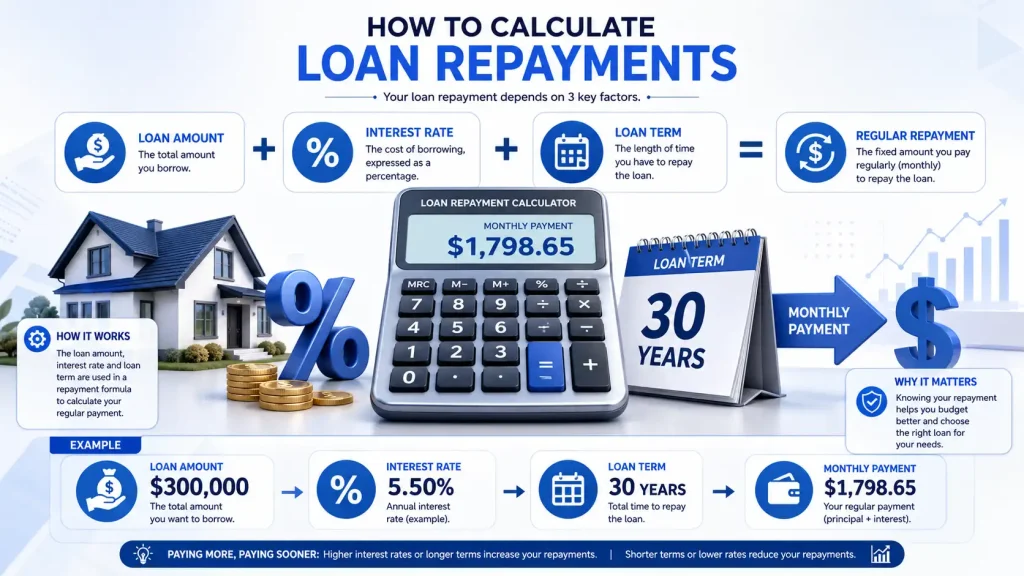
To calculate loan repayments, you generally need three key figures:
Loan amount + interest rate + loan term
For example, imagine borrowing $300,000 with an annual interest rate of 6% over 25 years.
The calculator converts the annual interest rate into the appropriate periodic rate and calculates the estimated repayment based on the number of scheduled repayments.
You can then change the inputs to see how the result changes.
For example, increasing the loan term may lower the monthly repayment, while increasing the interest rate generally increases it.
Remember that calculator results are estimates. Actual repayments can depend on the lender, loan product, fees, interest-rate changes, repayment frequency, and other conditions.
What Is LMI?
If you are researching Australian home loans, you may also come across the term LMI calculator.
LMI stands for Lenders Mortgage Insurance. It is generally insurance that protects the lender if a borrower cannot repay the loan and the property sale does not cover the outstanding debt.
LMI is commonly associated with borrowers who have a relatively small deposit compared with the property’s purchase price.
The exact requirements and cost depend on the lender, loan structure, property, borrower circumstances, and other factors.
An LMI calculator can provide an estimate of the potential LMI cost based on information such as the property value, loan amount, and deposit.

How to Calculate LMI
There is no single universal formula that allows every borrower to calculate LMI accurately because premiums can vary between lenders and circumstances.
However, an LMI calculator can provide an estimate.
A basic calculation process is:
- Enter the estimated property purchase price.
- Enter the amount you intend to borrow.
- Enter your deposit.
- Calculate the loan-to-value ratio (LVR).
- Estimate the applicable LMI premium.
- Add the estimated LMI to the overall borrowing costs if it is financed into the loan.
For example, if a property costs $600,000 and you have a $60,000 deposit, the initial loan amount would be approximately $540,000 before considering additional costs.
Your LVR would be:
$540,000 ÷ $600,000 × 100 = 90%
A higher LVR may mean LMI is applicable, depending on the lender and loan circumstances.
Because LMI pricing can vary, an online calculator should be treated as an estimate rather than a guaranteed premium.
Loan-to-Value Ratio and LMI
Loan-to-value ratio, or LVR, is an important concept when considering a mortgage.
The basic formula is:
LVR = Loan Amount ÷ Property Value × 100
For example:
$450,000 ÷ $500,000 × 100 = 90% LVR
A lower LVR generally means the borrower has more equity in the property.
A higher deposit can therefore reduce the amount borrowed relative to the property value and may reduce or eliminate the need for LMI depending on the lender’s requirements.
What Is a Student Loan Calculator?
A student loan calculator can help estimate repayments associated with education-related borrowing.
In Australia, student debt can include government-supported education debts such as HELP. Repayment arrangements can differ from those of conventional bank loans.
Unlike a standard personal loan calculator, a student loan repayment calculator may consider factors such as income and the applicable repayment rules rather than simply calculating a fixed monthly payment.
If you have an education debt, understanding how repayments interact with your income can help you plan your finances.

Payment Student Loan Calculator: What Should You Consider?
When using a payment student loan calculator, look at more than just the estimated repayment.
Consider:
- Your expected income
- Outstanding student debt
- Applicable repayment thresholds
- Compulsory repayment arrangements
- Voluntary repayments
- Changes to your income over time
- Other monthly financial commitments
Student loan rules can change, so always check current official information before making important financial decisions.
Loan Term vs Monthly Repayment
One of the most important things a loan calculator demonstrates is the relationship between loan term and repayment amount.
Suppose you borrow the same amount at the same interest rate.
A shorter loan term generally means:
- Higher regular repayments
- Less interest paid over the loan
- Faster reduction of the principal
A longer loan term generally means:
- Lower regular repayments
- More interest paid over the life of the loan
- A longer period of debt
This is why comparing different loan terms is an important step before borrowing.
How Extra Repayments Can Help
Some loans allow borrowers to make additional repayments.
If your loan permits extra repayments without significant penalties, paying more than the minimum may reduce the outstanding principal faster. This can potentially reduce the amount of interest paid over time.
For example, you could use a loan calculator to compare:
Scenario A: Minimum scheduled repayments
Scenario B: Minimum repayments + $100 per month
The difference can help you understand the potential impact of making additional payments.
However, loan conditions vary, so check your lender’s terms before making additional repayments.
Loan Calculator for Different Types of Loans
A loan calculator can be useful for several types of borrowing.
Home Loan Calculator
A home loan calculator can estimate mortgage repayments and help borrowers compare different loan amounts, interest rates, and terms.
Car Loan Calculator
A car loan calculator can help estimate repayments when financing a vehicle. You can also compare the impact of different deposits and loan terms.
Personal Loan Calculator
A personal loan calculator can estimate repayments for borrowing used for purposes such as renovations, large purchases, or other eligible expenses.
Student Loan Calculator
A student loan calculator can help you understand potential education-debt repayments based on the relevant repayment system.
Tips for Using a Loan Calculator
For better results, use realistic information rather than optimistic assumptions.
Use an accurate loan amount: Include the amount you actually expect to borrow.
Test multiple interest rates: Interest rates can change, particularly with variable-rate loans.
Compare different terms: Do not look only at the lowest monthly repayment.
Consider additional costs: Application fees, ongoing fees, insurance, taxes, and other expenses may affect your actual cost.
Check affordability: A calculator estimates repayments, but your actual borrowing capacity depends on your complete financial circumstances.
Final Thoughts
A loan calculator is a useful starting point for understanding borrowing costs. Whether you are comparing a mortgage, car loan, personal loan, or student debt, estimating repayments before making a commitment can help you create a more realistic budget.
If you are considering a home loan, an LMI calculator can also help you understand the potential impact of Lenders Mortgage Insurance, particularly when borrowing with a smaller deposit. Understanding LVR, interest rates, loan terms, and additional costs gives you a clearer picture of the overall cost of borrowing.
Use calculator results as estimates rather than financial advice, and confirm rates, fees, eligibility requirements, and repayment rules with the relevant lender or official government source before making a financial decision.
Frequently Asked Questions
What is the purpose of a loan calculator?
A loan calculator estimates loan repayments using information such as the borrowing amount, interest rate, and loan term. It can help you compare borrowing scenarios before applying for a loan.
How do I calculate loan repayments?
For a standard principal-and-interest loan, repayments can be calculated using the loan amount, periodic interest rate, and total number of repayments. An online loan calculator can perform the calculation automatically.
How do I calculate LMI?
LMI depends on factors including the loan amount, property value, LVR, lender, and borrower circumstances. An LMI calculator can provide an estimate, but the actual premium is determined according to the applicable lender and insurer criteria.
What is an LMI calculator?
An LMI calculator estimates the potential cost of Lenders Mortgage Insurance based on information such as the property value, loan amount, and deposit.
Can a student loan calculator calculate my repayments?
A student loan calculator can provide an estimate, but the calculation method depends on the type of student debt and the applicable repayment rules. For Australian government student debt, current official repayment information should be checked before making financial decisions.