NHS Pregnancy Calculator: How to Calculate Your Pregnancy date
Pregnancy is an exciting journey, but keeping track of pregnancy weeks and months can sometimes feel confusing. Many people search for terms such as “24 weeks in months,” “how many months is 12 weeks,” “20 weeks in months,” “14 weeks in months,” and “16 weeks to months” because pregnancy is usually measured in weeks rather than calendar months.
If you are trying to understand how far along you are, an NHS pregnancy calculator can be a useful reference for estimating your pregnancy dates and expected due date. A pregnancy calculator can also help you understand your current pregnancy week, trimester, and approximate due date based on your last menstrual period (LMP).
This guide explains how pregnancy weeks relate to months, how due dates are estimated, and how to use a pregnancy calculator accurately.
What Is an NHS Pregnancy Calculator?
An NHS pregnancy calculator is a pregnancy dating tool connected to the National Health Service in the UK. It helps figure out pregnancy dates, especially the expected due date by using details like the first day of your last menstrual period.
Pregnancy is usually measured from the day of the last menstrual period not from the day when conception actually happened. This means that when someone says they are 4 weeks pregnant the actual time since conception is usually 2 weeks though this can change from person to person.
A normal pregnancy takes 40 weeks from the first day of the last menstrual period.. Babies don’t always come exactly on the estimated due date. The due date is a guess, not a promise of when the baby will arrive.
Our pregnancy calculator can help you find out your pregnancy timeline fast and get an idea of where you are, in the 40-week pregnancy journey.
How Does a Pregnancy Calculator Work?
When you are pregnant most calculators figure out your date by using the first day of your last menstrual period.
For example if you know when your last menstrual period was a calculator can tell you things like
- Your estimated date
- How many weeks pregnant you are
- What month of pregnancy you are in
- What trimester you are in
- things that will happen during your pregnancy
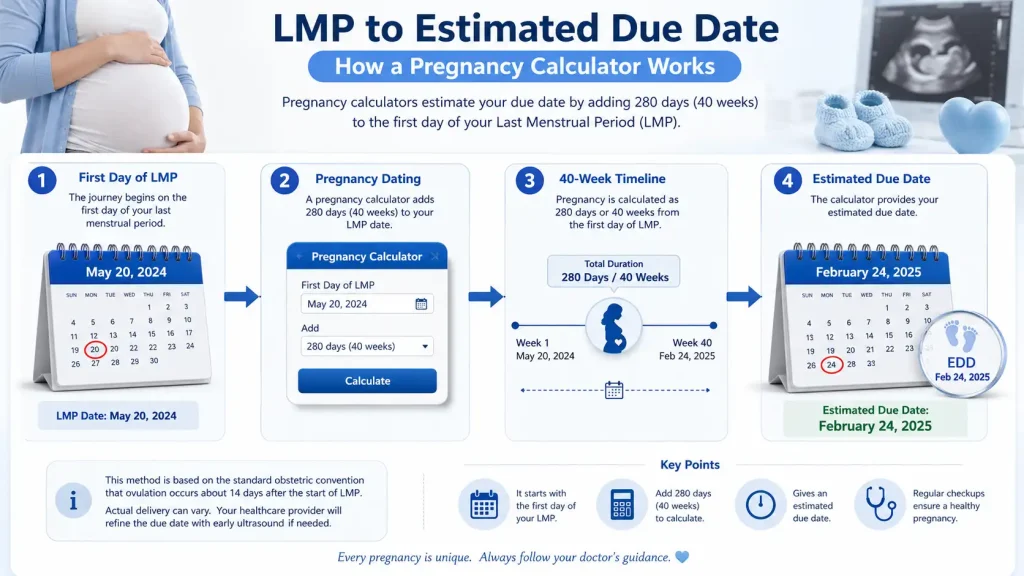
A common way to figure out your due date is to count 280 days from the first day of your last menstrual period, which is about 40 weeks.
The thing is, every womans menstrual cycle is different. You might ovulate before. After the 14th day of your cycle, which can make the first estimate not very accurate. That is why doctors and other healthcare people might use information, about your pregnancy to get a better idea of when you will have your babyrmation, including ultrasound measurements, when determining pregnancy dates.
Pregnancy Weeks vs Pregnancy Months
One of the biggest sources of confusion is converting pregnancy weeks into months.
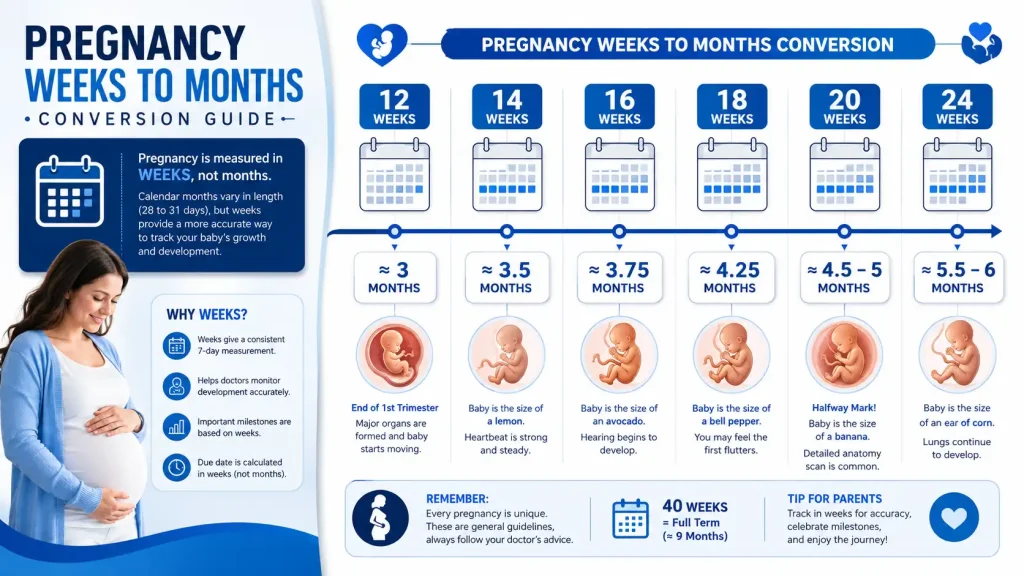
A month does not contain exactly four weeks. Most calendar months contain between 28 and 31 days. Therefore, simply dividing pregnancy weeks by four does not always give an accurate calendar-month equivalent.
For example:
12 weeks ÷ 4 = 3 months
This is a convenient approximation, but pregnancy dating is normally expressed in weeks and days because weeks provide a more consistent way to describe pregnancy progression.
Here are some commonly searched pregnancy week conversions.
12 Weeks in Months
Twelve weeks is approximately 3 months.
At around 12 weeks, you are approaching the end of the first trimester. This is an important point in pregnancy because many early pregnancy symptoms may begin to change around this time.
If your calculator says you are 12 weeks pregnant, it is generally better to describe your pregnancy as 12 weeks along rather than relying only on a month conversion.
14 Weeks in Months
14 weeks in months is approximately 3 months and 1–2 weeks, depending on how calendar months are counted.
At 14 weeks, you have entered the second trimester under common pregnancy dating systems.
Because pregnancy months do not perfectly correspond to four-week periods, your healthcare provider will normally continue to refer to your pregnancy in weeks.
16 Weeks to Months
16 weeks to months is approximately 3.7 months, or roughly 3 months and 3–4 weeks.
At 16 weeks, you are well into the second trimester.
If you are using an online pregnancy calculator, you may see your pregnancy represented as something like 16 weeks and 0 days. This format is more precise than simply saying “four months pregnant.”
18 Weeks in Months
18 weeks in months is approximately 4 months and 1–2 weeks.
At 18 weeks, pregnancy is progressing through the second trimester. Your pregnancy calculator can help you keep track of your estimated pregnancy week and due date.
Again, the exact calendar-month equivalent is only an approximation because calendar months vary in length.
20 Weeks in Months
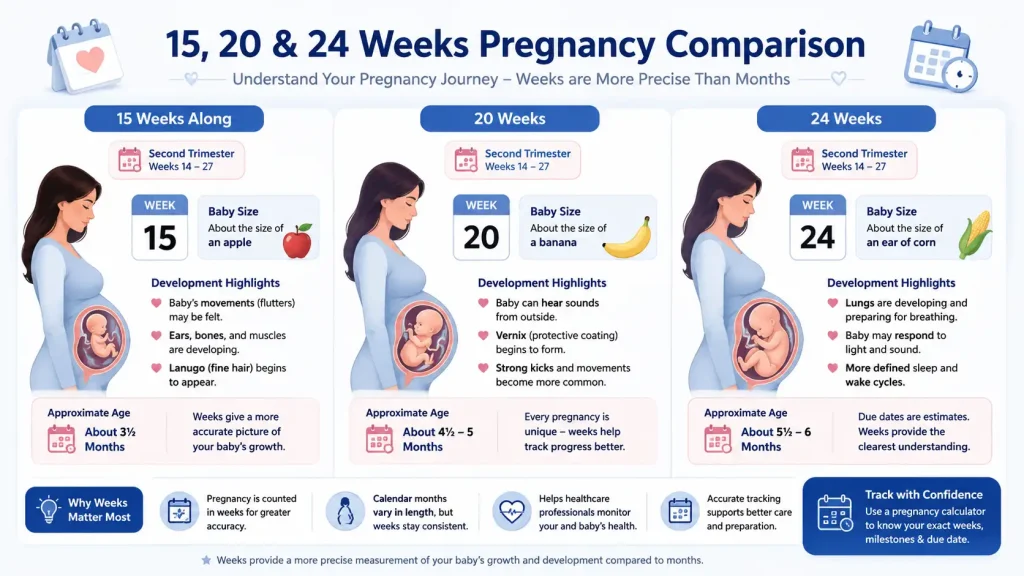
20 weeks in months is approximately 4.5 months.
Twenty weeks is roughly halfway through a 40-week pregnancy.
This is why people often describe 20 weeks as being around five months pregnant, although the mathematical conversion between weeks and calendar months is not exact.
If you search “20 weeks in months,” you may find slightly different answers depending on whether the calculation uses four-week periods, average calendar months, or pregnancy-month conventions.
For pregnancy tracking, 20 weeks pregnant is the clearest and most medically useful description.
24 Weeks in Months
24 weeks in months is approximately 5.5 months.
Some pregnancy-month charts describe 24 weeks as being around six months pregnant. This difference occurs because pregnancy months are not the same thing as standard calendar months.
At 24 weeks, you are in the second trimester and approaching the later stages of pregnancy.
If your pregnancy calculator shows 24 weeks, use the week number as your primary reference when discussing your pregnancy with a healthcare professional.
15 Weeks Along: What Does It Mean?
If you are 15 weeks along, your pregnancy has progressed through approximately 15 weeks from the first day of your last menstrual period.
You are generally in the second trimester.
People often ask what “15 weeks along” means because pregnancy can be described in several different ways. You might hear:
- 15 weeks pregnant
- 15 weeks along
- Approximately 3½ months pregnant
- Second trimester
These expressions can refer to the same general stage of pregnancy, although the month equivalent is only approximate.
A pregnancy calculator is useful because it gives you the specific pregnancy week rather than requiring you to convert between weeks and months yourself.
How Many Weeks Are in 3 Months?
There is no single exact number of weeks in three calendar months because months have different numbers of days.
For a simple approximation, 3 months is about 13 weeks.
For example:
- 12 weeks = approximately 3 months
- 13 weeks = approximately 3 months
- 14 weeks = approximately 3 months and 1–2 weeks
This demonstrates why pregnancy dating generally uses weeks rather than months.
When someone says they are “three months pregnant,” they may not be exactly 12 weeks pregnant.
5 Months Is How Many Weeks?
A common question is “5 months is how many weeks?”
Five calendar months is approximately 21–22 weeks, depending on which months are included.
For a simple pregnancy estimate, five months is often described as around 20–22 weeks.
This is another reason that pregnancy professionals usually use weeks and days instead of months.
For example, saying 21 weeks and 2 days pregnant provides much more precise information than saying “about five months pregnant.”
Pregnancy Trimesters Explained
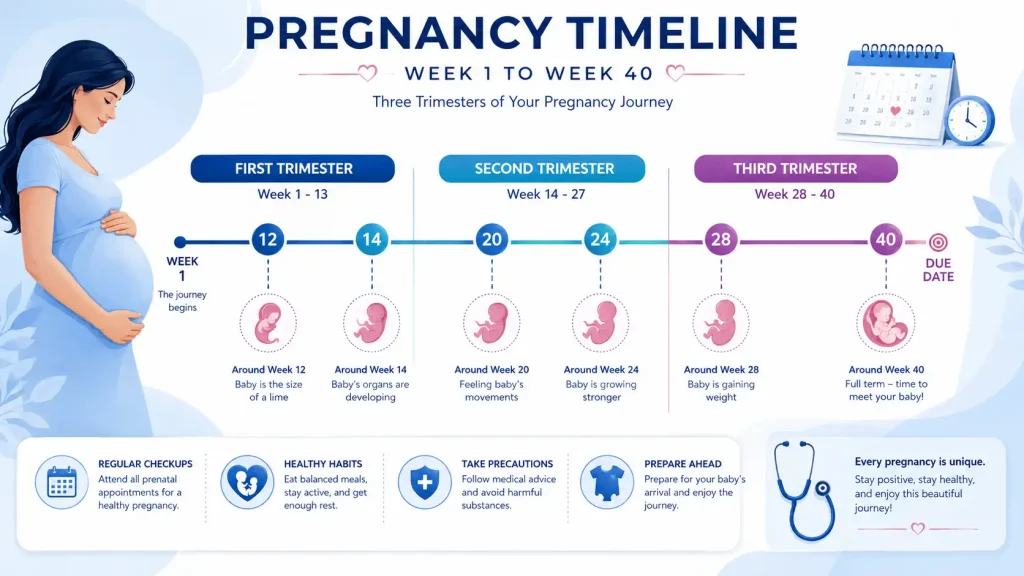
Pregnancy is commonly divided into three trimesters.
First Trimester
The first trimester covers the early stages of pregnancy and is generally considered to extend through approximately week 13.
During this period, major early developmental changes occur. Pregnancy symptoms such as nausea, tiredness, breast tenderness, and increased urination are common, although every pregnancy is different.
Second Trimester
The second trimester generally begins around week 14 and continues through approximately week 27.
This is when many people notice changes in energy levels and physical symptoms. Your pregnancy progresses rapidly during this period, and scheduled prenatal care helps monitor both your health and your baby’s development.
Third Trimester
The third trimester generally begins around week 28 and continues until birth.
During the final trimester, your healthcare team may pay increasing attention to your baby’s growth, position, your symptoms, and preparation for delivery.
These trimester boundaries are useful for general orientation, but individual healthcare advice should always come from your doctor, midwife, or other qualified healthcare professional.
How Is a Pregnancy Due Date Calculated?
A pregnancy due date is commonly estimated as approximately 40 weeks from the first day of the LMP.
A simplified calculation can be expressed as:
Estimated Due Date ≈ LMP + 280 days
For example, if the first day of your last menstrual period is known, a pregnancy calculator can add approximately 280 days to estimate your due date.
Another traditional approach is known as Naegele’s rule, which estimates the due date by adding seven days to the first day of the LMP, subtracting three months, and adding one year.
These methods provide an estimate. They should not be treated as an exact prediction of when labor will begin.
Why Is the Last Menstrual Period Important?
The LMP, or last menstrual period, is an important starting point for many pregnancy calculators.
To use an LMP-based calculator, you generally need to know the first day of your most recent menstrual period.
For example:
LMP → Pregnancy calculator → Estimated gestational age → Estimated due date
If you do not remember your LMP or your menstrual cycles are irregular, the initial calculation may be less precise.
An ultrasound may provide additional information about pregnancy dating, particularly when the LMP is uncertain.
NHS Pregnancy Calculator vs Online Pregnancy Calculators
When searching online, you may see phrases such as:
- NHS pregnancy calculator
- NHS due date calculator
- due date calculator NHS
- pregnancy due date calculator
- pregnancy week calculator
- how far along am I calculator
These searches generally reflect the same basic need: understanding pregnancy dates and estimating the due date.
An online calculator can be convenient for a quick estimate, while the NHS and healthcare professionals provide medical guidance and pregnancy care.
It is important not to confuse a calculator with medical advice. If your estimated dates differ significantly from the dates provided by your healthcare professional, discuss the difference with them.
Why Your Calculator Date May Change
It is possible for your estimated due date to change during pregnancy.
This can happen because:
- Your LMP may not be known exactly.
- Your menstrual cycle may be longer or shorter than average.
- Ovulation may have occurred earlier or later.
- Your initial calculation may have been based on an assumption.
- An ultrasound may provide a different estimate of gestational age.
A revised due date does not necessarily mean something is wrong. Pregnancy dating is an estimation process, and healthcare professionals use the available information to determine the most appropriate date.
How to Use Our Pregnancy Calculator
Using a pregnancy calculator should be straightforward.
Step 1: Enter Your Last Menstrual Period
Enter the first day of your last menstrual period if you know it.
Step 2: Check Your Pregnancy Dates
The calculator can estimate your current pregnancy week and expected due date.
Step 3: Understand Your Pregnancy Week
Your result may show a specific week and day, such as 15 weeks and 2 days.
Step 4: Use Weeks as Your Main Measurement
Although converting weeks into months can be helpful for general understanding, pregnancy weeks are more precise.
For example:
24 weeks in months → approximately 5½ months
But:
24 weeks pregnant → precise pregnancy-stage description
The second format is generally more useful for pregnancy tracking.
Quick Pregnancy Week-to-Month Guide
Here is a simple reference for some of the most commonly searched conversions:
| Pregnancy weeks | Approximate months |
|---|---|
| 12 weeks | About 3 months |
| 14 weeks | About 3½ months |
| 15 weeks | About 3½ months |
| 16 weeks | About 3¾ months |
| 18 weeks | About 4¼ months |
| 20 weeks | About 4½–5 months |
| 24 weeks | About 5½–6 months |
Remember that these are approximations, not exact medical conversions.
Final Thoughts
Understanding pregnancy weeks can make it much easier to follow your pregnancy journey. Searches such as “24 weeks in months,” “how many months is 12 weeks,” “20 weeks in months,” “12 weeks in months,” “14 weeks in months,” “16 weeks to months,” “18 weeks in months,” “5 months is how many weeks,” “how many weeks in 3 months,” and “15 weeks along” are common because weeks and months do not convert perfectly.
For the most accurate pregnancy tracking, think in terms of weeks and days rather than calendar months. A pregnancy calculator can provide a convenient estimate based on your last menstrual period and help you understand your estimated due date and current stage of pregnancy.
If you are comparing your results with an NHS pregnancy calculator, NHS due date calculator, or dates provided by your healthcare professional, remember that online calculations are estimates. For questions about your individual pregnancy, due date, symptoms, or baby’s development, speak with your midwife, doctor, or other qualified healthcare professional.
Frequently Asked Questions
How many months is 12 weeks?
12 weeks is approximately 3 months. However, pregnancy is normally measured in weeks because calendar months vary in length.
How many months is 20 weeks?
20 weeks is approximately 4½ months, although pregnancy-month charts may describe this stage as around five months pregnant.
How many months is 24 weeks?
24 weeks is approximately 5½ months. Depending on the pregnancy-month system being used, it may also be described as around six months.
How many weeks are in 3 months?
Three calendar months are approximately 13 weeks, although the exact number depends on the specific months involved.
5 months is how many weeks?
Five calendar months are approximately 21–22 weeks. For pregnancy tracking, it is better to use the exact number of weeks and days.
What does 15 weeks along mean?
Being 15 weeks along means your pregnancy is estimated at 15 weeks from the first day of your last menstrual period. This is generally within the second trimester.
Is an NHS pregnancy calculator the same as a due date calculator?
An NHS pregnancy calculator or due-date calculator can be used to estimate pregnancy dates and an expected due date. However, an online calculation is an estimate and does not replace professional pregnancy care.
Can I calculate my due date without knowing my LMP?
It can be more difficult to calculate an estimated due date accurately without knowing your LMP. Your healthcare professional may use other information, such as ultrasound measurements, to help establish pregnancy dating.