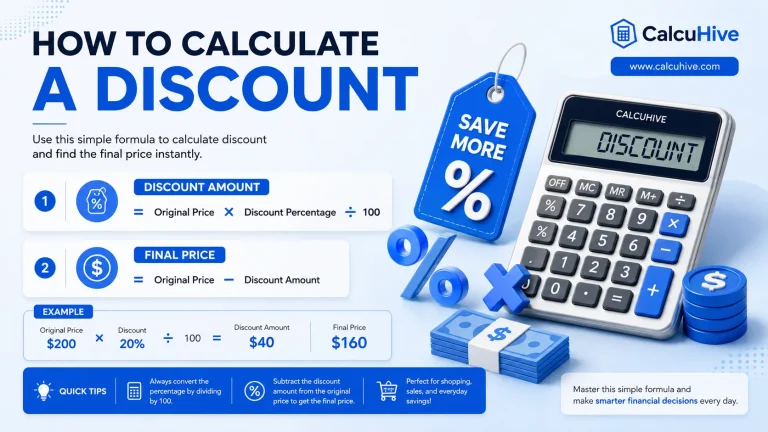
Percent Off Calculator: Calculate Sale Prices and Savings
Shopping discounts look simple until you have to work out the actual price at checkout. A percent-off calculator makes that process much easier. Enter the original price and discount percentage, and you can quickly see how much you save and what you will pay.
Whether you are comparing online deals, checking a store promotion, or calculating a sale price manually, understanding the underlying formula helps you avoid mistakes.
This guide explains how percent-off calculations work, how to use the calculator, and how discounts interact with sales tax and other pricing factors.
Table of Contents
What Is Percent Off?
“Percent off” describes a reduction from an item’s original price.
For example, if a $100 jacket is advertised at 20% off, the discount is $20. The customer therefore pays $80 before any applicable tax or additional charges.
The percentage represents the portion removed from the original price.
A simple example
Suppose a product costs $60 and has a 25% discount.
First, calculate the discount:
$60 × 25% = $15
Then subtract the discount:
$60 − $15 = $45
The final price is $45, while the savings are $15.

Percent Off Calculator
Enter the original price and the discount percentage below. The result shows the discount amount and the final price.ral products with different prices and promotional percentages.
Why the calculator helps
Mental arithmetic becomes less reliable when prices contain decimals or discounts vary between products.
A calculator gives you a consistent method for checking:
- Discount amount
- Remaining price
- Percentage reduction
- Potential savings
It can also help you compare deals without relying solely on the promotional wording displayed by a retailer.
How It Works
The calculation follows a straightforward sequence.
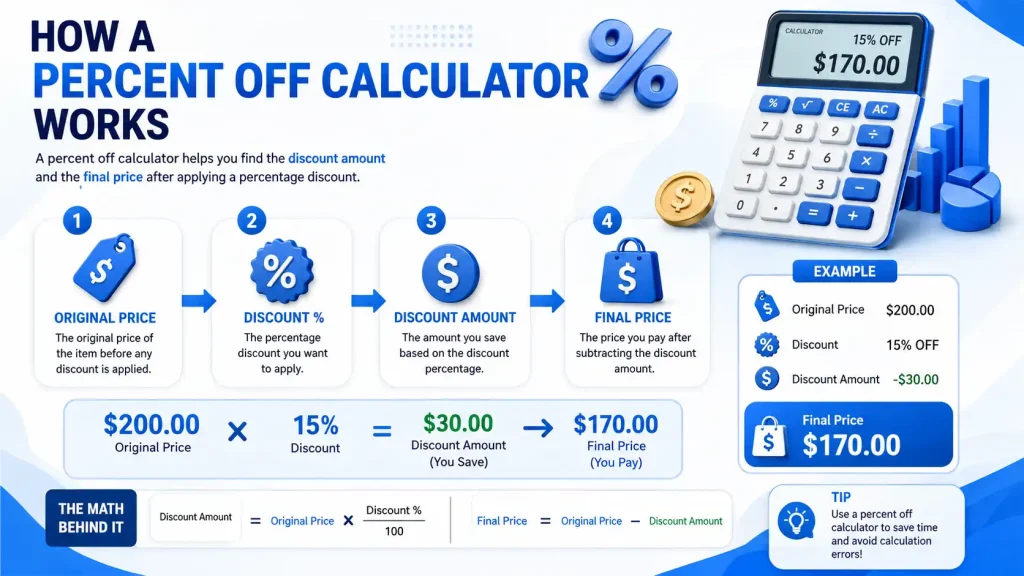
First, the calculator identifies the original price. Next, it converts the percentage into a decimal. It then multiplies the original price by that decimal to determine the discount.
Finally, the discount is subtracted from the original price.
Calculation sequence
Original Price → Discount Percentage → Discount Amount → Final Price
For a $200 item with 15% off:
$200 × 0.15 = $30 discount
Then:
$200 − $30 = $170 final price
Inputs
A typical percent-off calculator requires two main inputs.
Original price
This is the price before the discount is applied.
If a pair of shoes originally costs $120, enter 120 as the original price.
Discount percentage
This is the advertised reduction.
If the store offers 35% off, enter 35.
The calculator then uses these values to determine the savings and final price.
Check the original price carefully.
Some retailers show a “regular price,” “list price,” or “compare-at price.” These figures can have different meanings depending on the retailer.
For an accurate calculation, use the price that the discount is actually being applied to.
Results
The most useful results are usually the discount amount and final price.
For example, with an original price of $80 and a 20% discount:
Discount = $80 × 0.20 = $16
Final price = $80 − $16 = $64
So the customer saves $16 and pays $64 before tax or other charges.
Reading the result
A promotional message might say “Save 20%,” but the dollar amount gives you a clearer picture of the actual saving.
That makes percentage-based promotions easier to compare with fixed-dollar offers.
Final Price and Savings
Two numbers matter most when evaluating a discount:
- How much you save
- How much you actually pay
The discount amount represents the money removed from the original price.
The final price represents the amount remaining after that reduction.
Example
A $250 product receives a 40% discount.
Savings:
$250 × 0.40 = $100
Final price:
$250 − $100 = $150
The advertisement may emphasize “40% off,” but the practical result is $100 saved and $150 remaining.
Percent Off Formula
The basic discount formula is:
Discount Amount = Original Price × (Discount Percentage ÷ 100)
The final price formula is:
Final Price = Original Price − Discount Amount
You can combine both steps:
Final Price = Original Price × (1 − Discount Percentage ÷ 100)
Why divide by 100?
Percent means “per hundred.”
Therefore, 20% becomes:
20 ÷ 100 = 0.20
Likewise:
- 10% = 0.10
- 15% = 0.15
- 25% = 0.25
- 50% = 0.50
- 75% = 0.75
How to Calculate Percent Off
To calculate a percentage discount manually, follow three steps.
Step 1: Convert the percentage.
Change the percentage into a decimal.
For 35%:
35 ÷ 100 = 0.35
Step 2: Calculate the discount.
Multiply the original price by the decimal.
For $90:
$90 × 0.35 = $31.50
Step 3: Subtract the discount.
$90 − $31.50 = $58.50
Therefore, 35% off $90 gives you a final price of $58.50.
Original Price Formula
Sometimes you know the sale price and discount percentage but want to discover the original price.
The formula is:
Original Price = Sale Price ÷ (1 − Discount Percentage ÷ 100)
Example
Suppose an item costs $72 after a 20% discount.
The customer paid 80% of the original price.
$72 ÷ 0.80 = $90
Therefore, the original price was $90.
This reverse calculation is useful when a receipt or promotional listing only provides the reduced amount.
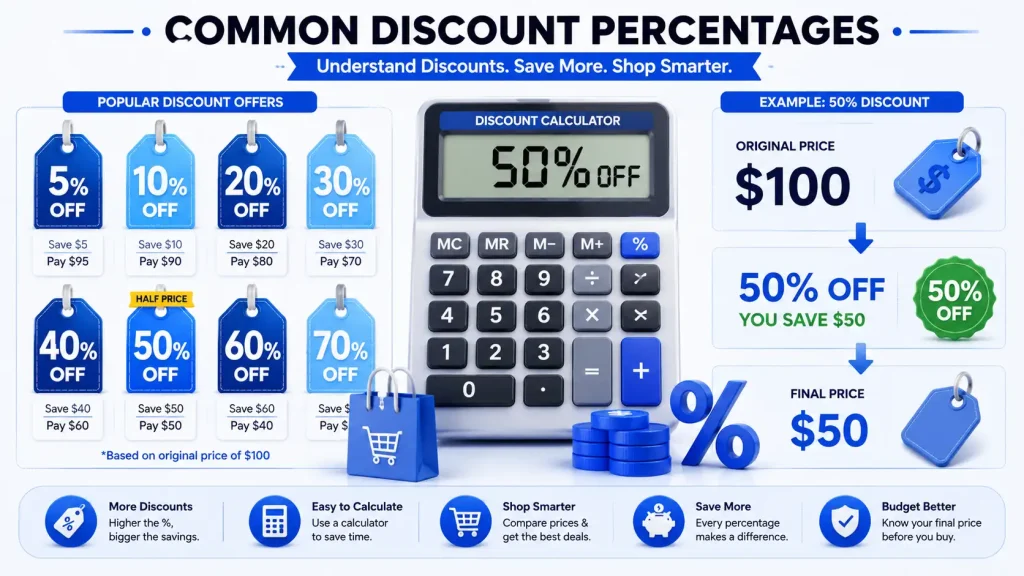
Sale Price Formula
The sale price can be calculated directly using:
Sale Price = Original Price × (100 − Discount Percentage) ÷ 100
For example, an item priced at $180 receives a 30% discount.
$180 × 70 ÷ 100 = $126
The sale price is therefore $126.
A faster mental method
For 30% off, you keep 70%.
For 25% off, you keep 75%.
For 10% off, you keep 90%.
This “remaining percentage” approach can make quick calculations easier.
Sale Price vs. Discount
The discount and sale price are not the same thing.
The discount tells you how much was removed.
The sale price tells you how much remains.
For a $500 item with 20% off:
- Discount: $100
- Sale price: $400
Confusing these two values can make a promotion appear cheaper than it actually is.
How to Figure Out Percentages
Percent calculations become easier when you understand common percentage values.
Useful mental shortcuts
10% means divide the price by 10.
For $70:
10% = $7
5% is half of 10%.
So 5% of $70 is:
$3.50
20% is twice 10%.
Therefore:
20% of $70 = $14
25% equals one-quarter.
So:
25% of $80 = $20
These shortcuts are useful for quick shopping estimates.
Shopping Discount Formulas
Different promotions require different calculations.
Single discount
Use:
Final Price = Original Price × (1 − Discount ÷ 100)
Fixed-dollar discount
If a store offers $15 off a $100 item:
$100 − $15 = $85
Multiple percentage discounts
Percentage discounts applied one after another are calculated sequentially.
A 20% discount followed by another 10% discount is not the same as 30% off.
For a $100 item:
After 20% off:
$100 × 0.80 = $80
Then apply 10%:
$80 × 0.90 = $72
The customer pays $72, meaning the combined reduction is $28, or 28%.
Examples of Percent Off Calculation
Here are several practical examples.
Example 1: 10% off
Original price: $50
Discount:
$50 × 0.10 = $5
Final price:
$50 − $5 = $45
Example 2: 25% off
Original price: $240
Discount:
$240 × 0.25 = $60
Final price:
$240 − $60 = $180
Example 3: 40% off
Original price: $75
Discount:
$75 × 0.40 = $30
Final price:
$75 − $30 = $45
Example 4: 15% off
Original price: $320
Discount:
$320 × 0.15 = $48
Final price:
$320 − $48 = $272
Worked Examples
Let’s look at a realistic shopping scenario.
Imagine you find a laptop priced at $900 with a 15% promotional discount.
The discount is:
$900 × 0.15 = $135
Subtract the savings:
$900 − $135 = $765
Your pre-tax purchase price is therefore $765.
Now imagine another retailer sells the same laptop for $820 with no advertised percentage discount.
The second retailer may still be cheaper.
This illustrates why you should compare final prices, rather than assuming the largest percentage represents the best monetary deal.
Example Problem
Consider this problem:
A $160 backpack is 35% off. What is the sale price?
Convert 35% to a decimal:
0.35
Calculate the discount:
$160 × 0.35 = $56
Subtract it:
$160 − $56 = $104
Therefore, the sale price is $104, and the savings are $56.
Checkout Breakdown
The advertised discount is only one part of the final transaction.
A checkout total may also include:
- Sales tax
- Shipping
- Delivery fees
- Service charges
- Membership fees
- Other applicable costs
Suppose a $100 product receives 20% off.
The discounted price is $80.
If applicable sales tax is then calculated at 8%:
$80 × 0.08 = $6.40
The total becomes:
$80 + $6.40 = $86.40
The exact checkout calculation depends on the retailer, location, and applicable tax rules.
Common Mistakes
Percentage calculations are simple, but several mistakes occur frequently.
Mistake 1: Subtracting the percentage directly
You cannot subtract 20 from a $150 price and call it 20% off.
The discount depends on the original price.
Mistake 2: Forgetting to divide by 100
Twenty percent is 0.20, not 20 when used as a multiplication factor.
Mistake 3: Confusing discount with final price
A $30 discount does not mean the product costs $30.
It means $30 was removed from the original price.
Mistake 4: Adding stacked discounts
20% plus 10% does not automatically equal 30% off.
Each discount can apply to the price remaining after the previous reduction.
Mistake 5: Ignoring tax
A displayed sale price may not equal the amount charged at checkout.
Key Concepts
Several concepts make percentage discounts easier to understand.
Original price
The starting price before the reduction.
Discount rate
The percentage removed from the original price.
Discount amount
The actual money saved.
Sale price
The amount remaining after the discount.
Effective discount
When multiple reductions are applied, the combined reduction may differ from simply adding the advertised percentages.
Key Facts
A few rules are worth remembering.
- A percentage discount depends on the original price.
- Higher percentages do not always mean greater dollar savings.
- Sequential discounts should be calculated one at a time.
- The final price can differ from the checkout total.
- Taxes and fees may be calculated separately.
- Rounding can affect the final amount by a few cents.
Key Output Metrics
A useful percent-off calculation focuses on several outputs.
Discount amount
This tells you the exact monetary saving.
Final price
This shows what remains after applying the discount.
Original price
This provides the baseline for comparison.
Effective discount
This can help when several promotions are applied sequentially.
These values provide more context than the advertised percentage alone.
Psychological and Strategic Aspects of Discounts
Discount percentages can influence how shoppers perceive prices.
A product advertised as 50% off can feel dramatically cheaper even before the customer checks the actual dollar saving.
Retailers may also use different promotional formats:
- 20% off
- $20 off
- Buy one, get one
- Extra 15% at checkout
- Up to 50% off
These offers are not directly comparable without calculating their actual monetary effect.
Compare the final numbers
Suppose Store A offers 30% off $200.
The savings are $60.
Store B offers $50 off the same $200 item.
Store A leaves a $140 price, while Store B leaves $150.
Calculating the final prices makes the comparison straightforward.
Percent Off Applications
Percent-off calculations appear across many areas of everyday purchasing.
Retail shopping
Clothing, electronics, furniture, appliances, and accessories frequently use percentage promotions.
Online shopping
E-commerce websites often display discount codes or automatic promotional reductions.
Wholesale purchasing
Businesses may use percentage reductions when negotiating supplier prices or bulk purchases.
Seasonal sales
Black Friday, clearance events, holiday promotions, and end-of-season sales often rely on percentage discounts.
Budget planning
Calculating the expected sale price before purchasing can help you determine whether an item fits your budget.
Sales Tax
Sales tax can change the amount you eventually pay.
In many situations, the discount is applied before tax. However, tax rules vary by jurisdiction and transaction type.
For example:
Original price: $100
Discount: 20%
Discounted price:
$80
If an 8% tax applies:
$80 × 0.08 = $6.40
Total:
$86.40
The percent-off calculation itself does not determine the applicable tax.
How to Understand and Use This Calculator
Using the calculator should take only a few seconds.
Enter the original price
Type the item’s price before the discount.
Enter the discount
Enter the percentage shown by the retailer.
Review the savings
Check how much money the promotion removes.
Check the final price
Use the resulting price when comparing the offer with another retailer.
Confirm the checkout total
Remember that taxes, shipping, and additional fees may change the final amount.
When to Use Each Variable
The original price is essential when calculating a standard percentage discount.
The discount percentage is needed when the promotion is expressed as a percentage.
If you are working backward from a reduced price, you may instead need the sale price and discount rate to estimate the original price.
Choosing the correct figures
Always confirm that the original price belongs to the exact product or service being discounted.
A promotion may apply only to selected items, specific quantities, or particular variations.
Learn More About This Calculation
Understanding the formula behind a percent-off calculator gives you more control over shopping decisions.
Once you know the relationship between the original price, discount, and sale price, you can calculate offers manually or verify automated results.
You can also apply the same principles to budgeting, retail analysis, and price comparisons.
From simple discounts to complex promotions
A single discount is straightforward. Multiple promotions require more attention because each percentage may apply to a different starting amount.
That distinction becomes especially important when a retailer advertises several consecutive discounts.
Further Reading
If you regularly work with prices and percentages, learning related calculations can make everyday financial decisions easier.
Useful topics include:
- Percentage calculations
- Discount calculations
- Sale price calculations
- Percentage difference
- Stacked discounts
- Sales tax calculations
- Markup and margin calculations
Learning these concepts together gives you a broader understanding of how prices change.
Related Calculators
A percent-off calculation is often only one part of a larger pricing problem.
Other useful calculator types can help with:
Percentage Calculator
Useful for finding percentages, percentage increases, decreases, and related values.
Discount Calculator
Helpful when calculating standard discounts and final prices.
GST Calculator
Useful when you need to calculate goods and services tax for applicable transactions.
Sales Tax Calculator
Useful for estimating tax-inclusive prices where sales tax applies.
Using the right calculator for each task reduces manual calculation and makes comparisons easier.
Related Sites
When researching discounts, pricing, or shopping calculations, look for sources that explain their formulas clearly.
Retailer terms and conditions can also clarify how a promotion is applied.
For tax-related calculations, consult the relevant government authority or official tax guidance for your location.
For mathematical calculations, prioritize resources that show the formula rather than simply displaying an unexplained result.
Word Definitions
Understanding common pricing terms makes discount offers easier to interpret.
Original price: The price before a discount.
Discount: A reduction from the original price.
Discount percentage: The percentage used to calculate the reduction.
Discount amount: The actual monetary value removed.
Sale price: The price after applying the discount.
Savings: The amount you avoid paying because of the discount.
Checkout total: The final amount charged after applicable taxes, shipping, and other fees.
These terms are often used interchangeably in advertisements, but they describe different parts of the transaction.
Frequently Asked Question(FAQS)
What is a percent off calculator?
A percent off calculator is an online tool that calculates the discount amount and final price of an item based on its original price and discount percentage.
How do I calculate a percentage discount?
Multiply the original price by the discount percentage and divide by 100. Then subtract the discount amount from the original price to find the final price.
What is the formula for calculating a discount?
The formula is:
Discount = Original Price × Discount Percentage ÷ 100
Then:
Final Price = Original Price − Discount
How much is 20% off $100?
20% of $100 is $20. Therefore, the final price after a 20% discount is $80.
How much is 30% off $200?
30% of $200 is $60. Subtracting $60 from $200 gives a final price of $140.
Can I use a percent off calculator for large prices?
Yes. A percent off calculator can be used for small purchases as well as expensive products such as furniture, electronics, vehicles, and other high-value items.
How to Calculate Percent Off?
Multiply the original price by the discount percentage divided by 100. Then subtract the discount from the original price.
How Much Is 20 Percent Off?
20% off means you pay 80% of the original price. For example, $100 becomes $80.
How Much Is 10 Percent Off?
10% off means you save one-tenth of the original price. A $90 item becomes $81.
How Much Is 15 Percent Off?
15% off means you pay 85% of the original price. For example, $200 becomes $170.
How Much Is 30 Percent Off?
30% off means you keep 70% of the original price. A $150 item becomes $105.
How Much Percent Is Off on Black Friday?
Black Friday discounts vary by retailer and product. Common promotions include percentage discounts, dollar reductions, and limited-time offers.
How Do I Calculate Percent Off on an Item?
Convert the discount percentage to a decimal and multiply it by the original price. Subtract that amount to find the sale price.
Which Is Better: Percent Off or Dollars Off?
It depends on the original price. Calculate both savings amounts and choose the offer that provides the larger actual reduction.
Can I Apply Multiple Percent-Off Discounts to a Single Item?
Yes, when the retailer allows it. Calculate each discount separately because later percentages usually apply to the already-reduced price.